


Quick answer: Peer-reviewed research suggests manuka honey has antimicrobial activity linked mainly to methylglyoxal (MGO), hydrogen peroxide, and other honey compounds. Studies document activity against organisms including H. pylori, MRSA, and a broader spectrum of bacteria, but this does not mean manuka honey treats infections or replaces medical care. Its most accurate wellness positioning is immune support, not immune treatment.
Manuka honey is often discussed for immune support, but the most useful question is not whether it is “good for immunity” in a vague sense. The better question is what peer-reviewed research actually shows about its biological activity, especially its antimicrobial effects.
The research base is strongest around manuka honey’s activity against microbes, including documented antimicrobial activity against H. pylori, MRSA, and a spectrum of bacteria in peer-reviewed studies. Papers available through PubMed Central, the NIH-hosted archive of biomedical literature, describe methylglyoxal (MGO) and hydrogen peroxide as important contributors to honey’s antimicrobial properties. This makes manuka honey especially relevant for health-conscious readers thinking about immune resilience during flu season, post-COVID wellness routines, or daily exposure to large groups of people.
That said, the science needs careful framing. Research suggests manuka honey can create antimicrobial effects under studied conditions, but it should not be described as a treatment, cure, or substitute for clinical care. For wellness use, the strongest claim is that manuka honey contains compounds studied for antimicrobial activity, which may support a broader immune-conscious lifestyle.
What “Immunity” Means When Discussing Manuka Honey
In wellness content, “immunity” often gets used too broadly. In scientific terms, immune support does not mean forcing the immune system to work harder. It usually means supporting the body’s normal defenses by reducing unnecessary stressors, maintaining barrier health, and helping the body manage microbial exposure.
Manuka honey fits this discussion because much of its research focuses on antimicrobial activity. Antimicrobial activity means a substance can inhibit or affect the growth of microorganisms under specific conditions. This is different from proving that a food or drink prevents illness in people.
For manuka honey, the immune-related conversation is best understood in three layers:
- Antimicrobial activity: Studies indicate manuka honey can act against certain bacteria in laboratory settings.
- Bioactive compounds: MGO, hydrogen peroxide, acidity, and osmotic effects appear to contribute to this activity.
- Wellness relevance: These properties make manuka honey a meaningful ingredient for people who value immune-conscious routines, especially during high-exposure seasons.
This distinction matters because it keeps the conversation accurate. Manuka honey can be discussed as a researched functional ingredient, but not as a medical intervention.
Key Compounds Studied in Manuka Honey
Peer-reviewed research often points to several factors that help explain why manuka honey behaves differently from ordinary sweeteners. The most frequently discussed contributors include MGO, hydrogen peroxide, low pH, high sugar concentration, and plant-derived compounds.
Methylglyoxal (MGO)
Methylglyoxal, commonly abbreviated as MGO, is one of the signature compounds associated with manuka honey. Research suggests MGO is a major contributor to the non-peroxide antimicrobial activity of manuka honey. This is one reason MGO grading is commonly used to communicate the strength or concentration of certain active compounds in manuka products.
MGO is especially relevant because it gives consumers a more concrete way to understand manuka honey quality. Instead of relying only on vague terms like “premium” or “active,” MGO labeling identifies a measurable compound that has been studied in the literature.
Hydrogen peroxide
Hydrogen peroxide is another important antimicrobial factor found in many honeys. Peer-reviewed papers available through PubMed Central describe hydrogen peroxide as one of the agents involved in honey’s antimicrobial activity. In manuka honey, this peroxide activity works alongside non-peroxide factors such as MGO.
This matters because manuka honey is not defined by one single compound. Its antimicrobial profile appears to come from multiple overlapping properties, which may explain why it has received sustained research attention.
Osmotic effect, acidity, and plant compounds
Honey’s high sugar concentration can create an osmotic effect, which means it can draw water away from microbes in certain environments. Its natural acidity may also make conditions less favorable for some organisms. In addition, manuka honey contains plant-derived compounds that may contribute to its overall biological activity.
These factors do not make honey a medicine. They help explain why researchers continue to study manuka honey as a functional natural substance with antimicrobial properties.
What Research Suggests About H. pylori
Studies indicate manuka honey has antimicrobial activity against Helicobacter pylori, often written as H. pylori. H. pylori is a bacterium commonly discussed in relation to the stomach environment and digestive health research.
The important point is that laboratory research has investigated whether manuka honey can inhibit H. pylori growth under controlled conditions. These findings are part of why manuka honey is frequently included in discussions about antimicrobial foods and natural compounds.
However, inhibition in a study setting is not the same as proving that eating or drinking manuka honey resolves an H. pylori infection. Anyone with suspected digestive infection symptoms should speak with a qualified healthcare professional. Manuka honey’s role in this article is as a researched wellness ingredient, not as a gut-friendly drink treatment recommendation.
How this relates to immune support
The immune system constantly interacts with microbes in the digestive tract. Research into manuka honey and H. pylori is relevant because it shows how manuka honey compounds may affect microbial behavior. For wellness-minded readers, this supports the idea that manuka honey is more than a simple sweetener.
Still, the most accurate conclusion is measured: research suggests antimicrobial potential, while clinical decisions belong in medical care.
What Research Suggests About MRSA
Peer-reviewed studies have also documented manuka honey’s antimicrobial activity against MRSA, which stands for methicillin-resistant Staphylococcus aureus. MRSA is significant because it is known for resistance to some commonly used antibiotics, making it an organism of interest in antimicrobial research.
Manuka honey has been studied in relation to MRSA because its antimicrobial mechanisms differ from standard antibiotics. Research suggests that compounds such as MGO, along with honey’s physical and chemical properties, can affect bacterial growth under controlled conditions.
This does not mean manuka honey should be used to self-manage MRSA or any suspected infection. MRSA requires appropriate medical evaluation. The research is important because it shows that manuka honey has measurable antimicrobial activity against a challenging organism, not because it creates a home treatment claim.
Why MRSA research matters for wellness readers
MRSA research matters because it places manuka honey in a serious scientific context. Wellness ingredients are often marketed with broad language, but MRSA studies show that manuka honey has been examined against organisms that researchers and clinicians take seriously.
For people who work in healthcare, schools, gyms, hospitality, travel, or other high-contact environments, this research can be especially interesting. The practical takeaway is not to use manuka honey as protection against exposure. It is to understand why manuka honey is discussed as part of an immune-conscious lifestyle.
Manuka Honey’s Broader Antimicrobial Spectrum
Research suggests manuka honey has activity against a broader spectrum of bacteria beyond H. pylori and MRSA. This broader activity is one reason it continues to be studied in microbiology, wound care research, and natural product science.
When scientists describe a “spectrum” of antimicrobial activity, they mean a substance has shown effects across multiple types of organisms under studied conditions. In manuka honey’s case, this appears to be connected to the combined influence of MGO, hydrogen peroxide, acidity, osmotic effects, and other compounds.
For consumers, the broader spectrum matters because it supports a more grounded understanding of manuka honey immune system benefits. The benefit is not that manuka honey “boosts” immunity in a dramatic or immediate way. The more accurate interpretation is that it contains bioactive compounds that research suggests can influence microbial growth.
This distinction is especially important in 2026, when wellness readers are more alert to overclaimed immune products. A credible immune-support ingredient should be discussed with evidence, limits, and context.
What Peer-Reviewed Research Does Not Prove
Peer-reviewed research supports manuka honey’s antimicrobial activity, but it does not justify broad medical claims. This is the most important boundary for anyone evaluating manuka honey for immunity.
Current research should not be translated into claims that manuka honey prevents flu, prevents COVID, cures infections, treats bacterial illness, or replaces prescribed therapies. Many antimicrobial studies are conducted in laboratory settings, where researchers can control concentration, exposure time, and microbial environment. The human body is far more complex.
Here is what the research can and cannot reasonably support:
- Reasonable: Manuka honey contains compounds studied for antimicrobial activity.
- Reasonable: Studies indicate activity against organisms including H. pylori, MRSA, and other bacteria.
- Reasonable: MGO and hydrogen peroxide are key agents discussed in the literature.
- Not appropriate: Manuka honey treats or cures infections.
- Not appropriate: Manuka honey replaces medical care, antibiotics, vaccination, hygiene, sleep, or nutrition.
This evidence boundary does not weaken the case for manuka honey. It makes the case more credible. Consumers deserve clear information that separates documented biological activity from unsupported health promises.
Why MGO Strength Matters in Beverages
MGO strength matters because it connects a manuka product to one of the active compounds studied in peer-reviewed literature. When a product identifies its MGO level, it gives consumers a clearer way to understand what kind of manuka honey is being used.
In beverages, this becomes especially relevant. A drink that contains generic honey may offer flavor and carbohydrates, but it does not necessarily communicate the same active-compound profile associated with manuka honey research. A manuka beverage with a stated MGO level provides more transparency.
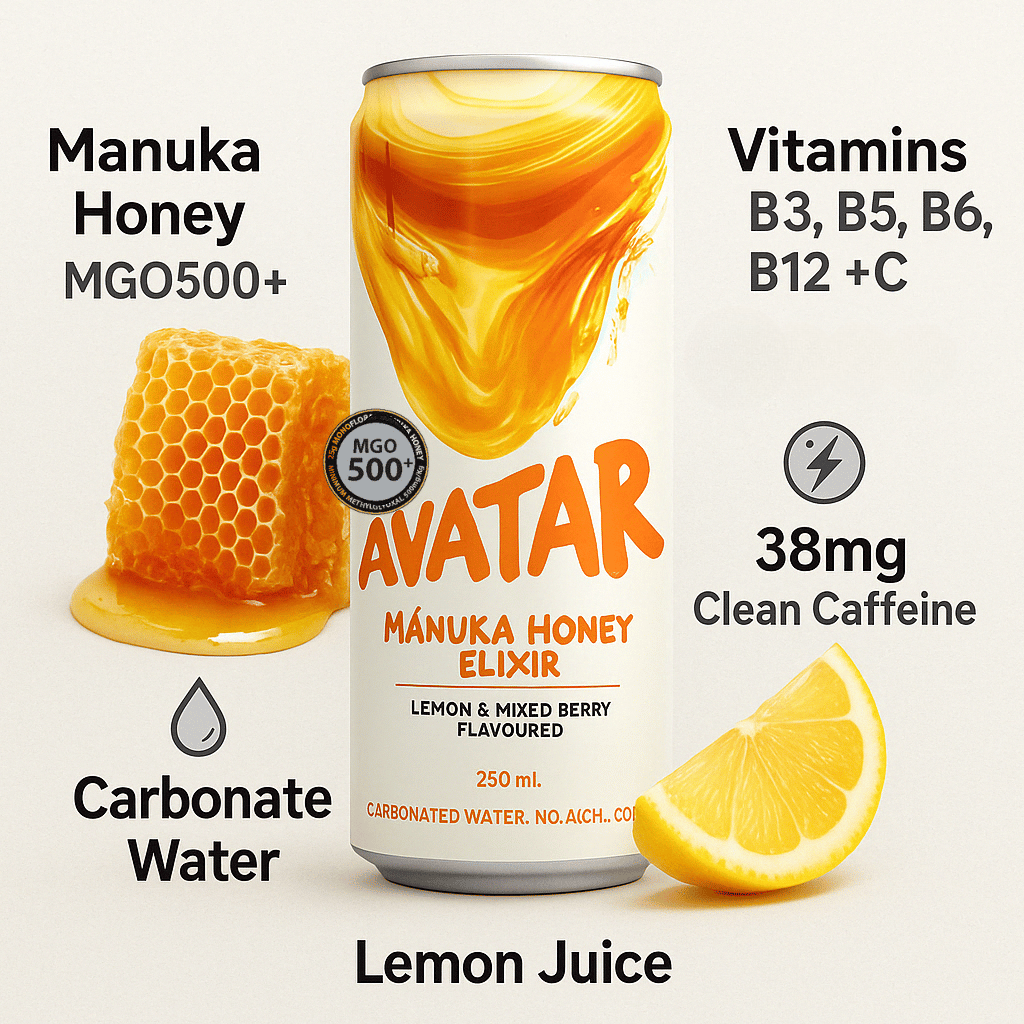
Avatar Elixir uses MGO500+ manuka honey, which means every can contains manuka honey with the same category of active compounds studied in the literature, including MGO. This is not a medical claim. It is a factual ingredient distinction that matters for wellness readers who want their beverages to be built around researched natural compounds rather than vague immune language.
For health-conscious consumers, this kind of transparency helps answer a practical question: is the product using manuka honey in a way that can be meaningfully connected to the research conversation? MGO labeling makes that discussion more specific.
How to Think About Manuka Honey During Flu Season and High-Exposure Periods
Manuka honey may be most relevant as part of a broader immune-support routine during flu season, post-COVID wellness planning, or periods of frequent contact with others. People who work in healthcare, education, fitness, retail, travel, or events often think more intentionally about daily habits because exposure is part of their environment.
In that context, manuka honey is best viewed as a functional ingredient, not a shield. Its researched antimicrobial properties make it interesting, but immune resilience still depends on fundamentals such as sleep, hydration, balanced nutrition, hand hygiene, stress management, and appropriate medical guidance.
A practical immune-conscious routine might include:
- Consistent sleep: Recovery is central to normal immune function.
- Hydration: Fluids support normal body processes, including mucosal comfort.
- Nutrient-dense meals: Protein, plants, and micronutrients support overall health.
- Hygiene habits: Handwashing and sensible exposure management remain important.
- Researched functional ingredients: Manuka honey can fit here because of its studied antimicrobial compounds.
This framing keeps manuka honey in the right place. It can be a useful part of a wellness routine, but it should not be positioned as the routine itself.
How to Read Manuka Honey Immune Claims Critically
The best way to evaluate manuka honey immune claims is to look for specific, research-aligned language. Credible claims usually mention antimicrobial activity, MGO, hydrogen peroxide, or peer-reviewed studies. Less credible claims often promise broad immune “boosting” without explaining what that means.
When reading labels, product pages, or wellness articles, look for these signs of stronger credibility:
- Specific compound references: MGO is identified rather than hidden behind vague language.
- Careful wording: The content uses phrases such as “research suggests” or “studies indicate.”
- No treatment claims: The brand does not imply that manuka honey cures illness.
- Clear product context: The amount or grade of manuka honey is explained where relevant.
- Balanced discussion: Benefits are described alongside limitations.
Be cautious with claims that sound too absolute. Words like “guaranteed,” “cure,” “kills all bacteria,” or “prevents infection” are not appropriate for consumer wellness positioning. A trustworthy discussion of manuka honey and immunity should respect both the promise and the limits of the research.
The Bottom Line on Manuka Honey and Immunity
Peer-reviewed research suggests manuka honey has meaningful antimicrobial activity, with studies documenting effects against H. pylori, MRSA, and a broader range of bacteria. The compounds most often discussed include MGO and hydrogen peroxide, supported by other properties such as acidity and osmotic effects.
For immune support, the most accurate takeaway is that manuka honey is a researched functional ingredient with antimicrobial properties. It should not be presented as a treatment, cure, or replacement for medical advice. Its value is strongest when placed inside a broader wellness routine that includes sleep, hydration, nutrition, hygiene, and appropriate care when symptoms or infection concerns arise.
For wellness lovers who want evidence-informed choices, manuka honey stands out because its active compounds have been studied in peer-reviewed literature. The key is to choose products that communicate those compounds clearly and to interpret the research with scientific care.
These FAQs clarify what peer-reviewed research actually suggests about manuka honey's antimicrobial activity and how that connects to immune-conscious wellness routines. You will also learn how to read common terms like MGO without turning them into medical claims.
Does manuka honey support immunity or directly "boost" the immune system?
Manuka honey is best framed as immune support, not immune treatment. In wellness content, "boosting" is often vague, while research suggests manuka honey's value is more about its documented antimicrobial activity and the presence of studied compounds like MGO and hydrogen peroxide. That can fit into an immune-conscious lifestyle, but it does not mean it treats infections or replaces medical care.
What does research suggest about manuka honey against H. pylori?
Studies indicate manuka honey has antimicrobial activity under studied conditions, including against H. pylori. This is part of why people discuss manuka honey immune system benefits in more science-based terms, rather than broad "immunity claims." The most accurate takeaway is that manuka honey contains compounds studied for antimicrobial effects, not that it treats H. pylori in real-world clinical use.
Why are MGO and hydrogen peroxide central to manuka honey research?
Research suggests MGO and hydrogen peroxide are key contributors to honey's antimicrobial properties. PubMed Central (NIH-hosted) papers commonly describe these as important agents that help explain why some manuka honeys show activity across a spectrum of bacteria. This matters because it connects "manuka honey immune system benefits" to measurable compounds, rather than marketing language.
How can I use manuka honey in an immune-conscious routine safely?
Use it as a consistent wellness food, not as a replacement for medical care. Practical best practices include:
- Choose a product that clearly states its MGO rating so you know what you are buying.
- Use a small, regular serving in a routine you can maintain, such as in warm (not boiling) drinks.
- Keep the framing honest: it may support immune-conscious habits, but it is not a treatment.
Is manuka honey better than regular honey for antimicrobial activity?
Manuka honey is discussed differently because research often links its antimicrobial activity to MGO. Many honeys can produce hydrogen peroxide related activity, but manuka is frequently highlighted in peer-reviewed discussions for its non-peroxide activity components as well. The best-practice comparison is to look for clear labeling and to focus on "documented antimicrobial activity" rather than assuming all honeys behave the same.
How does an MGO500+ manuka drink relate to the studied compounds?
An MGO500+ manuka format is a way to standardize the presence of an active compound discussed in the literature. For example, Avatar Elixir's MGO500+ honey means each can contains the same active compounds that are commonly examined in peer-reviewed research, which can simplify consistent use. Even with standardization, the responsible framing stays the same: research suggests antimicrobial activity, but it does not indicate medical treatment.