



Quick answer: Mānuka honey is widely used by singers because honey can act as a demulcent that coats and lubricates irritated throat tissues, which may reduce the urge to cough and make the voice feel smoother. Mānuka varieties are also discussed for their unique MGO content, which is often associated with antimicrobial activity, and this is one reason performers frequently choose Mānuka over standard honey for vocal-care routines.
Singers tend to judge a “vocal remedy” by one simple standard: does it make the throat feel reliably comfortable without creating new problems like excess mucus, reflux, or dehydration. Honey has stayed in the vocal-care conversation for a long time because it fits that standard in a practical way, it is easy to take, easy to tolerate, and commonly reported to feel soothing during heavy rehearsal blocks.
This matters even more when the honey is specifically Mānuka. In everyday wellness discussions, Mānuka honey is treated as a premium option because it contains methylglyoxal (MGO), a compound used to grade potency. That MGO focus is a big part of why people search phrases like manuka honey for singers and honey for singers voice, especially when they want an evidence-aware reason for what they feel in the moment.
Manuka honey is also part of many modern vocal-care routines that get mentioned in the public eye. Ed Sheeran and Ariana Grande are among the vocalists commonly cited as using Mānuka honey as part of their overall voice care. That is not clinical evidence, but it is a useful signal of how normalized Mānuka has become in professional performance culture.
What common vocal-use patterns suggest about why honey “works” for singers
The most consistent reason singers reach for honey is immediate sensation, not long-term “healing.” The widely discussed mechanism is honey’s demulcent action, meaning it forms a soothing, coating layer over mucous membranes. In plain terms, honey can make the throat feel less scratchy and less reactive, which can help a singer feel more stable on onset and less tempted to clear the throat.
Honey’s demulcent effect, coating and comfort
When a singer says, “It feels like it lubricates my throat,” they are usually describing this coating effect. The implication is not that honey changes vocal folds directly, but that it can make the upper throat feel calmer. That can matter because vocal performance is sensitive to tiny sensations, dryness, tickle, postnasal drip, and the urge to cough.
Why reduced cough urge matters for vocal control
Research discussions around honey often highlight that it can reduce the urge to cough in some contexts, which aligns with what singers report anecdotally. For a vocalist, fewer cough impulses can mean fewer sudden pressure events and fewer cycles of throat clearing, both of which can be disruptive during rehearsals or right before a take.
Takeaway: Honey’s reputation in vocal care is largely explained by a demulcent, coating sensation that may reduce irritation-driven coughing and throat clearing, two things that commonly interfere with singing comfort.
What makes Mānuka different, and what “MGO” actually signals
Not all honey is discussed the same way. Mānuka honey is usually distinguished by its MGO rating, short for methylglyoxal, a compound associated in the public scientific conversation with antimicrobial activity. The key point for consumers is that MGO is used as a label-based potency marker, which is one reason Mānuka feels more “specific” than generic honey.
MGO and the “anti-inflammatory” conversation, what can be said responsibly
It is common to see Mānuka described as “anti-inflammatory.” In a strict evidence-aware framing for singers, the safer interpretation is this: Mānuka is often chosen when people suspect irritation has more going on than simple dryness. That “root cause” language is popular, but it should be treated as a consumer rationale, not a medical claim.
For vocalists, irritation can come from multiple sources, dry air, long sets, intense speaking, travel, reflux triggers, or allergies. Because the causes differ, the response to any remedy differs too. Still, the pattern is clear: Mānuka is commonly picked when a singer wants both the coating comfort of honey and the added “active compound” framing that MGO provides.
Why singers often prefer higher-grade Mānuka in practice
In singer-to-singer conversations, “higher grade” is often shorthand for “more likely to feel worth it.” That does not guarantee a specific outcome, but it explains consumer behavior. If a performer is already paying attention to hydration, warm-ups, and rest, they often want a honey choice that feels intentionally selected rather than generic.
Takeaway: Mānuka’s MGO labeling gives singers a clearer way to choose a “stronger” honey, which helps explain why Mānuka is frequently preferred over standard honey in vocal-care routines.
What this means for understanding throat irritation during rehearsals and performances
Vocal irritation is not one thing, and this is where the “science behind the best vocal remedy” becomes more about matching mechanisms to sensations. Honey’s best-supported logic is local soothing, not systemic change.
Dryness vs scratchiness vs “tickle,” three different problems that feel similar
- Dryness is often about environment and airflow, it can feel like friction.
- Scratchiness often shows up after heavy use, travel, or mouth breathing, and can come with a raw sensation.
- Tickle is frequently tied to cough reflex sensitivity, where the main problem is the urge to cough or clear.
Honey aligns most directly with the “scratchy” and “tickle” buckets because coating and perceived soothing can make the area feel less reactive. Hydration strategies align more directly with “dryness,” though many singers combine both because sensations overlap.
Why “coating” can feel like better technique, even when it is just comfort
Singers often report that when the throat feels calmer, technique feels easier. The important nuance is that comfort can reduce compensatory behaviors like pushing, squeezing, or hard glottal onsets. That does not mean honey improves technique, but it can change how the body responds under pressure, especially right before a performance.
Takeaway: Honey is most plausibly helpful when irritation and cough urge are driving discomfort, and singers often interpret that reduced reactivity as improved vocal ease.
How singer routines typically use Mānuka honey, and the trade-offs to watch
Singer routines tend to be conservative: small, repeatable actions that do not risk unexpected side effects. In that context, Mānuka honey is usually used in simple formats like warm water, tea, or a spoonful, timed around rehearsals and performances.
Common timing patterns singers use
- Before performing: warm honey water is commonly used because it feels gentle and supports a “warmed, coated” sensation.
- During rehearsals: some singers prefer a convenient honey-based drink format to avoid sticky mess and constant mixing.
- After performing: honey may be used as a comfort ritual when the throat feels overworked.
Why many singers avoid dairy and dehydrating drinks around vocal use
In performance circles, dairy is often avoided because it is widely reported to increase perceived mucus or thickness for some people. That is not universal, but it is a common enough pattern that singers plan around it. Dehydrating drinks are also avoided, not because one sip “ruins” a voice, but because dryness and irritation tend to accumulate during long days.
This is one reason a singer may prefer a simpler ingredient profile when choosing what to sip. Predictability is part of vocal reliability.
Takeaway: Singers typically use Mānuka honey in warm, simple formats and avoid common triggers like dairy or dehydrating drinks when they are trying to keep throat sensations predictable.
Where a ready-to-drink Mānuka honey beverage fits, and what to look for on the label
Ready-to-drink formats exist because singers need convenience without sacrificing consistency. Mixing honey can be messy, hard to dose, and hard to repeat exactly, especially in studios, backstage, or while traveling.
Avatar Elixir as a case example of a singer-friendly format
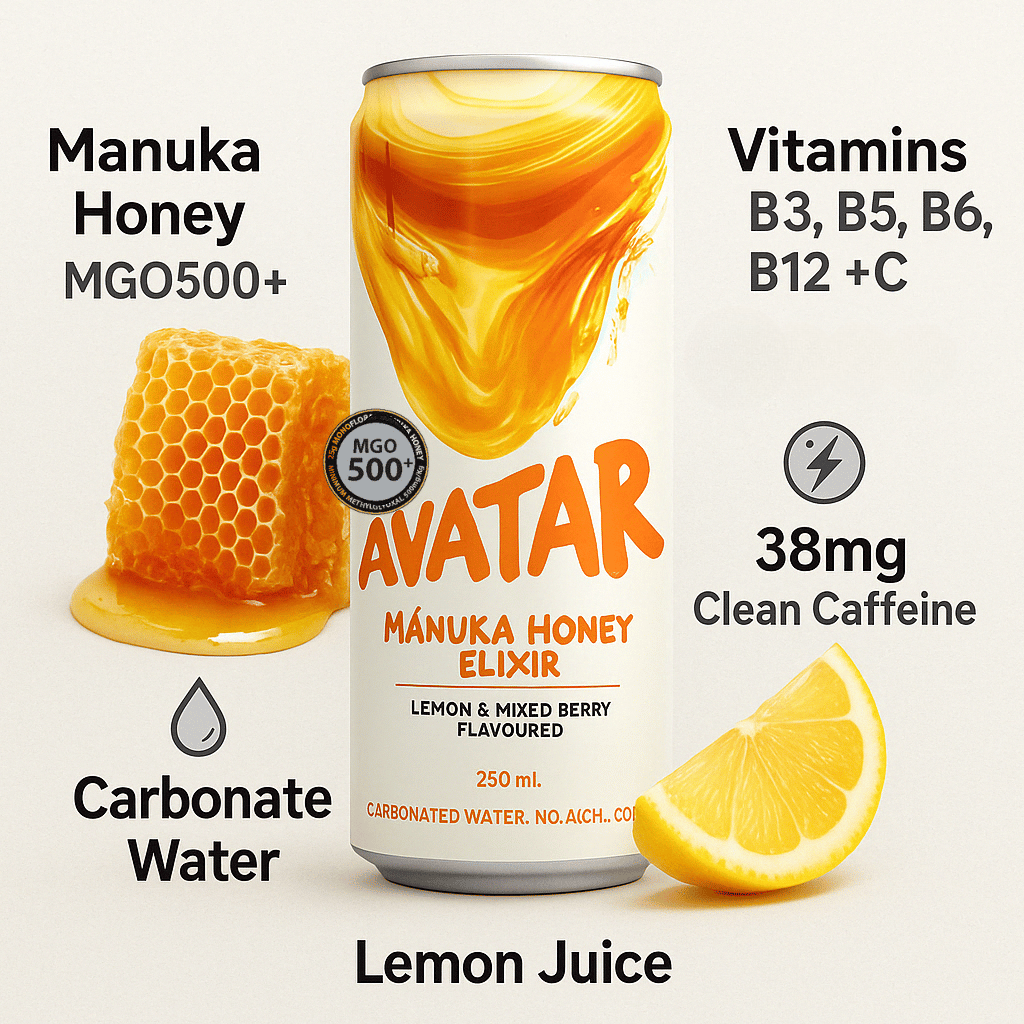
Avatar Elixir positions itself as a drinkable Mānuka honey product rather than a typical energy drink. Based on the brand’s published product details, each 250 ml can includes 25 g of certified MGO500+ Mānuka honey sourced from the brand’s own New Zealand hives, plus fresh lemon juice, lightly carbonated water, and added vitamins including a B-complex (B3, B5, B6, B12) plus vitamin C.
For singers, the key relevance is not “more stimulation,” it is the format: a measured honey dose in a consistent can. The product also lists 38 mg of caffeine, which some performers may find useful for alertness, while others may prefer to avoid caffeine close to performance if it tends to dry them out or increase reflux sensitivity. That is an individual trade-off, not a universal rule.
How to interpret “MGO500+” in plain language
MGO500+ indicates a high MGO grade relative to many common retail options. It does not guarantee a particular vocal outcome, but it does mean the honey component is positioned at a premium potency tier, which is often the point when singers choose Mānuka in the first place.
Small-batch production and award signals, what they can and cannot tell you
Avatar Elixir describes itself as small-batch and notes that its first batch sold out, with a second version in development. It also states it was awarded New Zealand’s Best Beverage at the NZ Fine Food Awards, judged by 35 independent experts, and that it earned the New Zealand Food Awards Quality Mark, described as reflecting capability, compliance, food safety, and consumer trust.
For a singer, these signals are mainly about product integrity and consistency, not vocal performance. Awards can suggest strong taste and credible manufacturing standards, but they are not evidence of voice-specific effects.
Takeaway: A ready-to-drink Mānuka beverage can make vocal routines more consistent and portable, but singers still need to interpret the label through trade-offs like caffeine sensitivity and personal throat triggers.
What remains unknown, and how to keep “vocal remedy” claims grounded
Honey is widely used in vocal care, and there are plausible mechanisms for why it may soothe irritation. At the same time, several important areas remain uncertain for any individual singer.
- Individual response varies: what feels soothing to one vocalist can feel too sticky or too sweet to another.
- Irritation has multiple causes: allergies, reflux triggers, infection, overuse, and dry air can all feel similar.
- Mānuka is not a substitute for vocal technique and recovery: rest, hydration, and load management are still the foundations of vocal reliability.
If a singer has persistent hoarseness, pain, or loss of voice, it is appropriate to consult a qualified clinician or voice professional for personalized guidance. That step is about clarity and safety, not alarm.
Takeaway: Honey, including Mānuka, is best viewed as a comfort-support tool with plausible local effects, not a treatment, and it works most predictably when paired with basic vocal-care fundamentals.
These FAQs break down how singers commonly use Mānuka honey for vocal comfort, and why MGO and "demulcent" coating are frequently mentioned in vocal-care conversations. You will also find practical ways performers time honey use around rehearsal and performance without overpromising medical outcomes.
Does manuka honey for singers work better than regular honey?
Often, the difference is why you are using it. For immediate comfort, both regular honey and Mānuka honey can act as a demulcent that coats and lubricates irritated throat tissues, which may reduce the urge to cough. Mānuka is additionally chosen because it is discussed for its MGO content, a grading marker commonly associated with antimicrobial activity in general wellness conversations. In practice, many singers pick Mānuka when they want the same soothing feel plus the "MGO factor" that is specific to Mānuka varieties.
Why do singers use honey for singers voice before rehearsal?
Singers typically use honey for immediate sensation, not long-term "healing." The commonly discussed reason is honey's demulcent action, it can leave a light coating that makes the throat feel smoother and may reduce the urge to cough. This is why "honey use for singers voice" stays popular during heavy rehearsal blocks where comfort and consistency matter. If honey feels too heavy, many performers simply adjust the amount rather than abandoning it entirely.
How do I take warm honey water before a performance?
A common approach is warm, not hot, honey water taken close to warmups. Singers often dissolve honey into comfortably warm water so it feels soothing without being irritating. Many performers keep it simple to avoid stomach discomfort right before singing. For more options, see vocal warm-up drinks.
- Use warm water so the drink is comfortable on the throat.
- Mix thoroughly so the honey is evenly diluted and easy to sip.
- If coughing is a concern, sip slowly to let the coating sensation settle.
What does anti-inflammatory MGO mean in Mānuka honey discussions?
MGO refers to methylglyoxal, a compound used to grade Mānuka honey. In everyday wellness discussions, people often connect higher MGO with "stronger" Mānuka, and the phrase anti-inflammatory MGO is frequently used to explain why Mānuka feels different from standard honey. It is still best understood as a labeling and selection signal rather than a guarantee of a specific vocal outcome. For singers, the practical takeaway is that MGO is one reason Mānuka gets chosen when throat irritation is part of the picture.
Why do performers mention Ed Sheeran and Ariana Grande using Mānuka?
Those mentions show how normalized Mānuka has become in performance culture. Ed Sheeran and Ariana Grande are commonly cited in public conversations as using Mānuka honey as part of broader voice care, and that visibility reinforces the idea that it is a "professional" option. This is not clinical evidence, but it does help explain why searches like manuka honey for singers spike around touring, rehearsals, and vocal-demand seasons. The useful point for readers is cultural context, not proof of effectiveness for any one person.
What should singers avoid with honey to prevent mucus or dehydration?
Singers often avoid pairings that feel drying, reflux-triggering, or mucus-promoting for them. Individual tolerance varies, but many vocal routines keep honey separate from ingredients that commonly get blamed for thickness or dryness during rehearsals. The goal is to support comfort without creating a new problem that distracts from singing.
- Avoid dairy if it reliably makes your voice feel thicker.
- Limit dehydrating drinks (for example, very caffeinated options) if they dry you out.
- If reflux is a known issue, keep pre-performance choices light and easy to tolerate.