



Headline finding: Smaller drink cans are not always better for reducing waste. A smaller portion can prevent an unfinished drink, while larger cans may use less packaging per unit of beverage. A fair comparison also considers transport, recycled content and what happens to the empty can locally. Can size alone cannot establish a lower environmental footprint.
An empty can is easy to notice. The drink poured down the sink is less visible once it has gone, yet both belong in a discussion about waste. Judging only the container can miss the resources used to make its contents; judging only the leftovers can overlook additional packaging.
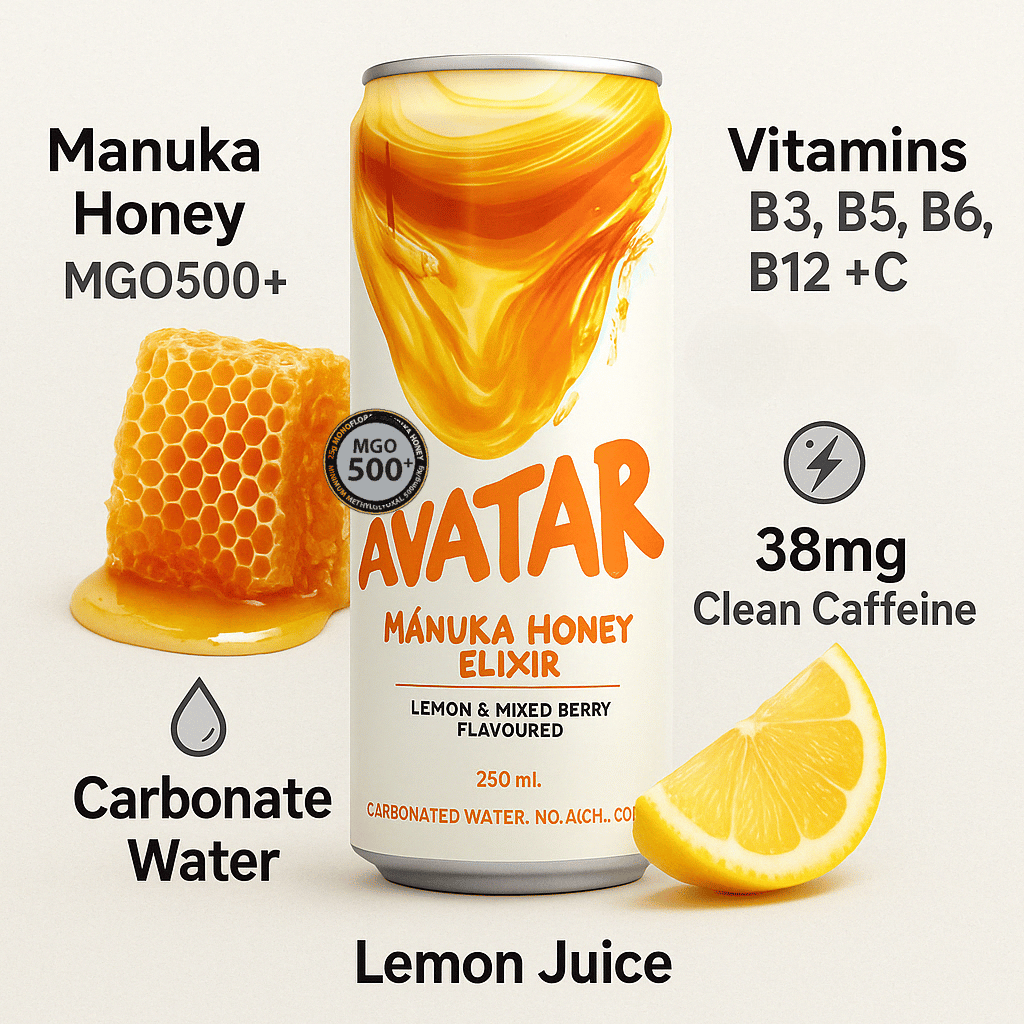
Our Avatar Mānuka Honey Elixir comes in a 250 ml can. That makes it a useful example of a smaller portion format, not proof of an environmental advantage. For an environmentally minded buyer, the useful question is how the portion, packaging and disposal route fit the way the drink will actually be consumed.
1. Unfinished drinks and packaging waste are separate problems
A smaller can can reduce beverage waste when it replaces a larger drink that would otherwise be partly discarded. It does not automatically reduce packaging waste.
Consider a clearly hypothetical occasion: someone wants 250 ml of a lightly carbonated drink. They could finish a 250 ml can, or open a 500 ml can and discard half after it loses the fizz they enjoy. The smaller format avoids 250 ml of liquid waste in that scenario. Whether it also reduces total environmental impact depends on the packaging and the resources involved in producing and delivering the drink.
The comparison changes if that person wants the whole 500 ml. Two smaller cans then provide the same beverage volume as one larger can, without preventing any unfinished drink. A larger format has a stronger reason to matter when its contents are fully consumed or shared.
This trade-off has a basis in lifecycle research. In the published abstract of their packaging lifecycle model, researchers Fredrik Wikström and Helén Williams report that additional packaging impacts can be justified when reduced food losses compensate for them. The model considers the contents as well as packaging, transport, consumers and waste handling.
That is a conditional finding, not evidence that smaller cans necessarily prevent waste. Its practical implication is narrower: packaging deserves credit for preventing discarded contents only when those contents would actually have been wasted.
2. Equal beverage volume and a consumed serving answer different questions
A fair can-size comparison needs a consistent basis. Comparing one small can with one large can does not account for the different amounts of drink they contain.
Two useful perspectives are equal beverage volume purchased and an equivalent amount actually consumed. Each reveals something different.
Comparing equal purchased volume
One litre requires four 250 ml cans or two hypothetical 500 ml cans. Packaging mass would therefore be four times the small-can weight versus two times the large-can weight. The answer requires actual weights, not just a count of containers.
A larger can does not necessarily weigh twice as much as a can with half its capacity. This is why larger formats may offer a packaging-material advantage per litre. But counting fewer cans is not enough to quantify that advantage, and packaging mass alone is not a complete environmental assessment.
Comparing an actually consumed serving
If the purpose is to provide 250 ml that someone drinks, the comparison also needs to count any beverage discarded along the way. A fully consumed small can and a half-discarded large can provide the same consumed amount, but require different quantities of beverage to be produced and purchased.
If every drop is consumed, that potential advantage disappears. If someone opens another small can, the relevant comparison includes both containers. These perspectives can therefore produce different conclusions without either being misleading, provided the assumptions are explicit.
For readers more familiar with US serving sizes, A 250 ml Can in US Ounces: What the Smaller Format Means explains the portion. The conversion helps establish how much drink is involved; it does not establish which package is environmentally preferable.
3. A can lifecycle assessment is not necessarily a whole-drink assessment
Lifecycle assessment, or LCA, evaluates environmental impacts across defined stages of a product’s life. Its conclusions depend on what is included, what is excluded and the basis used for comparison.
Sphera’s Life Cycle Assessment of North American Aluminum Cans, prepared for the Aluminum Association and published in 2021, uses a common beverage-capacity basis. That is more informative for packaging comparison than treating an arbitrary small can and large can as equivalent products.
However, the study assesses the can, including raw materials, manufacture and end-of-life. It excludes beverage manufacture and filling, consumer distribution packaging, distribution and use, including refrigeration and consumption.
Those boundaries matter. A can-only assessment cannot resolve the footprint of a delivered, chilled drink that is partly poured away. Equally, an assessment focused on climate emissions does not by itself answer every question about material waste or local recovery.
The Sphera report is industry-sponsored, represents North American production and uses a 2016 production reference year. It is useful for understanding the comparison framework, but its results are not an assessment of Avatar Mānuka Honey Elixir or a measurement of present-day production everywhere.
What this means when choosing: a meaningful environmental comparison needs to identify whether it concerns the empty packaging, the packaged beverage or the beverage actually consumed. “Lower impact” is incomplete without that context.
4. Transport is a separate consideration, not a benefit implied by size
A smaller individual can does not necessarily mean less transport impact for an equivalent amount of drink. Shipment weight, packing arrangement, route and transport mode all affect the comparison.
For equal beverage volume, several smaller cans may involve a different amount of metal and outer packaging than fewer larger cans. Cartons and other delivery materials belong in a delivered-product comparison even when they are absent from a can-only study.
Origin also matters as context, rather than as an automatic verdict. Avatar Mānuka Honey Elixir is made in New Zealand. Our US promotional shipping pages have described direct air delivery from New Zealand, but the current fulfilment method for a particular order needs confirmation. Promotional delivery language is not a shipment-level emissions measurement.
It would therefore be unsupported to claim that the 250 ml format offsets international delivery, or to calculate a freight footprint from delivery speed. The defensible conclusion is that transport needs its own information.
A portion that suits the occasion can still be a sensible purchase. Its usefulness should not be confused with evidence that every stage of its journey has a lower impact.
5. Recycled content, collection and completed recycling are different attributes
A can’s material history and its eventual destination are separate parts of the waste question. Neither can be read from its size.
The US Environmental Protection Agency distinguishes recycled content from recyclability. Recycled content concerns material already incorporated into a product. Recyclability concerns whether that product can enter a recycling process. A recyclable container does not necessarily contain recycled material.
Post-consumer recycled content is narrower still: it refers to material recovered after consumer use, rather than all possible recycled inputs. A meaningful supplier claim should identify what its percentage includes. A regional industry average cannot establish the recycled content of a particular Avatar can.
After use, there are further distinctions:
- Material recyclability: whether the material can be processed for another use.
- Local acceptance: whether the collection service available where the drink is consumed accepts that container.
- Actual recovery: whether the collected material is sorted, processed and used in manufacturing.
EPA’s explanation of the US recycling system separates collection, processing and remanufacturing. Processing includes sorting and contamination removal. Putting a can in an accepted collection bin gives it access to that pathway; it is not proof that every deposited can becomes a new can.
Preparation rules also matter. EPA generally advises emptying and rinsing metal containers, with local instructions taking precedence. Its guidance generally advises against crushing aluminium cans in single-stream recycling because flattened cans can be harder to detect during sorting.
These are US guidance points, not universal rules for every collection system. Acceptance, crushing rules and deposit eligibility need local confirmation, particularly for imported drinks. Our guide to rinsing and recycling sticky beverage cans without the mess covers the preparation question in more detail.
6. The useful conclusion is a set of purchasing and disposal questions
The strongest reason to choose a smaller can is that its portion matches what will be consumed. The strongest packaging argument for a larger can arises when it provides the required drink with less material per unit of volume and its contents are fully used. Neither argument settles transport or recycling outcomes.
For our 250 ml Avatar Mānuka Honey Elixir, the supported fact is the portion size. Establishing a lower environmental footprint would require a defined comparison and product-specific information, rather than an inference from the format.
Instead of declaring a packaging winner, these questions make the choice more grounded:
- Will I finish this portion? Would a larger drink leave leftovers, or would it be fully consumed or shared?
- Would I open another small can? If so, how does the total packaging compare for the amount I actually want?
- What does the packaging claim describe? Is it verified recycled content, recyclability or a lifecycle result with clear boundaries?
- What delivery information is available? Where is the drink coming from, how is it transported and what outer packaging accompanies it?
- Where will the empty can go? Is there an accepted curbside, drop-off or eligible deposit-return route where it will be consumed, and what preparation does that service require?
These follow-up questions cover sticky cans, collection alternatives and the limits of drink-size comparisons.
Does a sticky honey drink can need dishwasher cleaning before recycling?
Dishwasher cleaning is not a requirement established by the EPA guidance cited here. EPA generally advises emptying and rinsing metal containers, with local collection instructions taking precedence. For a sticky honey drink can, follow the preparation requirements of the service accepting it rather than assuming it needs sterilising or a dishwasher cycle.
What if curbside recycling does not accept my drink can?
A local drop-off service or an eligible deposit-return programme may provide another collection route. Check whether that service accepts the particular container and what preparation it requires. Deposit eligibility should not be assumed for an imported drink, and acceptance by one service does not establish acceptance by another.
Can I fairly compare can sizes when the drinks are different?
You can compare packaging per equal beverage volume, but that will not isolate the environmental impact of the whole drinks. Different contents introduce differences in ingredient production and processing, alongside packaging and delivery. A whole-drink comparison needs to account for those differences; otherwise, it cannot show whether can size explains any apparent advantage.
How much leftover drink would justify choosing a smaller can?
There is no supported universal break-even amount. Estimating one would require the impacts of producing and delivering the discarded beverage, the packaging difference and the disposal scenarios. It would also require a defined measure, such as climate impact. Finishing a smaller portion can demonstrate avoided liquid waste in that instance, but not automatically a lower total environmental footprint.