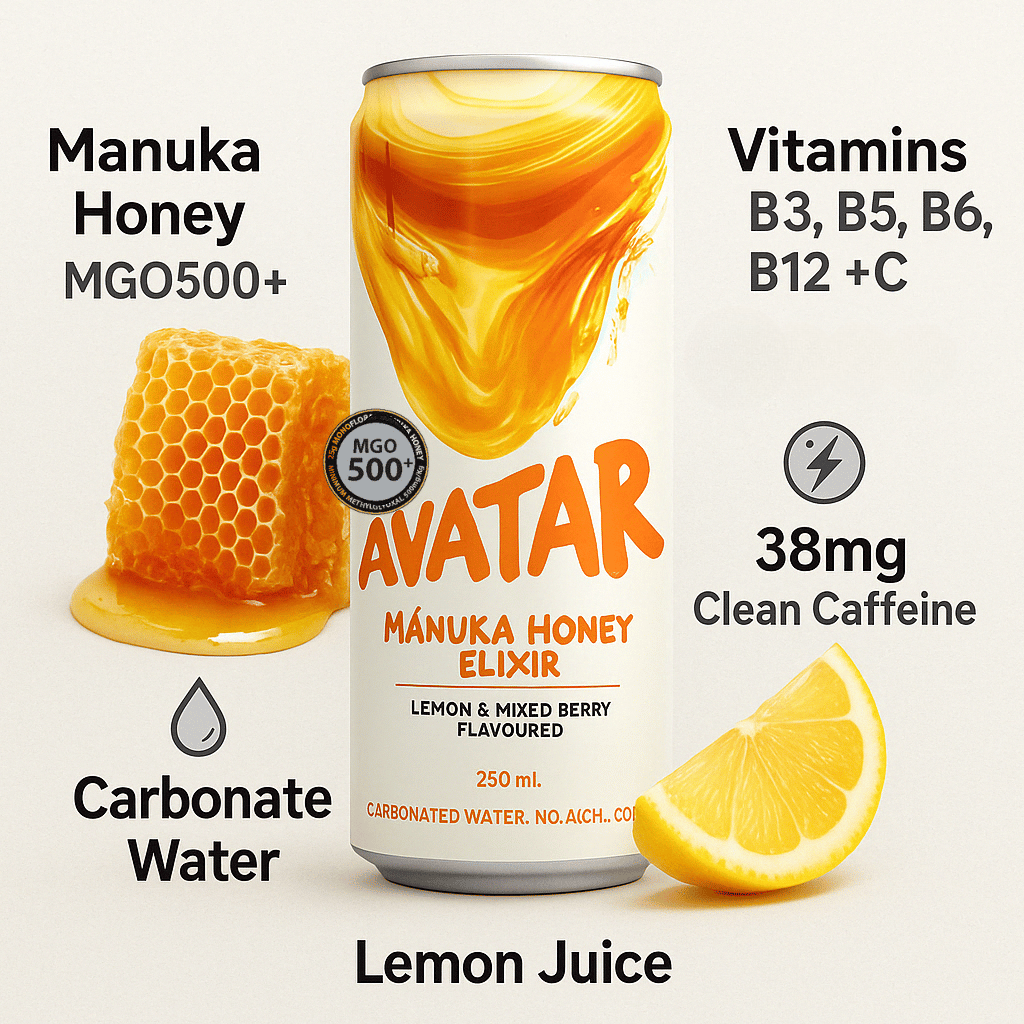




Short answer: B vitamins are added to functional energy drinks because they are familiar nutrients involved in the body’s normal processes for using food, but they are not stimulants and do not create an instant energy effect like caffeine. Their presence can add nutritional context to a beverage, although the full label still matters more than a prominent list of vitamins on the front of the can.
A row of vitamins can make a functional drink look more considered than an ordinary soft drink. B3, B5, B6, and B12 often appear beside ingredients such as caffeine, fruit flavours, botanical extracts, or honey, giving the impression that the drink has a broader purpose than sweetness and fizz.
That impression needs practical context. B vitamins are common additions to functional beverages, but their presence does not mean every person will experience more energy, sharper focus, or a particular wellness result. To understand what they contribute, it helps to separate their nutritional role from the immediate sensation associated with a caffeinated drink.
What are B vitamins in a functional energy drink?
B vitamins are a group of water-soluble vitamins that support normal processes within the body, including processes involved in releasing energy from food. In a functional energy drink, they are usually included as part of the beverage’s nutritional formulation rather than as the ingredient responsible for its immediate stimulating effect.
The word energy can be confusing on drink labels because it may refer to different things. Food provides dietary energy, measured in calories or kilojoules. Caffeine can increase alertness for a period of time. B vitamins have nutritional roles in normal metabolism, but they do not behave like caffeine and should not be interpreted as a separate stimulant.
Common B vitamins on functional beverage labels include:
- Vitamin B3: Usually listed as niacin or a form of niacin.
- Vitamin B5: Often listed as pantothenic acid.
- Vitamin B6: May appear by its vitamin name or as a specific form of B6.
- Vitamin B12: Often highlighted because it is widely recognised by consumers.
These names may appear in the ingredient list, the nutrition information panel, or both. The precise format depends on the product and the labelling rules in the market where it is sold.
Why do beverage makers add B vitamins?
Beverage makers add B vitamins to create a more complete functional formulation and to provide clearly identifiable nutrients that fit the drink’s intended positioning. They are practical for use in many beverage formats and familiar to people who already associate functional drinks with ingredients beyond flavour, sugar, and carbonation.
There are several common reasons they appear:
- Nutritional formulation: The maker may want the drink to provide selected vitamins alongside its other ingredients.
- Functional positioning: B vitamins help distinguish the product from a standard flavoured soft drink, provided the label accurately represents their presence.
- Consumer recognition: Names such as B6 and B12 are easy to recognise, even if their actual roles are not always well understood.
- Compatibility with the occasion: Functional energy drinks are often designed for work, study, travel, or long days, so makers choose ingredients that suit that broader use context.
None of these reasons turns a beverage into a medicine or guarantees a result. A functional drink remains a food and beverage product. The word functional generally signals that it has been formulated to offer something beyond basic refreshment, not that it can treat a condition or produce the same experience for everyone.
Do B vitamins provide the immediate lift in an energy drink?
No. B vitamins are not stimulants, so they are not responsible for the immediate lift commonly associated with a caffeinated energy drink. If a beverage contains caffeine, the caffeine is the ingredient more directly connected with its alerting effect.
This distinction is useful when comparing products. A can may place B vitamins and caffeine together on the front label, but the ingredients do not perform the same function. Carbonation, acidity, serving temperature, sweetness, aroma, and flavour can also shape how lively or refreshing the drink feels without being stimulants themselves.
Expectations should remain practical. Drinking more B vitamins does not automatically translate into a proportionally stronger feeling of energy. A person’s experience of a functional drink can also vary with sleep, meals, caffeine habits, timing, and personal sensitivity.
How should you read B vitamins on a drink label?
Read the nutrition panel and ingredient list together, starting with the serving size. This shows which B vitamins are present, how much the stated figures apply to, and what else the drink contains.
- Check the serving basis. Determine whether the panel refers to the whole can, a smaller serving, or a standard volume such as 100 millilitres.
- Identify the vitamins listed. Look for B3, B5, B6, and B12 by both their common vitamin names and any named forms.
- Review the stated amounts. Depending on the market, the label may show an amount, a percentage reference value, or both.
- Check the caffeine information. Do not assume that a longer vitamin list means more or less caffeine. These are separate parts of the formulation.
- Read the broader ingredient list. Consider sweeteners, sugars, fruit ingredients, flavours, acids, botanicals, honey, and carbonation as part of the complete drink.
- Notice the wording of claims. A factual statement that a drink “contains vitamin B12” is different from a promise that it will deliver a guaranteed personal outcome.
The order of ingredients also provides context. Ingredient lists generally place ingredients in descending order by weight, although vitamins can appear near the end because they are used in comparatively small quantities. A low position does not mean the vitamin is absent or unimportant, but the nutrition panel is the better place to understand the declared amount.
Does a longer vitamin list make an energy drink better?
No. A longer vitamin list does not automatically make a functional energy drink better. Product quality depends on the whole formulation, the clarity of the label, the flavour, the caffeine level, the serving size, and whether the drink suits the occasion and the person choosing it.
A useful comparison considers questions such as:
- Is the caffeine amount clearly stated?
- Does the serving size match the amount you are likely to drink?
- Do the flavour and sweetness fit your preferences?
- Are the functional ingredients clearly identified?
- Does the label use measured language rather than promising dramatic outcomes?
- Would you actually enjoy drinking it as a beverage?
This last question matters. Functional ingredients do not replace good drink-making. Citrus brightness, floral notes, balanced sweetness, and light carbonation may have more influence on whether a product fits your routine than the number of nutrients printed on the can.
How do B vitamins fit into Avatar Elixir?
Avatar Elixir uses B vitamins as one part of a broader food and beverage formulation. The New Zealand-made drink combines certified MGO500+ Manuka honey, lemon, elderflower, vitamin C, clean caffeine, and lightly carbonated water alongside its B vitamins.
In that context, the B vitamins do not need to carry the entire story of the drink. The Manuka honey contributes its distinctive ingredient character, lemon brings citrus brightness, elderflower adds a light floral note, caffeine provides the caffeinated element, and carbonation shapes the fresh drinking experience.
This is a practical way to view any functional beverage. Rather than isolating one familiar nutrient and expecting it to explain the whole product, consider how the ingredients work together as a drink. Avatar Elixir is still a beverage for refreshment and everyday occasions, not a medicine or a guarantee of energy, focus, performance, or health outcomes.
What expectations are reasonable when choosing a drink with B vitamins?
A reasonable expectation is that the drink provides the B vitamins declared on its label as part of its overall formulation. It is not reasonable to assume that those vitamins alone will produce an immediate or identical feeling of energy for every person.
Use the label to separate three different ideas:
- Nutrient content: Which vitamins the drink contains and the amounts declared.
- Stimulation: Whether it contains caffeine and how much is stated per serving or container.
- Drinking experience: How flavour, sweetness, temperature, carbonation, aroma, and serving occasion affect enjoyment.
Keeping these categories separate makes functional drink labels easier to interpret. It also helps prevent a familiar vitamin name from overshadowing the rest of the can.
What is the key takeaway about B vitamins in functional energy drinks?
B vitamins fit into functional energy drinks as nutritional ingredients, not as instant stimulants. They can be a thoughtful part of a well-labelled formulation, but they should be considered alongside caffeine, serving size, sweetness, flavour, and the rest of the ingredient list.
A good label tells you what is in the drink without asking you to assume a guaranteed result. When B3, B5, B6, or B12 catches your eye, treat that as the start of your label reading rather than the final reason to choose the can.
These follow-up points clarify how to compare B vitamin labels and choose a functional drink for a particular occasion.
Can a caffeine-free functional drink still include B vitamins?
Yes. B vitamins and caffeine serve different roles, so a functional drink can contain B vitamins without containing caffeine. The vitamins remain nutritional ingredients, but their presence alone does not make the beverage a stimulant or promise an immediate lift.
How can I compare B vitamin labels with different serving sizes?
Compare the vitamins using the same serving basis, such as per can, per serving, or per 100 millilitres. If two labels use different serving sizes, units, or percentage reference values, headline percentages may not provide a like-for-like comparison. Check the full nutrition panels before deciding which formulation fits your preferences.
Should B vitamins decide which drink I choose for work or study?
No. For work or study, consider the whole beverage, including its stated caffeine content, serving size, sweetness, flavour, ingredients, and your personal caffeine sensitivity. B vitamins can be part of the formulation, but their presence does not guarantee energy, focus, or the same experience for every person.