


Short answer: Ingredients on a US beverage label generally appear in descending order by weight, from the ingredient used most to the ingredient used least. Parentheses can show the ingredients within a mixture, and certain small-quantity ingredients may follow different ordering rules. The sequence describes a drink’s composition, not a ranking of quality, health value, or effectiveness.
When you turn over a natural energy drink, the ingredient list can help you separate the drink’s main components from smaller additions. The useful skill is recognizing which names belong to the main list, which sit inside another ingredient, and where the order stops telling you very much.
What does descending order by weight mean on a drink label?
Descending order by weight means ingredients are generally listed according to how much they weigh when used to make the drink. An ingredient listed earlier contributes at least as much weight as one listed later, subject to applicable labeling exceptions.
This is why water commonly appears first in a water-based beverage. If honey follows water, honey is generally the next-largest individual ingredient by weight. That does not mean honey makes up most of the drink, or reveal how close its amount is to the ingredient after it.
The rule concerns weight, not volume, sweetness, flavor intensity, or prominence on the front of the can. A small amount of a strongly flavored ingredient can noticeably influence the taste without appearing near the beginning.
The FDA’s Food Labeling Guide explains the general ingredient-declaration framework for conventional foods and beverages. This article is a consumer reading guide, not legal advice or a labeling-compliance checklist.
How do you read a drink ingredient list with parentheses?
Parentheses usually identify sub-ingredients within a compound ingredient, meaning an ingredient that is itself a mixture. Read the compound ingredient’s position in the main list separately from the order of the components inside its parentheses.
Consider this fictional, simplified example, created only to illustrate sequence and hierarchy. It is not Avatar Elixir’s ingredient statement or a labeling template:
Ingredients: Carbonated water, honey, citrus preparation (lemon juice, water, lemon oil), natural flavor, caffeine.
- Start with the main ingredients. Carbonated water comes before honey, followed by the citrus preparation, natural flavor, and caffeine.
- Treat the citrus preparation as a unit. Its position reflects the weight of the whole preparation, not just its lemon juice.
- Read inside the parentheses separately. Lemon juice, water, and lemon oil describe the preparation’s own components in their internal weight order.
- Do not flatten the two lists together. The example does not establish where lemon juice alone would rank against every other ingredient in the finished drink.
US labeling rules also allow sub-ingredients to be declared individually within the overall ingredient list in appropriate circumstances. Consequently, two labels can organize similar components differently. Parentheses are a useful clue to ingredient hierarchy, not a quality signal.
Are ingredients near the end always listed from most to least?
No. Qualifying small-quantity ingredients may be grouped after wording such as “contains … or less of,” with a stated percentage threshold. Ingredients within that group need not appear in descending order, so their positions do not reliably rank their amounts against one another.
The introductory wording matters. A threshold statement applies to the ingredients in that group, rather than saying they all have the same amount or that their combined amount equals the threshold.
Even without that exception, the end of a list is not a measure of importance. Caffeine, vitamins, flavorings, and other concentrated ingredients can be used in relatively small amounts. Their position alone cannot tell you whether the amount suits your preferences or what effect you might experience.
For an energy drink, caffeine listed last does not automatically mean “low caffeine.” Look for a declared caffeine amount rather than using its place in the sequence as a substitute.
What can’t ingredient order tell you about a drink?
Ingredient order cannot, by itself, establish exact percentages, ingredient quality, overall nutritional value, or the purpose of every component. It provides relative weight information within the relevant ordering rules, not a complete explanation of the recipe.
- Exact amounts: Honey in second place does not reveal its grams per serving or percentage of the drink.
- Combined categories: Several separately listed sweetening ingredients cannot be added together accurately from their positions. Check the nutrition panel for sugar information.
- Quality and origin: An ingredient’s position does not establish where it came from, how it was produced, or whether a quality claim is supported.
- Purpose: A component may contribute flavor, acidity, sweetness, or stability, and some ingredients have more than one role. Position does not identify those roles.
- Health value: A shorter list or a familiar ingredient near the top does not, on its own, make one beverage a better choice for everyone.
Likewise, descriptions such as “natural” or “clean caffeine” do not disclose quantities or change how you should interpret the ingredient sequence.
How does this apply to Avatar Manuka Honey Elixir?
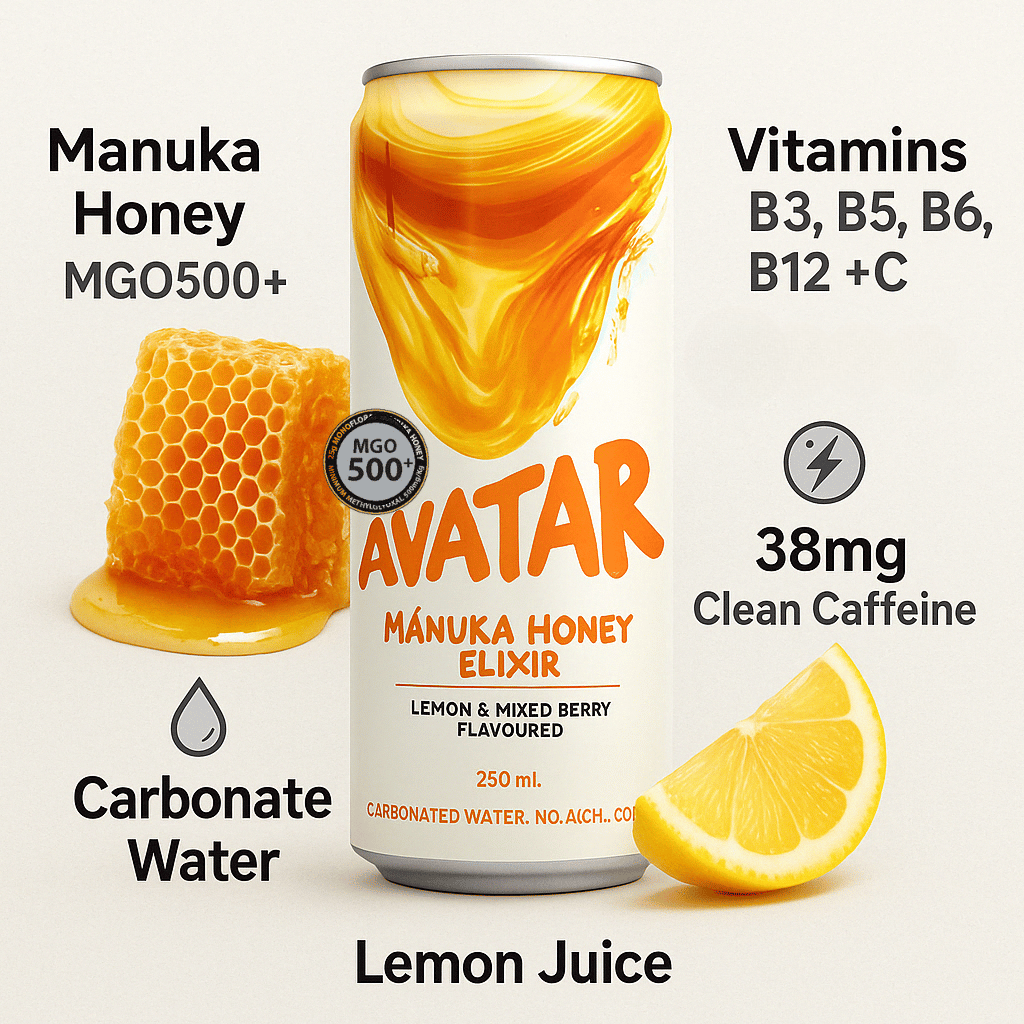
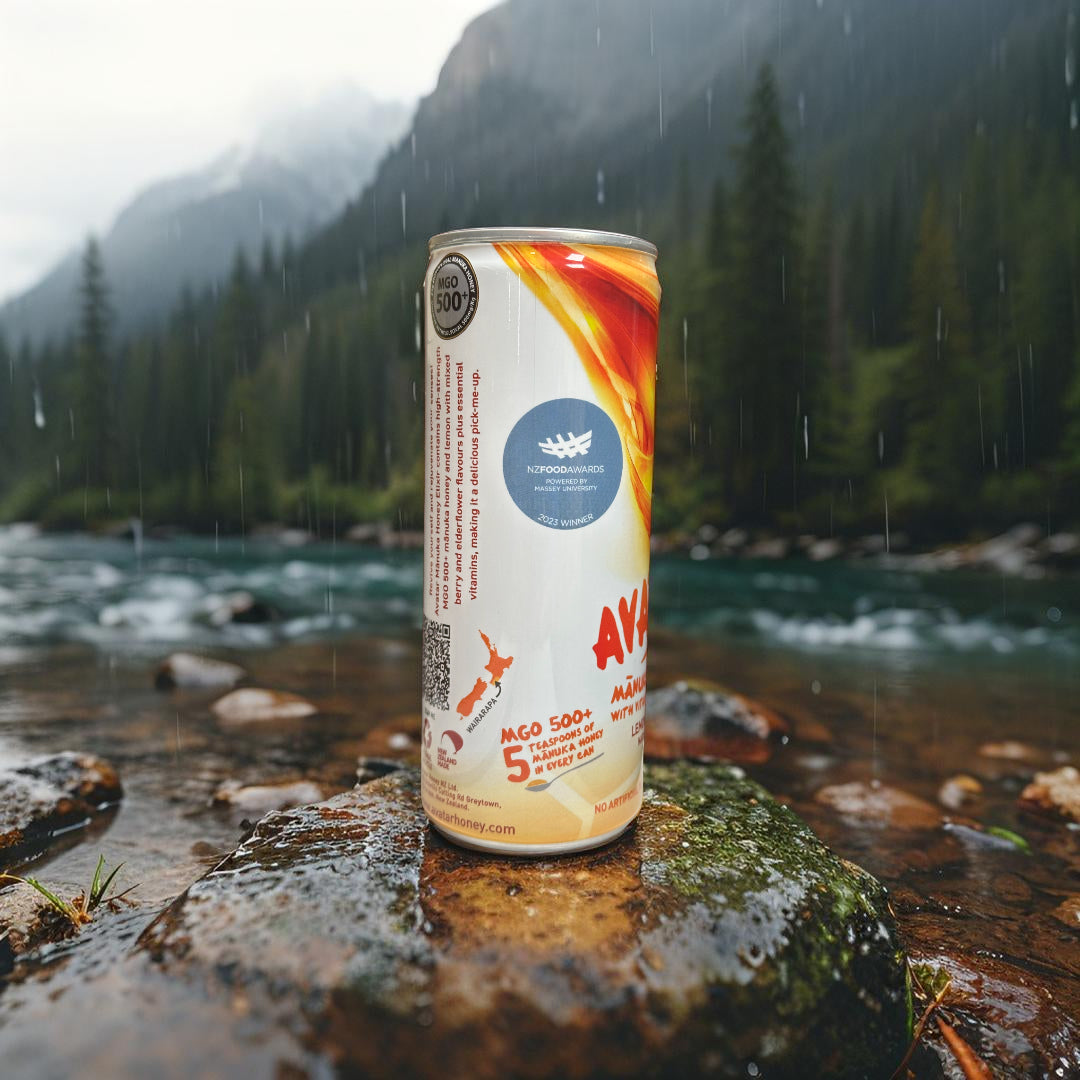
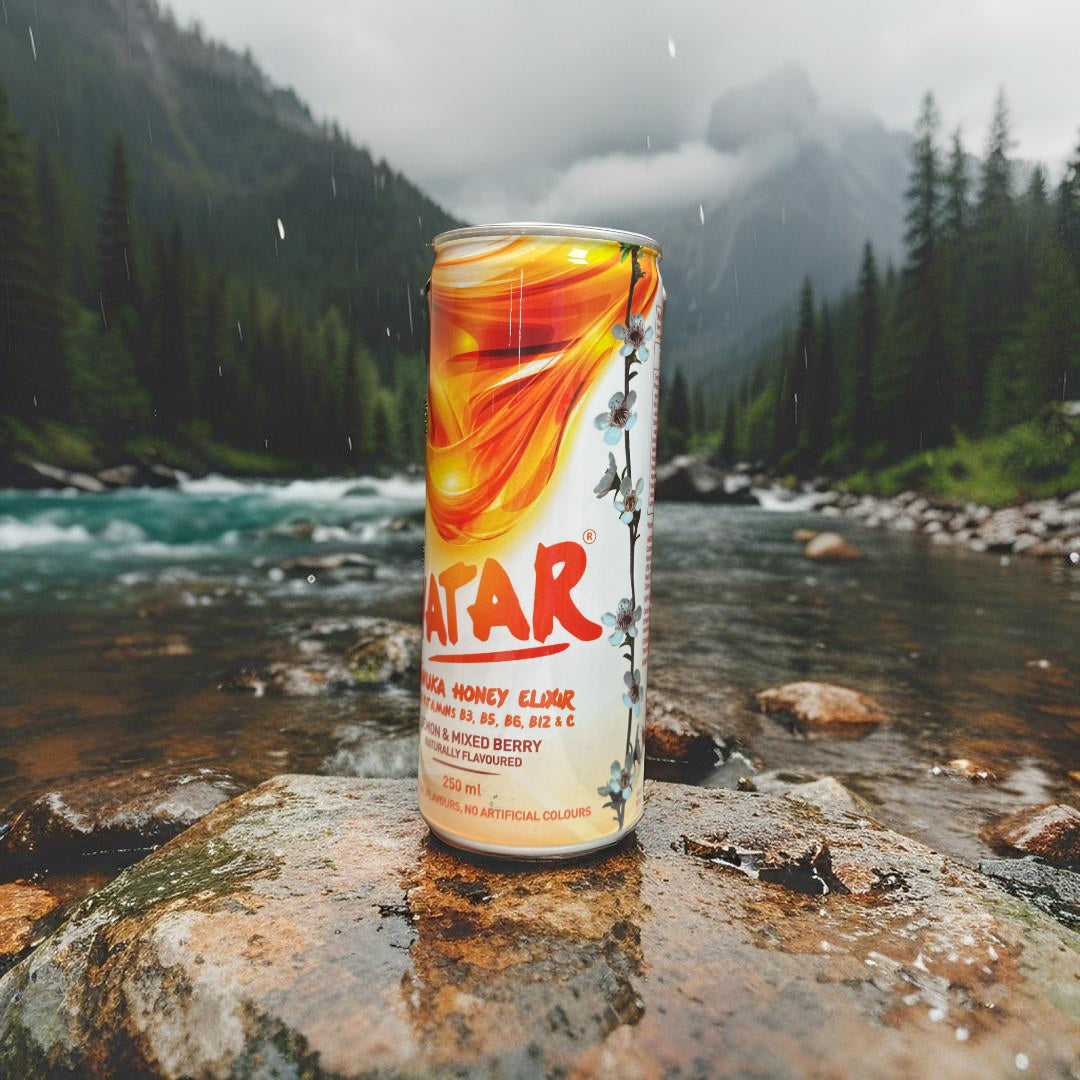
Our Avatar Manuka Honey Elixir ingredient summary identifies what goes into the drink, but it should not be treated as the ordered ingredient statement on a US label. The known ingredients include certified MGO500+ Manuka honey, lemon, elderflower, B vitamins, vitamin C, clean caffeine, and lightly carbonated water.
That summary provides ingredient context, including the honey’s stated certification and the drink’s lemon-and-elderflower flavor direction. It does not establish the official sequence, the form in which each component must be declared, or how any sub-ingredients are grouped.
Do not infer undisclosed quantities from the order of that summary. In particular, the honey’s MGO500+ designation is not a percentage of honey in the drink or a measure of the finished beverage’s health value.
What should you check alongside the ingredient sequence?
Check serving size, caffeine information, and the Nutrition Facts panel alongside the ingredient list. Together, these give you information that ingredient order alone cannot supply.
- Serving size and servings per container: Establish whether the figures describe the whole can or a smaller serving before comparing drinks.
- Caffeine information: Look for the amount and its stated basis, such as per serving or per container. If it is not available, the ingredient list cannot fill that gap.
- Nutrition Facts: Compare calories, total sugars, added sugars, and other nutrients relevant to your choice on a consistent serving basis. Honey’s presence does not make sugar information unnecessary.
For the broader label-reading routine, our article How to Read a Natural Energy Drink Label in 60 Seconds covers the next checks. If a product carries a different facts panel, Nutrition Facts vs Supplement Facts on Energy Drinks explains that distinction.
The practical stopping point: Use ingredient order to understand relative amounts and ingredient hierarchy. Use declared quantities and nutrition information to compare what you will actually drink. Neither one replaces the other.
These follow-ups help you compare similar drink labels and clarify information that ingredient order cannot settle.
Do two drinks with the same ingredient order contain equal amounts?
No. Two drinks can list ingredients in the same order while using different proportions. Matching sequences show a similar relative weight ranking, subject to labeling exceptions, not an identical recipe. Compare declared quantities and Nutrition Facts on the same serving basis rather than assuming the drinks contain equal amounts.
Does a different order online mean the recipe has changed?
No, a different order online does not by itself establish a recipe change. A product description may highlight ingredients rather than reproduce the official ingredient statement. First check whether you are comparing two actual ingredient statements. If those differ, ask the maker which statement applies to the product you have.
What should I ask if a drink's ingredient list leaves gaps?
Ask the maker for the specific information you need, rather than an explanation of the order alone. For example, request the caffeine amount per serving and per container, clarification of a compound ingredient's components, or the purpose of an unfamiliar ingredient. If an exact quantity is not disclosed, its position cannot supply the missing figure.