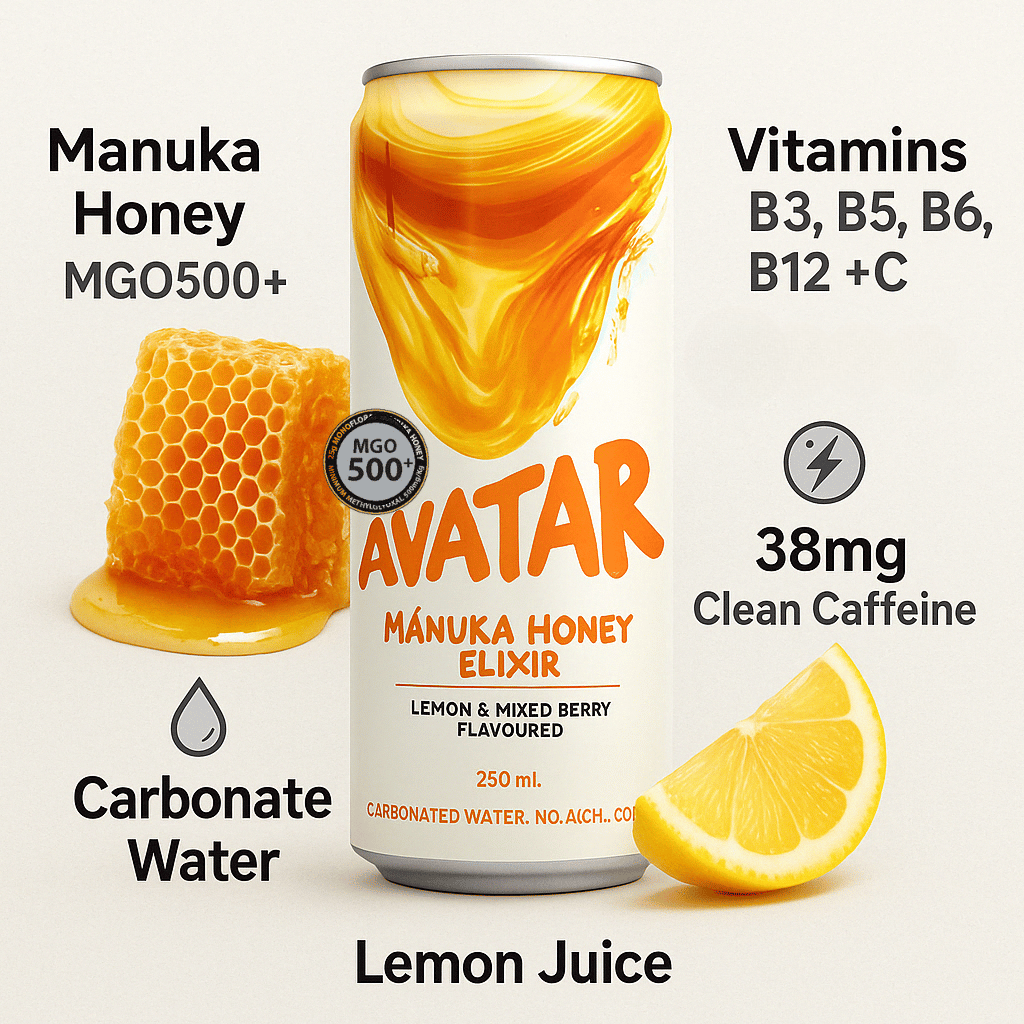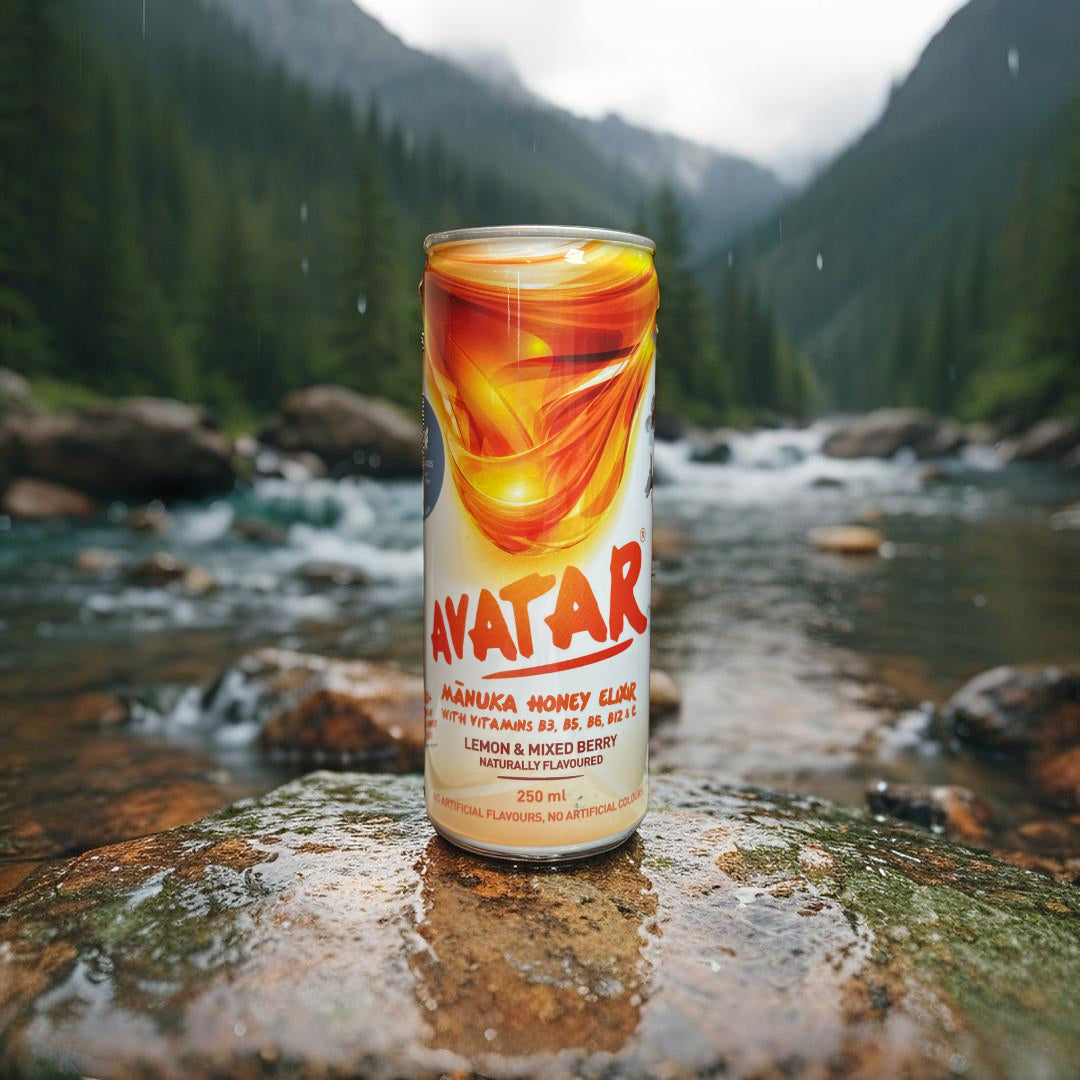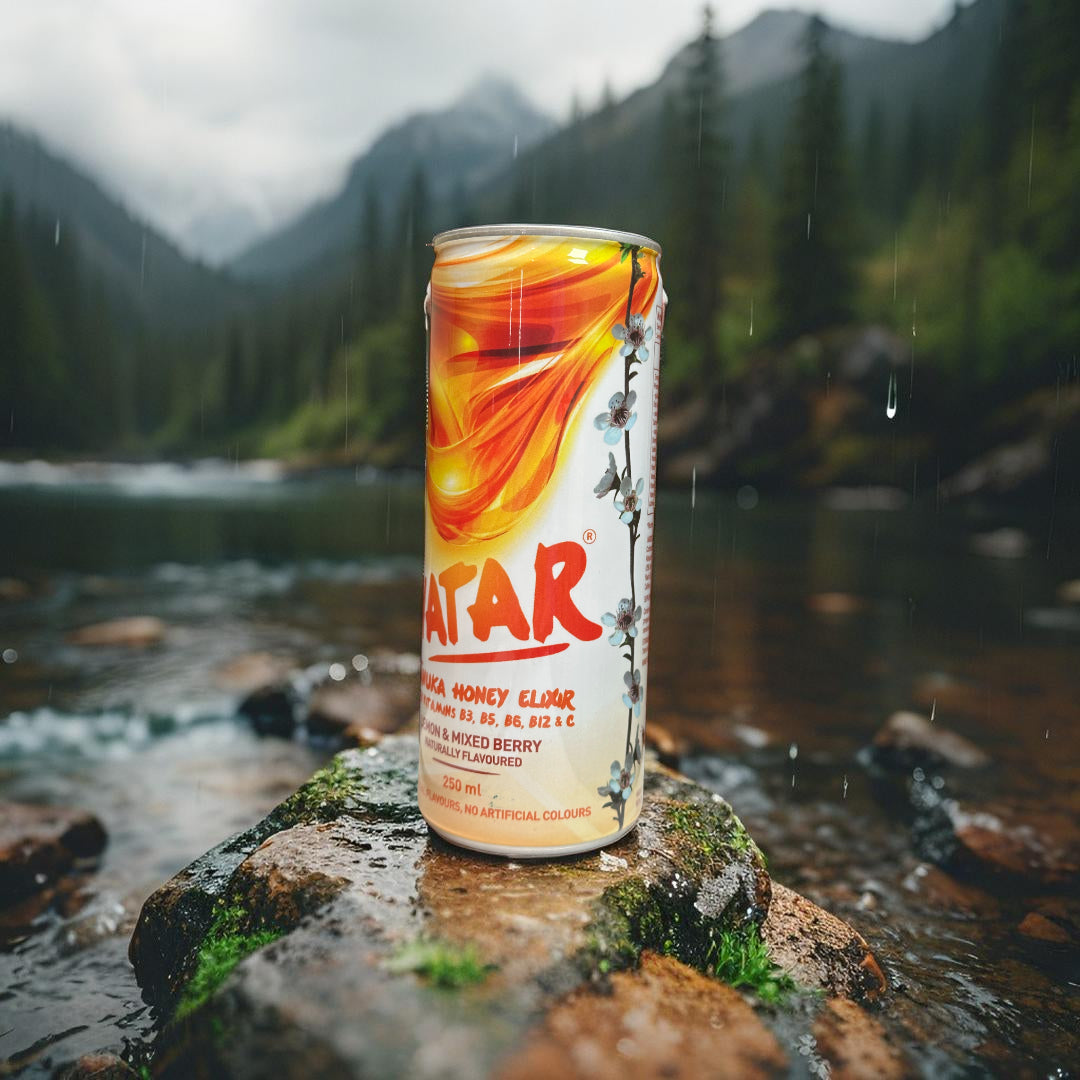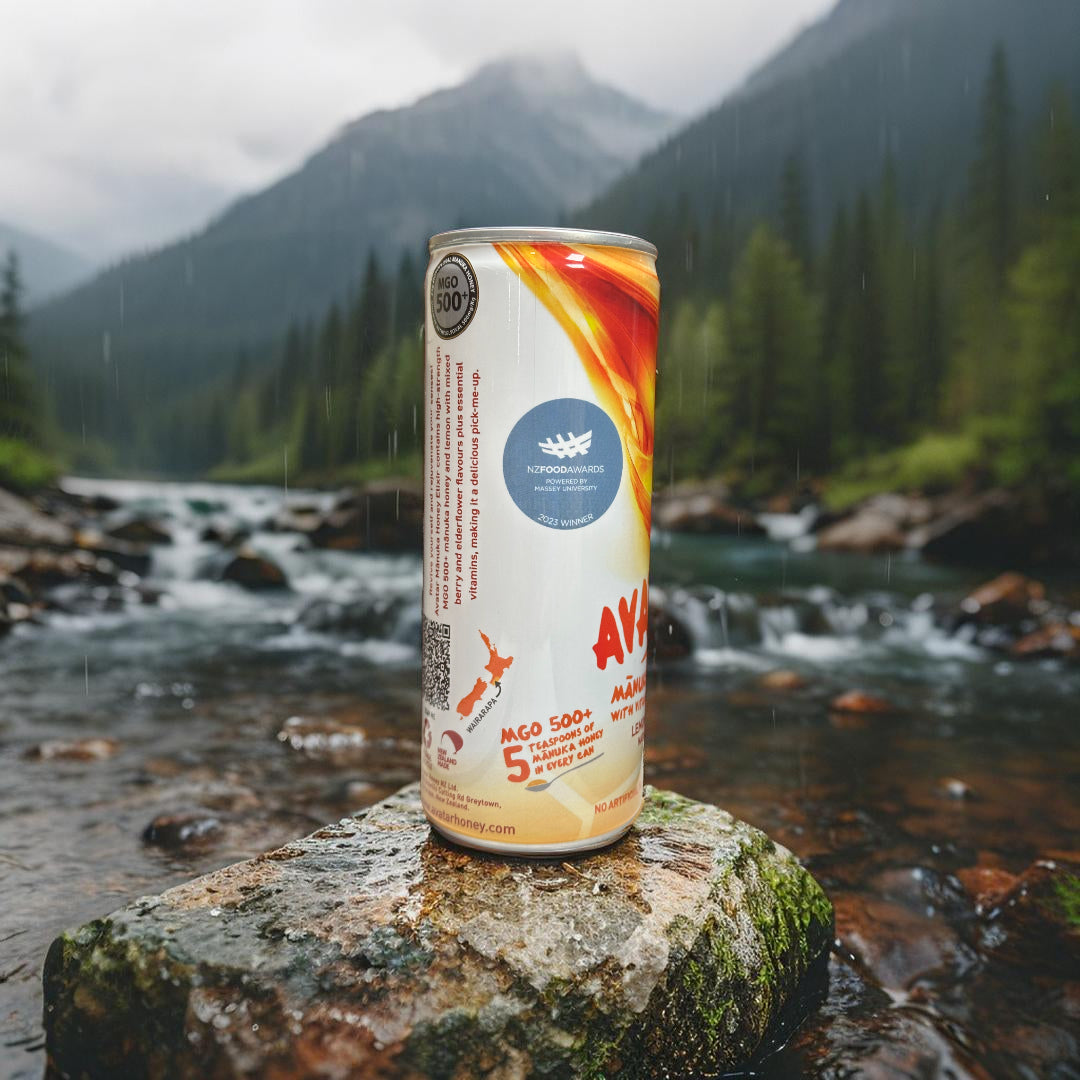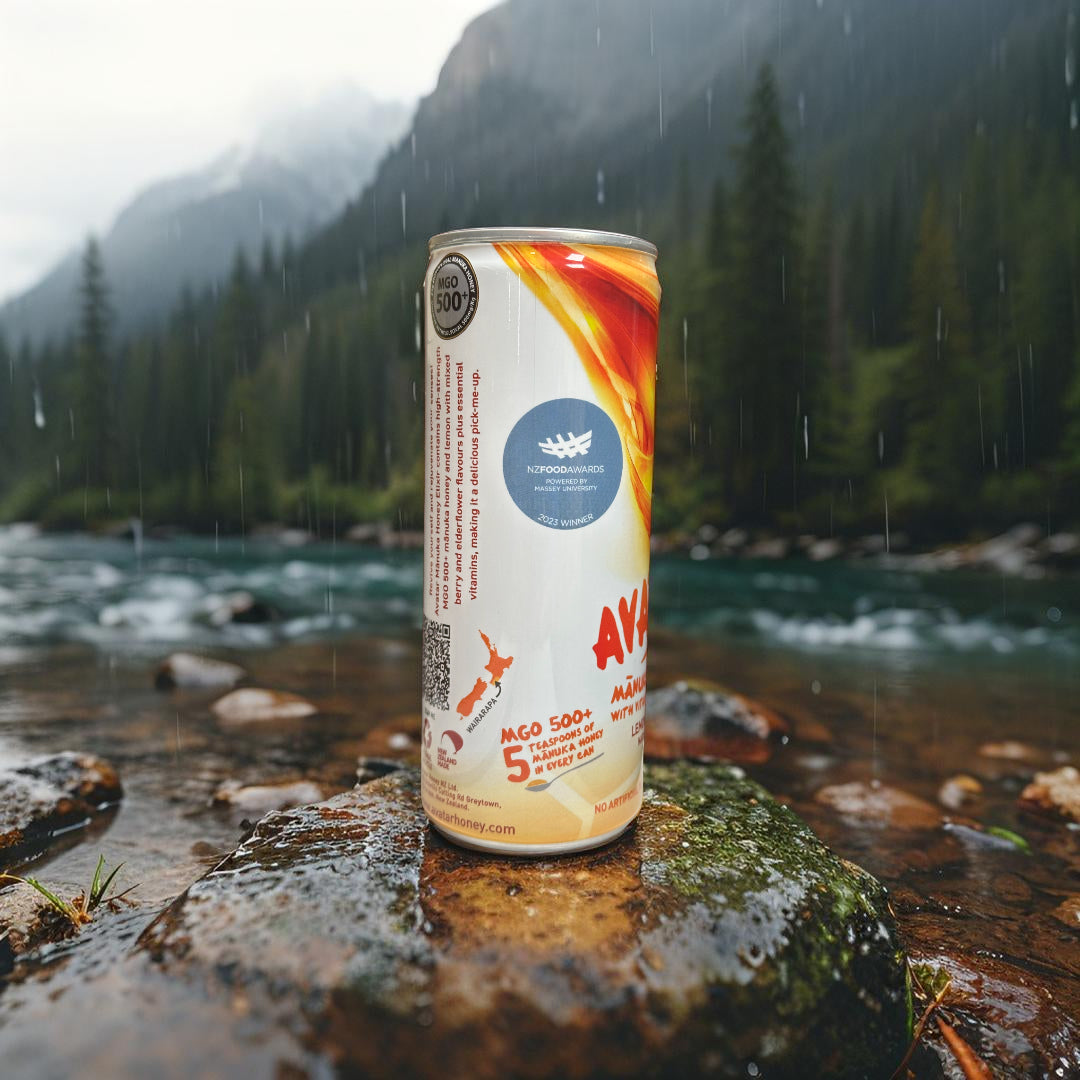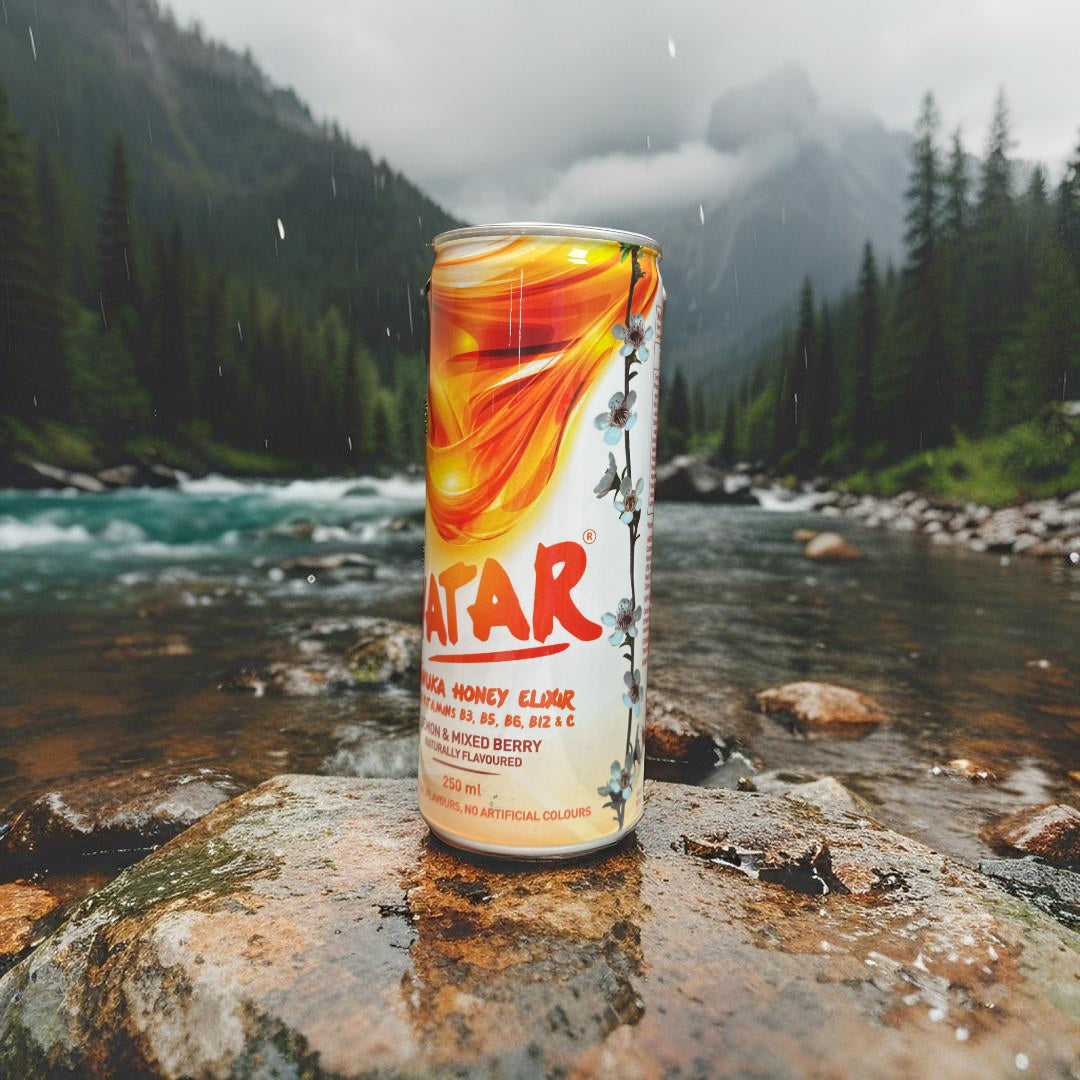



Short answer: Manuka honey can add cost to a ready-to-drink beverage because it is a New Zealand-origin ingredient with variable seasonal supply, MGO grading and certification requirements, a higher ingredient value than ordinary sweeteners, and specific formulation considerations. The amount used matters too. Avatar Elixir, for example, contains 25g of certified MGO500+ Manuka honey per can, which is more informative than simply seeing “Manuka honey” on the front of a label.
That does not mean every beverage containing Manuka honey automatically deserves a premium price. A higher price cannot prove authenticity, generous ingredient quantity, better flavour, or better overall value. The useful question is not simply whether Manuka honey appears in the ingredient list. It is whether the producer gives enough specific information to explain what is in the drink and why it may cost more.
What actually makes Manuka honey more expensive than an ordinary beverage sweetener?
Manuka honey generally carries more cost because its production is tied to New Zealand Manuka flowering, seasonal harvest conditions, grading, testing, and a comparatively limited supply. Ordinary beverage sweeteners are often produced at much larger scale and purchased as standardised commodities, so they do not necessarily carry the same origin and grading considerations.
These differences begin before the honey reaches a beverage facility. Bees must forage during the Manuka bloom, and beekeepers must manage hives, harvest honey, and maintain suitable handling and traceability practices. The resulting honey is then assessed to determine how it can be represented and graded.
For an MGO-graded product, the number refers to the measured concentration of methylglyoxal used in that grading system. A label such as MGO500+ is therefore more specific than a general statement such as “made with honey.” It identifies a defined grade rather than relying only on the reputation of the Manuka name.
Certification and testing are not interchangeable with taste or health outcomes. They help establish what grade is being represented. They do not guarantee that every consumer will prefer the drink or consider it good value.
How do New Zealand origin and harvest variability affect beverage cost?
New Zealand origin and variable Manuka harvests can affect cost because genuine Manuka honey depends on a particular flowering source, location, season, and successful bee foraging conditions. It cannot be produced anywhere or treated as a completely predictable year-round crop.
Manuka flowering periods are limited, and each harvest can be influenced by practical agricultural factors such as weather, bloom timing, hive placement, and access to suitable forage. These variables can affect how much honey is available and the characteristics of the harvested batches.
This does not justify unsupported claims that every season creates a shortage or that every producer faces the same supply conditions. It simply means Manuka honey is not as uniform or unrestricted as a widely available commodity sweetener.
For a ready-to-drink producer, ingredient planning may therefore involve securing honey of the required origin and grade rather than purchasing any interchangeable sweetener. The exact commercial arrangements will vary between businesses, so a shopper cannot calculate the manufacturer’s ingredient cost from the retail price alone.
Why do MGO testing and certification add to the cost?
MGO testing and certification add cost because a specific grade needs more substantiation than an ungraded honey claim. Testing, batch documentation, certification requirements, and traceability processes all require work beyond simply buying a sweet ingredient and adding it to a recipe.
The distinction matters because “Manuka-flavoured,” “with Manuka honey,” and “certified MGO500+ Manuka honey” do not communicate the same level of detail. A specific grade gives the buyer something concrete to examine, although shoppers should still read the full ingredient information and product description.
There are two important limits to remember:
- A high MGO grade is not a flavour guarantee. The finished drink still depends on its complete recipe, sweetness, acidity, aroma, and carbonation.
- A certification claim is not a medical promise. A ready-to-drink Manuka honey beverage remains a food and beverage product, not a treatment or cure.
Certification should therefore be viewed as part of ingredient identity and quality communication. It can help explain cost, but it should not be used as a shortcut for judging every aspect of the finished beverage.
Does the quantity of Manuka honey in each can make a meaningful difference?
Yes, ingredient quantity can make a substantial difference to cost. A beverage containing a clearly stated amount of graded Manuka honey gives shoppers more useful information than a drink that mentions Manuka honey without saying how much is included.
Avatar Elixir is a concrete example because each can contains 25g of certified MGO500+ Manuka honey. That statement identifies both the amount and the grade. It allows a buyer to assess the ingredient proposition without assuming that the presence of Manuka honey alone explains the product’s price.
The quantity also matters when comparing two apparently similar drinks. One may use Manuka honey as a meaningful recipe component, while another may include a much smaller quantity alongside other sweeteners. Both products might legally list Manuka honey, but their ingredient economics and flavour formulations could be quite different.
Position in the ingredient list can provide additional context because ingredients are generally presented in descending order by weight. However, the clearest information is an explicit quantity per serving or can. Without that information, shoppers should avoid guessing how much Manuka honey is present.
Why can Manuka honey be more difficult to formulate into a sparkling drink?
Manuka honey can require more formulation work because it contributes sweetness, aroma, colour, texture, and its own distinctive flavour. A drink maker must balance those characteristics with acidity, botanical notes, carbonation, caffeine, vitamins, and the desired finish.
Honey is not merely neutral sugar. Its flavour can remain noticeable in the finished drink, particularly when used in a meaningful quantity. In a sparkling beverage, too much sweetness may feel heavy, while excessive acidity can obscure the honey character. Carbonation can also change how sweetness and aroma are perceived on the palate.
A balanced formulation may combine honey with citrus or floral ingredients. Avatar Elixir uses lemon and elderflower alongside its Manuka honey, creating a broader flavour profile than honey and carbonated water alone. Its clean caffeine, B vitamins, and vitamin C are separate formulation elements and should not be treated as evidence of medical efficacy.
These formulation requirements can contribute to product development and production complexity. They still do not reveal the manufacturer’s exact costs, and they do not mean that complexity always produces a better-tasting drink. Taste remains a matter of recipe quality and personal preference.
Does international distribution also contribute to the final price?
Yes, international distribution can contribute to the final price because packaged beverages are relatively heavy and bulky, and they must move through storage, freight, importing, and retail channels. These costs are separate from the value of the Manuka honey itself.
A New Zealand-made ready-to-drink beverage sold overseas may carry costs associated with moving both the packaged liquid and its containers to the destination market. Local taxes, retailer margins, order quantities, packaging formats, and distribution arrangements can also influence shelf price.
Buyers should therefore avoid attributing the full difference between a Manuka honey drink and a standard soft drink to the honey alone. The final price reflects the complete product, which may include its ingredients, canning, packaging, freight, distribution, and retail positioning.
Without a documented cost breakdown, it is not possible to assign an exact dollar amount to each factor. A transparent product page can explain the ingredient choices, but it cannot by itself reveal confidential purchasing or supply-chain terms.
Which common claims about Manuka honey beverage pricing are myths?
The main pricing myths are that the word “Manuka” automatically proves premium quality, that a higher price proves authenticity, and that a high MGO grade guarantees a better drink. None of those conclusions can be made from price or branding alone.
Myth: Any Manuka honey beverage is expensive because Manuka honey is expensive
Cost driver: The grade and amount used are more relevant than the name by itself. A specific statement such as 25g of certified MGO500+ Manuka honey per can gives substantially more context than an unspecified Manuka honey claim.
Myth: The most expensive drink must use the most authentic honey
Cost driver: Price is influenced by the whole product and sales channel. Packaging, freight, retailer margins, brand positioning, and other ingredients may all affect the final amount. Authenticity should be assessed through clear origin, grading, certification, and ingredient information rather than price alone.
Myth: A higher MGO number guarantees better flavour
Cost driver: A defined MGO grade can influence ingredient value, but flavour depends on the complete beverage formulation. Honey, citrus, florals, acidity, sweetness, and carbonation must work together. Some shoppers may prefer a lighter honey character, while others may want it to be more prominent.
Myth: Manuka honey makes a beverage inherently healthy
Cost driver: Manuka honey is still an ingredient in a food or beverage. Its presence does not make the drink a medicine, remove the need to consider total sugars and caffeine, or guarantee focus, energy, or wellness outcomes.
What should shoppers check before paying more for a Manuka honey drink?
Shoppers should check the honey’s stated origin, grade, certification language, quantity, full ingredient list, serving size, caffeine information, sugar information, and overall drink format. These details help distinguish a transparent ingredient proposition from premium storytelling alone.
- Look for a precise honey description. “Certified MGO500+ Manuka honey” is more informative than a vague reference to premium honey.
- Check whether the quantity is disclosed. A stated number of grams per can makes comparison easier. Avatar Elixir discloses 25g of certified MGO500+ Manuka honey per can.
- Confirm the stated origin. Manuka claims should be accompanied by clear New Zealand origin information where relevant.
- Read the complete ingredient list. Check whether other sugars or sweeteners are used and how the honey fits into the overall recipe.
- Review sugar and caffeine information. These are practical considerations for choosing when and how the drink fits into your routine.
- Separate grading from health claims. An MGO grade describes the honey grade. It does not promise a medical, focus, or performance result.
- Judge the complete drinking experience. Consider flavour, carbonation, can size, occasion, and whether you want the drink for work, travel, social serving, gifting, or use as a mixer.
- Compare like with like. A premium honey-based functional beverage is not directly equivalent to a basic soft drink, but that does not prevent you from comparing ingredient transparency and value per can.
When is the added cost of Manuka honey justified?
The added cost is easier to justify when the beverage clearly states the Manuka honey’s origin, grade, certification, and meaningful quantity, and when the complete flavour and format suit the buyer’s needs. It is not justified by the Manuka name or a premium price alone.
Avatar Elixir’s disclosure of 25g of certified MGO500+ Manuka honey per can provides a concrete basis for evaluating its ingredient choice. Buyers can then consider the rest of the drink, including lemon, elderflower, light carbonation, clean caffeine, B vitamins, and vitamin C, without treating any single ingredient as proof of guaranteed value or benefit.
In practical terms: Manuka honey can legitimately add cost through origin, harvest variability, grading, certification, quantity, formulation, and distribution. A careful shopper should expect transparent details in return. The best evidence of value is not a premium-looking label, but a clear account of what is actually in the can and a finished drink that suits the buyer’s taste and occasion.
These follow-up points clarify how to interpret MGO grading, compare less transparent labels, and assess overall beverage value.
Does MGO500+ describe the honey or the finished drink?
MGO500+ describes the grade of the Manuka honey used, not the finished beverage as a whole. It should not be interpreted as the MGO concentration of every ingredient or the complete drink. In Avatar Elixir, the specific disclosure is 25g of certified MGO500+ Manuka honey per can.
How can I compare drinks when the honey quantity is not disclosed?
You cannot determine the exact amount of Manuka honey without a quantity statement. The ingredient list may provide context because ingredients are generally listed in descending order by weight, but it does not reveal precise grams. Compare the stated grade, origin, certification language, full ingredients, serving size, sugar information, and caffeine information instead of guessing.
Is disclosed Manuka honey content enough to prove good value?
No, disclosed quantity and grade provide useful evidence about the ingredient proposition, but value depends on the complete drink. Consider flavour, sweetness, carbonation, can size, caffeine, other ingredients, price, and intended occasion. A transparent label supports an informed comparison, but it cannot guarantee that you will prefer the taste or consider the price worthwhile.