


Key observation: A bee sting allergy does not automatically mean a honey allergy or a need to avoid every honey drink. Sting reactions involve injected venom, while honey reactions follow ingestion. That distinction cannot establish your individual safety: honey can cause uncommon but serious reactions, and an allergist should assess a relevant allergy history rather than you testing a drink with a small sip.
The connection between bees and honey makes this a reasonable question, especially after a frightening sting reaction. But “comes from bees” is not a precise enough category for assessing allergy risk. The substance involved, the way exposure occurred, and your previous reactions all matter.
This article explains what allergy guidance and clinical evidence can establish, where drink labels help, and where individual medical advice is needed. If you are experiencing a suspected severe allergic reaction now, use your prescribed epinephrine immediately and call 911, following your emergency plan.
Bee venom allergy and honey allergy describe different exposures
A sting-allergy diagnosis concerns a reaction to insect venom. It does not, by itself, diagnose an allergy to honey as a food.
The American College of Allergy, Asthma & Immunology (ACAAI), in its guidance on insect sting allergies, describes reactions to venom injected through a sting. Drinking a honey-containing beverage is a different exposure: it involves swallowing honey and the drink’s other ingredients, rather than receiving a sting.
That difference is the reason a blanket rule such as “anyone allergic to bee stings must avoid honey” goes beyond what the diagnosis establishes. It is also why the opposite statement, “honey is safe because it is not venom,” is too reassuring. Clinical research has identified potential allergens in honey that warrant a more careful explanation.
For an individual reader, the useful distinction is between a known venom allergy and a possible food reaction. Those questions may need separate assessment. A history of symptoms after eating honey or drinking a honey-containing beverage deserves attention in its own right, even when a sting allergy has already been diagnosed.
Honey reactions are uncommon, but the evidence rules out blanket reassurance
Clinical reports document allergic reactions after honey ingestion, including severe reactions. Their existence matters, but these reports do not tell a particular venom-allergic adult how likely they are to react.
In Allergy to honey: relation to pollen and honey bee allergy, Helbling and colleagues investigated a small, selected group of people with systemic symptoms after eating honey, alongside comparison groups. The published abstract describes findings implicating pollen and potentially bee-derived allergens, including possible cross-reacting venom components.
This evidence makes it inappropriate to describe honey allergy as always being “just a pollen problem” or to call venom allergy and honey allergy completely unrelated. However, the study was not designed to establish the probability that an adult with a bee sting allergy will react to a honey drink. Its participants cannot stand in for everyone with venom allergy.
A peer-reviewed case report by Steininger and colleagues, Honey as a rare cause of severe anaphylaxis: Case report and review of literature, also describes recurrent severe reactions in which blossom honey was identified as the suspected food trigger. A case report establishes clinical possibility, not frequency. It does not establish a risk specific to Mānuka honey or a particular beverage.
What this means: “Uncommon” is not a reason to dismiss a previous reaction. Equally, an individual case report is not evidence that everyone with a sting allergy needs to avoid honey.
An allergist interprets the history, not just a test result
The next useful question is not simply whether a food-allergy test is positive. It is whether your history and any appropriate testing together support a diagnosis.
ACAAI’s guidance on diagnosing food allergies explains that a positive skin or blood test may indicate sensitization, meaning the immune system recognizes an allergen, without proving that eating the food will cause a reaction. Those tests also do not predict how severe a reaction would be.
An allergist’s assessment therefore depends on details such as what happened after a sting, whether symptoms have ever followed honey or another food, and which ingredients were present in a drink associated with symptoms. Previous experience eating honey is relevant information, but it should not be converted into a guarantee about every honey-containing product.
For an appointment, your sting-reaction history, any food or drink reactions, and the relevant ingredient label give the clinician more useful context than the broad description “allergic to bees.” They can help distinguish the established allergy from a separate, unresolved concern.
A small trial sip is not a substitute for this assessment. ACAAI states that oral food challenges belong in a medical setting under allergist supervision, with emergency treatment available, not at home. A clinician may consider a supervised challenge when appropriate; it is not something every reader needs or should attempt independently.
Drink labels provide information, not individual safety clearance
An ingredient list can help identify a possible trigger, but neither an ingredient list nor an allergen statement can determine whether a drink is safe for a particular person.
For US labeling, the Food and Drug Administration’s guidance on food allergen labeling distinguishes ordinary ingredient declarations from the additional identification required for major food allergens. Ingredients generally appear under their common or usual names, but some may be grouped under permitted collective terms, such as flavorings.
A “Contains” statement therefore should not be read as a personalized list of everything that could cause an allergic reaction. Someone with a relevant allergy may need information beyond that statement. If a flavor description leaves a potentially relevant ingredient unclear, manufacturer clarification can provide factual information for an allergist to consider. It is not, on its own, a medical safety assessment.
Precautionary statements answer a different question. FDA explains that wording such as “may contain” or references to shared facilities is voluntary, and differences in wording do not reliably indicate the presence or quantity of an allergen.
- An ingredient declaration describes the formulation, subject to applicable labeling rules and permitted collective terms.
- A major-allergen declaration identifies specified allergen sources; it is not a catalogue of every possible individual trigger.
- A precautionary statement may flag potential cross-contact, but its wording is not a dependable scale of risk.
The absence of a precautionary statement cannot establish that cross-contact is absent. These are general label limitations, not conclusions about any particular manufacturer’s equipment, cleaning procedures, or allergen controls.
Avatar Elixir needs ingredient-specific consideration
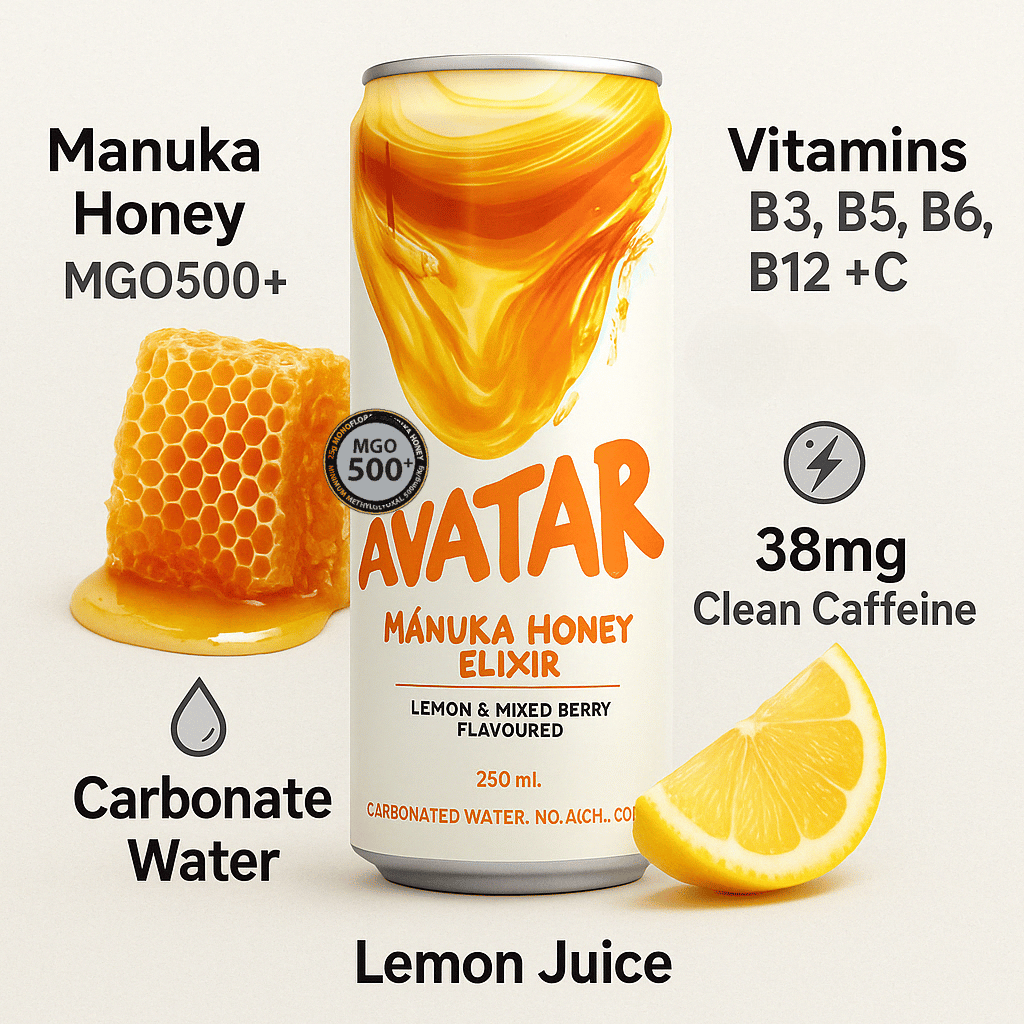
Our Avatar Elixir contains Mānuka honey, lemon, and elderflower. Those ingredients require consideration against the individual’s allergy history; their presence does not make the drink an allergy-friendly option.
These three ingredients are not a complete formulation statement. The product description identifies elderflower, while the ingredient block groups flavor ingredients as “Natural Flavourings.” For someone with a relevant ingredient concern, a descriptive flavor name and a collective ingredient term may leave different questions unanswered.
The same reasoning applies to honey drinks generally: identifying honey does not establish that honey would be the cause of any reaction, because other ingredients also need consideration. Nor does distinguishing venom allergy from food allergy establish that Avatar Elixir is suitable for a particular reader. That remains an individual clinical question.
A suspected severe reaction needs prompt action
Breathing difficulty, throat tightness, hoarseness, dizziness, or fainting after exposure can be signs of anaphylaxis, a severe allergic reaction. ACAAI identifies these among the warning symptoms and recommends immediate epinephrine for anaphylaxis.
For a suspected severe reaction, use your prescribed epinephrine immediately and call 911, following your emergency plan. Do not wait to see whether symptoms settle. Antihistamines do not replace epinephrine for anaphylaxis.
ACAAI also explains that selected patients may have an individualized plan allowing different emergency-service decisions when symptoms resolve promptly and specific safeguards are in place. That exception depends on a clinician-developed plan. It should not be interpreted as general permission to delay emergency help during a suspected severe reaction.
The practical conclusion is narrower than either blanket avoidance or blanket reassurance: a bee sting allergy does not automatically establish a honey allergy, but it does not clear a honey drink for you either. An allergist can interpret your actual exposures and reaction history. Ingredient information supports that conversation; a home trial does not replace it.
These follow-up questions explore honey varieties, reactions to mixed drinks, and information that can help an allergy assessment.
Is Mānuka honey safer than other honey for someone with allergies?
The cited evidence does not establish that Mānuka honey is safer than other honey for someone with allergies. The honey-allergy research and blossom-honey case report do not provide a comparative safety assessment of honey varieties. Switching honey types is not a substitute for an allergist's assessment, and a different variety should not be tested at home.
If I react to a honey drink, does that identify honey as the trigger?
A reaction to a honey-containing drink does not, by itself, identify honey as the trigger. Other ingredients also need consideration. The drink's ingredient label and a description of the symptoms and their timing can help an allergist assess the possible cause. Do not try to isolate the trigger by tasting the ingredients separately at home.
What can I ask a manufacturer about unclear flavour ingredients?
You can ask whether a specific ingredient relevant to your allergy is included under a collective term such as "Natural Flavourings." Questions about potential cross-contact may also help clarify information that the label leaves unresolved. A manufacturer's response can supply facts for an allergist to consider, but it cannot establish your individual medical safety.
Does everyone with a sting allergy need a supervised honey challenge?
A sting-allergy diagnosis alone does not establish a need for a honey challenge. An allergist considers the reaction history and any appropriate testing before deciding whether a supervised oral food challenge would be useful. ACAAI specifies that food challenges belong in a medical setting with emergency treatment available, not at home.