



Key observation: Human studies can assess whether L-theanine changes specific attention-task results under controlled conditions. Evidence for L-theanine alone must be separated from evidence for L-theanine combined with caffeine, and neither automatically establishes that a finished focus drink delivers calm, sustained concentration or better everyday productivity.
L-theanine is an ingredient name you may encounter when comparing focus drinks. Its presence raises a reasonable question: does it add something meaningful to the drink, or does the label suggest more than the evidence can establish?
The answer depends on what was tested, who took part, what the comparison was and how the outcome was measured. “Studied in humans” is not, by itself, a useful description of effectiveness.
This article explains how to interpret human-study claims rather than presenting a trial-by-trial evidence review. Without identifiable reviews and trial results to assess, it would be misleading to claim a proven benefit, a reliable effect size or an established duration of action. The useful distinction is between what a study could demonstrate and what a focus-drink label might invite you to assume.
1. L-theanine is an ingredient, not a definition of focus
L-theanine is an amino acid naturally present in tea. In a focus drink, however, its name does not describe the complete formulation or establish what drinking that product will feel like.
Tea, an isolated ingredient and a ready-to-drink beverage are different things. A beverage containing L-theanine may also contain caffeine, sweeteners, vitamins or other ingredients. Evidence about one component cannot simply be assigned to the whole mixture.
“Focus” also needs a clearer definition. It can mean responding accurately to a signal, ignoring distractions, maintaining attention during a repetitive task or feeling mentally ready to work. Those experiences overlap, but they are not interchangeable.
A study could measure performance on a specific computer task without measuring the ability to write a report, understand a difficult chapter or make a considered decision. Likewise, a participant could report feeling calmer without performing an attention task more accurately.
What this means for understanding the label: “Contains L-theanine” is an ingredient statement. “Improves focus” is an outcome claim that needs separate, relevant evidence.
2. Systematic reviews and controlled trials answer different questions
A systematic review is useful for assessing the wider evidence, while a controlled human trial is useful for examining a defined comparison. Neither is automatically decisive simply because of its study type.
A systematic review uses explicit methods to find and assess research addressing a question. Its value depends on the quality and relevance of the included studies. A review that combines different formulations, participant groups and outcomes may not provide a straightforward answer about a particular drink.
A controlled trial compares an intervention with another condition, such as a placebo or caffeine alone. Randomisation and blinding can help reduce bias, but the interpretation still depends on the participants, measurements, study duration and completeness of the reporting.
The table below is an evidence-reading framework, not a summary of verified L-theanine findings.
| Evidence or comparison | What it could establish | Important limitation |
|---|---|---|
| Systematic review of L-theanine alone | Whether eligible studies give a consistent answer about specified outcomes | Its conclusions depend on the quality, similarity and completeness of the included research |
| Controlled trial of L-theanine versus placebo | Whether the tested ingredient differs from placebo on measured outcomes | Applies to the tested conditions, participants and observation period |
| L-theanine plus caffeine versus placebo | Whether the combination differs from placebo | Cannot, by itself, identify what L-theanine adds beyond caffeine |
| L-theanine plus caffeine versus caffeine alone | Whether adding L-theanine changes the measured response to caffeine | Does not automatically establish synergy or an effect in another formulation |
| Controlled trial of a finished focus drink | Whether that formulation differs from its comparator under the tested conditions | Does not establish unmeasured benefits or guarantee an individual experience |
A review or trial becomes useful to a drink buyer when its actual findings and limitations are available. The phrase “research-backed ingredient” leaves those essential details unresolved.
3. L-theanine alone and L-theanine with caffeine require separate evidence
A result for L-theanine combined with caffeine cannot be treated as a result for L-theanine alone. This is the central comparison when assessing a caffeinated focus drink.
Caffeine can affect alertness, so its inclusion changes the question being tested. If a combination is compared only with placebo, any difference belongs to the combination as tested. That design cannot establish whether L-theanine contributed to the result.
Consider a hypothetical trial in which participants complete an attention task after receiving either L-theanine with caffeine or a placebo. Even if the combination produces a better task score, the study would leave an important question unanswered: would caffeine alone have produced the same result?
A comparison with caffeine alone helps address that question. A design including placebo, L-theanine alone, caffeine alone and their combination can offer a clearer basis for separating the components. Appropriate analysis would still be needed before describing the ingredients as working synergistically.
The same reasoning applies to promises that L-theanine “smooths out” caffeine. Better attention-task performance would not prove fewer jitters, greater calm or protection against sleep disruption. Each of those is a different outcome requiring relevant measurement.
For adults choosing a drink for work or study, the practical implication is straightforward: evidence for a combination needs to show what the added ingredient contributes, not merely that the combination was tested.
4. A statistically significant attention result is not a productivity promise
A study finding can be statistically meaningful while leaving its everyday importance uncertain. Statistical significance does not describe how noticeable or useful a difference would be during your working day.
Attention research can use tasks measuring response speed, accuracy, distraction resistance or the ability to switch between rules. These measures make a narrow question testable. They do not capture every part of concentration.
A faster response, for example, needs to be considered alongside accuracy. Completing a task more quickly is not necessarily an improvement if errors increase. Results across several tasks also need careful interpretation, especially when a positive headline highlights one outcome without explaining the others.
Measured performance and reported feelings are separate
A rating of calmness, alertness or mental fatigue describes a participant’s reported experience. A task score describes performance on that task. Both can be relevant, but one should not be substituted for the other.
“Calm focus” combines at least two ideas: a subjective feeling and an ability to direct attention. Evidence supporting only one would not establish the whole claim.
Everyday productivity adds further demands, including judgement, motivation, prior knowledge and the nature of the work itself. A laboratory attention result does not demonstrate better writing, more effective revision or fewer mistakes across a long shift. Nor does an attention-task finding establish treatment for a medical condition.
What this means when comparing claims: A credible description names the measured outcome. “Performed differently on a particular attention task” is narrower, and more informative, than “unlocks sustained focus”.
5. Participant groups and study duration set the limits
A human study’s relevance depends on who participated and how long they were observed. “Tested in adults” is too broad to establish that the result applies equally to every adult buying a focus drink.
Participant characteristics worth understanding include age, health status, usual caffeine intake and sleep conditions. A result from rested volunteers in a controlled setting would not automatically apply to someone working overnight, travelling across time zones or studying after poor sleep.
Caffeine conditions also matter. If participants were asked to avoid their usual caffeine before testing, that detail can affect how a caffeine-containing intervention should be interpreted. It is part of the study context, not a detail to leave out of an evidence summary.
Short observation does not establish lasting performance
A single-session study can address what happens during its observation window. It cannot establish the effects of repeated daily use, a full working day or an ongoing study routine.
Timing matters within that window too. Measurements taken at selected points do not prove an uninterrupted benefit between those points. “Sustained focus” is therefore a stronger claim than a favourable result recorded during one test session.
Longer research can address additional questions, but duration alone does not solve weaknesses in comparison groups or outcome measurement. A useful study summary reports the participant group, task and observation period together, rather than reducing the finding to “works for focus”.
6. Ingredient evidence does not establish a finished drink’s performance
An impressive ingredient name does not establish how a finished drink performs. The formulation, ingredient quantities, caffeine content and relevance of any product-specific testing all affect what can reasonably be concluded.
A drink may contain an ingredient discussed in research without matching the preparation or conditions used in that research. Unclear quantities make that comparison harder. Additional ingredients do not automatically strengthen the evidence, and a longer ingredient list is not a measure of effectiveness.
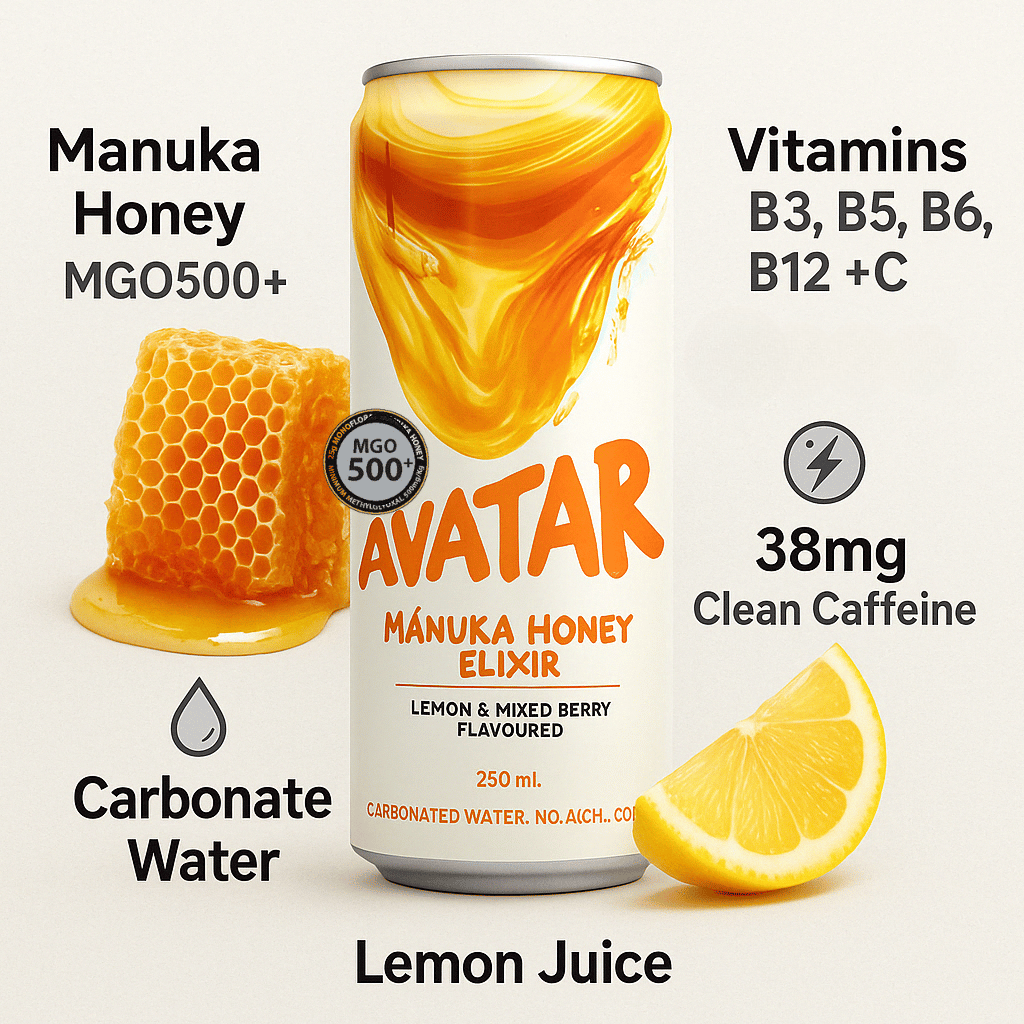
For an ingredient-led comparison, our Avatar Elixir has its own formulation: certified MGO500+ Mānuka honey, lemon, elderflower, B vitamins, vitamin C, caffeine and lightly carbonated water. Its honey, citrus and floral ingredients offer a flavour-based point of comparison, separate from claims about L-theanine.
Avatar Elixir should not be assumed to contain L-theanine or receive effects attributed to it. Its formulation must be assessed on its own merits, rather than borrowing an evidence story from another ingredient or drink category.
For any focus drink, uncertainty is not proof that it cannot have an effect. It means the claim should remain proportionate to what is actually known. Ingredient transparency and flavour can inform a beverage choice without being presented as proof of cognitive performance.
The clearest conclusion is also the most useful: human research can answer carefully defined questions about L-theanine alone or in combination with caffeine. Turning those answers into promises of calm, sustained focus requires additional evidence. The ingredient name on the can is the beginning of that assessment, not the conclusion.
These follow-up questions help you assess L-theanine claims when study details or drink labels leave gaps.
What evidence should a brand provide for its L-theanine claim?
A useful response would identify the review or trial and explain how it supports the exact claim. Relevant details include the participants, tested formulation, comparison group, measured outcomes and observation period. For a caffeinated drink, it also matters whether the research tested L-theanine alone, the combination or the finished beverage.
How should I interpret studies that appear to disagree?
Apparently conflicting studies may be answering different questions. A trial measuring reported calmness is not directly comparable with one measuring attention-task accuracy. Differences in participants, caffeine conditions and observation periods also matter. A systematic review can help assess consistency, but its conclusions still depend on the relevance and quality of the included research.
Can I compare a drink with research if quantities are undisclosed?
You cannot establish a close formulation match from the ingredient name alone. Without the relevant quantities, it remains unclear how the drink compares with the preparation tested. That gap does not prove the drink is ineffective, but it limits how confidently ingredient research can support claims about that particular beverage.
If I feel more focused, does that show L-theanine worked?
Feeling more focused does not, by itself, identify L-theanine as the cause. Your experience can matter to your beverage preference, but it does not separate L-theanine from caffeine or other differences in the situation. It also cannot establish that attention-task performance or everyday productivity improved.