



Key observation: Ingredient studies can help explain why a functional drink might have a particular effect, but they do not, by themselves, prove that the finished drink delivers it. The strength of that connection depends on what was studied, in whom, at what amount, in which formulation, and against which measured outcome.
A drink can contain carefully chosen ingredients and still carry a benefit claim that reaches beyond its evidence. The gap is not necessarily in the ingredients. It may be in the leap from “this ingredient has been studied” to “this can will improve your working day”.
A functional beverage is a drink positioned around an additional function beyond refreshment, often through ingredients such as caffeine, vitamins or botanicals. To assess whether one “works”, the useful starting point is a more specific question: works for which outcome, under which conditions?
This is not a reason to dismiss functional drinks. It is a way to separate a plausible ingredient choice, a demonstrated effect and a promise that remains unproven.
1. An evidence ladder shows how close research comes to the claim
Evidence becomes more directly relevant when the research resembles the drink, the person drinking it and the benefit being claimed. A simple ladder helps explain that connection, although study quality matters at every level.
- Laboratory or animal research: Can explore properties and possible mechanisms. It does not establish what happens when a person drinks the finished beverage.
- Human research on an isolated ingredient: Can test an ingredient’s effects under specified conditions. Its relevance depends on the participants, amount, ingredient form and outcome.
- Human research on a comparable formulation: Moves closer to the beverage, but differences in ingredients, quantities or preparation may still matter.
- Well-designed human research on the finished drink: Provides the most direct test of that formulation for the particular outcome and population studied. Consistent results across suitable studies can strengthen confidence.
This is a ladder of relevance, not an automatic ranking of trustworthiness. A poorly controlled study of a finished drink can leave more uncertainty than a rigorous ingredient study. Neither becomes stronger simply because its title sounds scientific.
What study design contributes
A comparison group helps distinguish an effect of the drink from other explanations. Random assignment helps reduce systematic differences between groups. Blinding, where participants or assessors do not know which drink was given, can reduce the influence of expectations.
The comparison itself also changes the question. Testing a beverage against water examines a different contrast from testing it against a drink with the same caffeine and sugar content. The latter could help investigate whether the remaining formulation adds something, provided the study is otherwise suitable.
A review that brings together multiple studies can offer a broader view, but it cannot remove limitations shared by those studies. A collection of ingredient trials does not become a clinical trial of a finished beverage.
2. Human evidence still needs to match the intended drinker
A study involving people is more directly relevant to human use than a laboratory experiment, but “tested in humans” is not the end of the assessment.
Laboratory work may expose cells or microorganisms directly to an ingredient. Drinking involves dilution, digestion and absorption, with different substances reaching different parts of the body. An interesting laboratory result can justify further investigation without establishing a benefit from ordinary beverage consumption.
Within human research, the participants’ starting circumstances shape the meaning of a result. Evidence from people with a low intake of a nutrient does not automatically describe what additional amounts would do for people whose intake is already adequate.
Similarly, research conducted during sleep loss answers a different question from research conducted in well-rested adults. A controlled test after fasting may not describe drinking the same beverage alongside lunch. These are differences in context, not reasons to discard the research.
For caffeine-related claims, participants’ usual caffeine habits may also be relevant to interpreting a study. A result under tightly controlled intake conditions should not silently become a promise to every coffee drinker, student or shift worker.
What this means when choosing: The closer the study population and setting are to your circumstances, the more relevant the evidence may be. A claim addressed broadly to “busy adults” needs more justification than a result confined to one narrowly defined group.
3. Amounts, formulation and processing connect the ingredient to the can
Sharing an ingredient name is not enough to establish that a beverage matches a study. The amount, form and finished formulation are part of the comparison.
The amount needs to be comparable
A study tests a particular amount under a particular schedule. A beverage containing an unspecified amount of that ingredient cannot be assumed to reproduce the result. Evidence from repeated consumption also does not automatically support a claim about one serving.
More is not automatically better, either. A tested amount establishes the conditions of that experiment, not a rule that increasing it produces a larger benefit. This is a question of evidence matching, not a reason to adjust consumption to imitate a trial.
The formulation can change the question
A purified compound, a plant extract and a whole-food ingredient are not necessarily interchangeable. They may differ in composition even when their descriptions share a familiar word.
The surrounding food or drink, sometimes called the food matrix, can also matter. Ingredients are consumed together, rather than as separate entries on a label. Whether that changes a particular effect requires appropriate evidence; it should not be assumed either way.
For the same reason, combining several ingredients with individual research histories does not establish that their benefits add together. A claim of “synergy”, meaning that the combination does more than the separate contributions would suggest, needs evidence about the combination.
Processing and storage introduce another comparison
Heat, acidity, light, oxygen and storage conditions can affect some food components. The relevance depends on the ingredient and the actual process. Processing is not automatically harmful, and the presence of a sensitive ingredient does not prove that a finished drink has lost it.
Composition testing can help establish what remains in a beverage. An outcome study asks a different question: what happens when people consume it? Confirming ingredient content is useful, but it is not the same as demonstrating improved concentration or another consumer benefit.
4. A measured endpoint is narrower than a wellness promise
An endpoint is the specific outcome researchers measure. “Wellness”, “focus” and “energy” can each describe several different things, so a claim needs to stay close to the actual measurement.
For example, research might measure:
- A subjective rating: How alert or tired participants say they feel.
- Task performance: Accuracy, response speed or errors on a defined test.
- A biological marker: A measurable characteristic in the body that may help explore a mechanism.
- An everyday outcome: A defined result in a setting resembling ordinary life.
These outcomes are not interchangeable. Feeling more alert does not necessarily mean making fewer mistakes. Responding faster on a short task does not establish better learning, judgement or performance across a full working day. A change in a biological marker does not automatically demonstrate a benefit that a person notices.
Timing matters too. An effect measured shortly after consumption does not establish an all-day effect or a lasting benefit from regular use.
Even a statistically detectable difference needs interpretation. Its size, uncertainty and practical importance matter. If researchers measure many outcomes, highlighting only a favourable result can give an incomplete impression, particularly when it was not the main outcome specified in advance.
What this means for understanding claims: “Changed a measured response on a particular test” and “improves brain performance” are different statements. The broader promise needs broader support.
5. A hypothetical example makes the evidence gap visible
Hypothetical example, not an actual study or product claim: Imagine a drink containing caffeine, vitamins and a botanical extract. Its description says that the ingredients are research-backed and that the drink supports sustained focus.
Suppose the supporting material consists of a controlled human study of caffeine alone that measured response speed on a brief attention task, plus laboratory research on the botanical extract.
The caffeine study could be relevant to a narrowly framed statement about that ingredient under the conditions tested. Its relevance to the drink would still depend on the caffeine amount, the participants and the way the beverage was consumed. The laboratory work could offer a reason to investigate the botanical further, but would not establish a focus benefit in people.
Neither piece of research, on its own, demonstrates sustained focus from the combined beverage. The word “sustained” adds a duration claim. The word “focus” may also suggest more than the brief task measured.
Now imagine that the finished drink is tested against a matched beverage containing the same caffeine amount. That design could help investigate whether the other ingredients contribute to the measured result. If the comparison were caffeine-free instead, it would answer a different question about the formula as a whole.
Even a favourable finished-drink result would need to be described within its limits. A study of one task during one session would not establish better exam results or reliable performance through every long shift.
The lesson is not that the hypothetical drink cannot have an effect. It is that each additional promise creates another question the evidence must answer.
6. Ingredient facts and demonstrated benefits belong in different categories
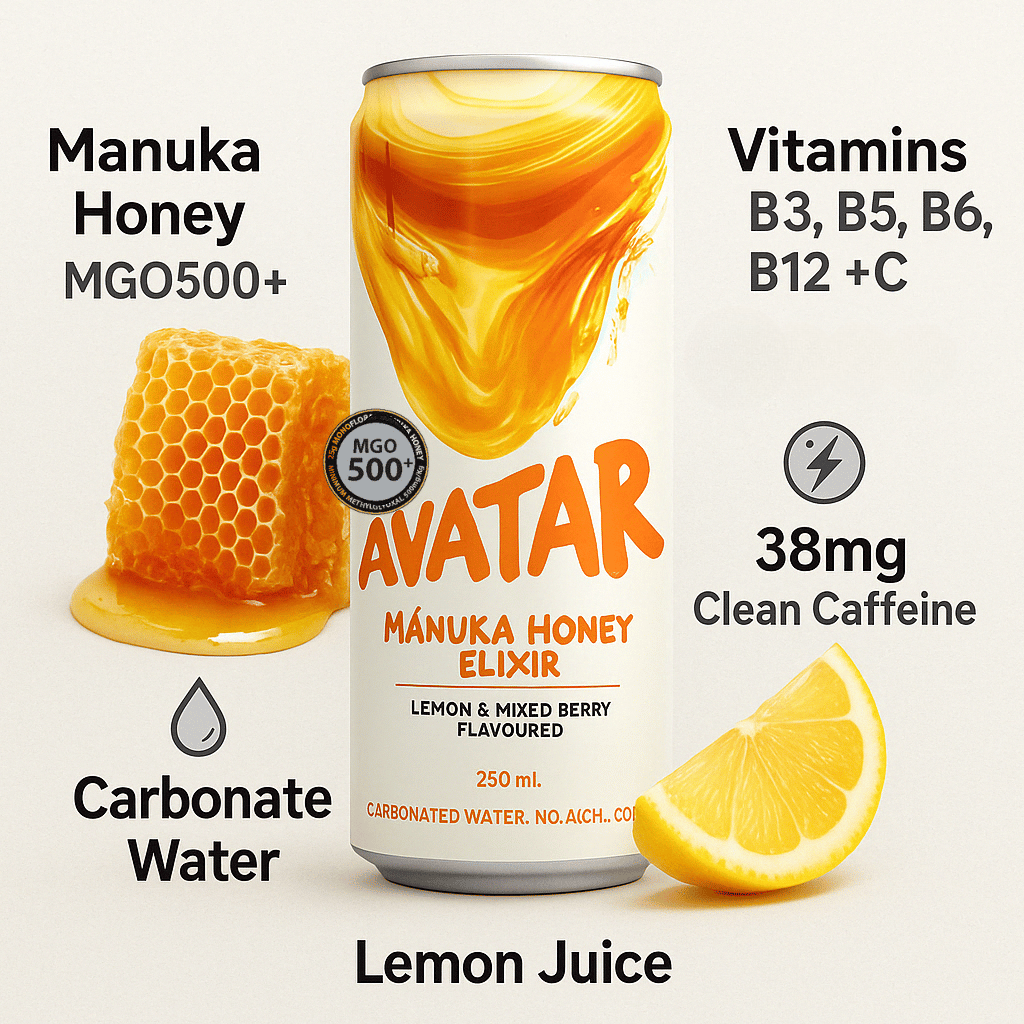
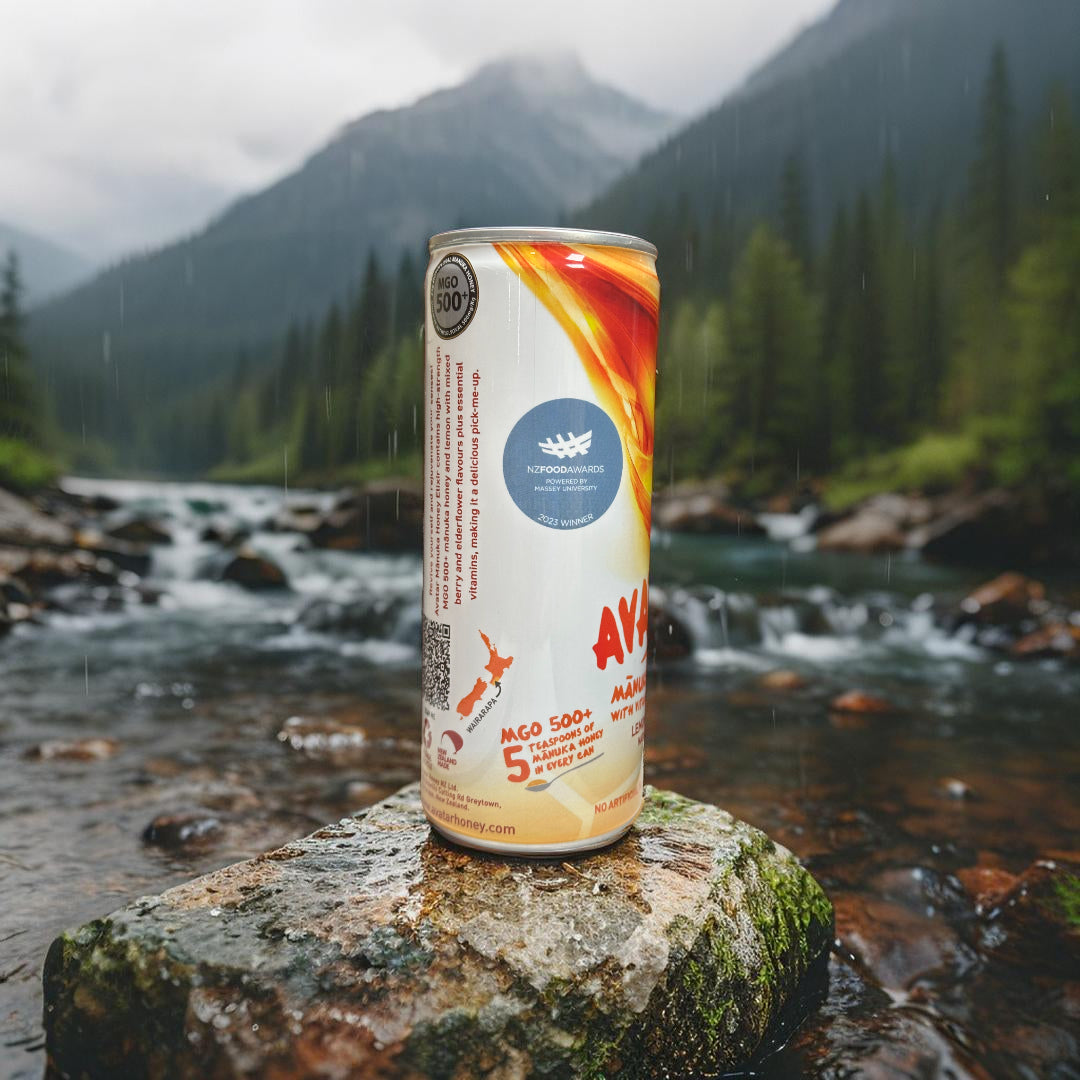
Our Avatar Elixir offers a practical example of a multi-ingredient beverage: it contains Mānuka honey, B vitamins, vitamin C and caffeine, with lemon, elderflower and lightly carbonated water. Those ingredients describe the formulation. They do not, by themselves, demonstrate a finished-drink outcome.
The MGO500+ grade of its Mānuka honey describes the honey ingredient in relation to methylglyoxal, the compound abbreviated as MGO. It is not a measure of beverage effectiveness. It does not prove that the drink treats illness, improves cognition or delivers a particular experience after consumption.
Likewise, a vitamin’s established nutritional role is a different proposition from a claim that a vitamin-containing drink will produce a noticeable improvement for every adult. Adding caffeine alongside vitamins and honey does not turn the ingredient list into clinical evidence for the combination.
A useful distinction is between what the beverage contains, what relevant ingredient evidence can explain and what has been demonstrated for the finished drink. Confidence in one category should not be borrowed to fill a gap in another.
There is still room to value a drink for its ingredients, flavour, origin and place in your routine. Honey sweetness, bright citrus, floral elderflower and light carbonation are legitimate reasons to enjoy a beverage without attaching a cognitive or medical promise to it.
Ingredient research is best treated as part of an explanation, not a universal proof stamp. The most informative benefit claims identify the outcome, match the evidence closely and leave the remaining uncertainty visible. That approach allows curiosity about functional drinks without asking the science to say more than it does.
Evaluating functional drink claims also means knowing what to ask, how to compare evidence and what personal experience can tell you.
What evidence should I ask a functional drink brand to share?
Ask for the research supporting the specific benefit claimed, along with an explanation of how it matches the drink. Useful details include whether researchers tested the finished formulation, the ingredient amounts, the participants and the outcome measured. An ingredient list alone cannot resolve those questions.
Does a missing finished-drink trial mean the drink has no effect?
No. A lack of finished-drink evidence leaves the claimed outcome unestablished; it does not demonstrate that the drink has no effect. Relevant ingredient research may still help explain a possible effect, but confidence should remain proportionate to how closely that research matches the beverage and its intended use.
How can I compare drinks that cite different kinds of research?
Compare how directly the research addresses the same outcome, rather than counting citations. A laboratory study and a controlled human trial answer different questions. If one drink cites research on self-reported alertness and another cites task accuracy, those findings do not establish which drink is better for concentration.
Can my own experience show whether a functional drink works?
Your experience can help you judge enjoyment and fit with your routine, but it cannot reliably isolate what caused a perceived benefit. Without a controlled comparison, expectations and differences in circumstances remain possible explanations. Feeling more alert after a drink is a personal observation, not proof of improved accuracy or sustained performance.