


Direct answer: Manuka honey gives a functional beverage a distinctive New Zealand origin, a measurable MGO grade, and a deeper flavour and mouthfeel than neutral sweeteners. Its role depends on the amount used and the wider recipe, and an MGO rating describes the honey ingredient rather than automatically applying to the finished drink.
On a drinks shelf, sweeteners are often listed simply as sugar, syrup, concentrate, or an alternative sweetener. These ingredients can provide sweetness without saying much about where they came from or how they should taste. Manuka honey is different because it is a named ingredient with a specific botanical source, regional identity, grading language, and recognisable character.
That does not make every Manuka honey beverage the same. The honey grade, sourcing, quantity, accompanying flavours, carbonation, and caffeine level all affect the finished drink. Understanding those details helps explain why Manuka honey can be more than a sweetener in a functional beverage.
What makes Manuka honey different from ordinary honey?
Manuka honey is produced by bees collecting nectar from the flowers of the mānuka plant, which is closely associated with New Zealand. Ordinary honey may come from clover, wildflowers, pasture plants, or a blend of floral sources, so its flavour and composition depend on where the bees have foraged.
All honey is a naturally sweet ingredient created by bees, but floral origin matters. A light clover honey may taste gently sweet and relatively neutral. Other honeys can be floral, herbal, malty, earthy, or rich. Manuka honey commonly has a more robust profile, with aromatic, herbal, caramel-like, and slightly earthy notes that can remain noticeable when it is used in a drink.
The word Manuka therefore identifies more than a style of sweetness. It points to the nectar source and gives the drink maker a more defined ingredient to formulate around. In a well-balanced beverage, that character can sit alongside citrus, botanicals, fruit, or gentle bitterness rather than disappearing behind them.
Manuka honey is also commonly sold with an MGO rating. That creates a clearer distinction between graded Manuka honey and an unspecified honey or generic syrup. The rating does not tell you everything about flavour or beverage quality, but it provides useful information about the honey being used.
What does an MGO rating mean on a Manuka honey drink?
An MGO rating refers to the measured concentration of methylglyoxal in the Manuka honey ingredient. For example, MGO500+ indicates that the honey meets a methylglyoxal level of at least 500 milligrams per kilogram at the point covered by its grading and certification.
The rating is a characteristic of the honey, not a sweetness scale. MGO500+ does not mean the honey is 500 times sweeter, nor does it tell you how strong the drink will taste. It also should not be read as a promise that the finished beverage contains 500 milligrams per kilogram of MGO. Once honey is incorporated into water and other ingredients, it forms only part of the complete recipe.
This distinction is important when comparing labels. “Made with MGO500+ Manuka honey” identifies the grade of honey selected by the producer. It does not, by itself, disclose how much honey is present in each can or bottle. If the quantity matters to your purchase, look for an amount or percentage on the packaging rather than trying to infer it from the MGO number.
It is also useful to separate MGO grading from broader drink claims. An MGO rating helps identify and describe the Manuka honey ingredient. It does not establish that the beverage will deliver a particular health, focus, or performance outcome.
How does Manuka honey change the flavour of a functional beverage?
Manuka honey can add rounded sweetness, floral depth, and a gently herbal or earthy finish. Unlike a highly neutral sweetener, it may become part of the drink’s flavour identity rather than simply making the liquid sweet.
The precise result depends on the full formulation. Lemon can brighten the honey and bring forward its fresher, sharper side. Elderflower can emphasise floral notes. Carbonation can lift aromas and make the finish feel cleaner, while acidity can prevent the honey from tasting heavy or overly rich.
Manuka honey can be especially useful in a functional beverage containing caffeine, vitamins, botanicals, or other strongly flavoured ingredients. Some functional ingredients can taste bitter, tart, mineral-like, or otherwise prominent. Honey can help bring those elements together, although a successful recipe still requires careful control of sweetness, acidity, aroma, and aftertaste.
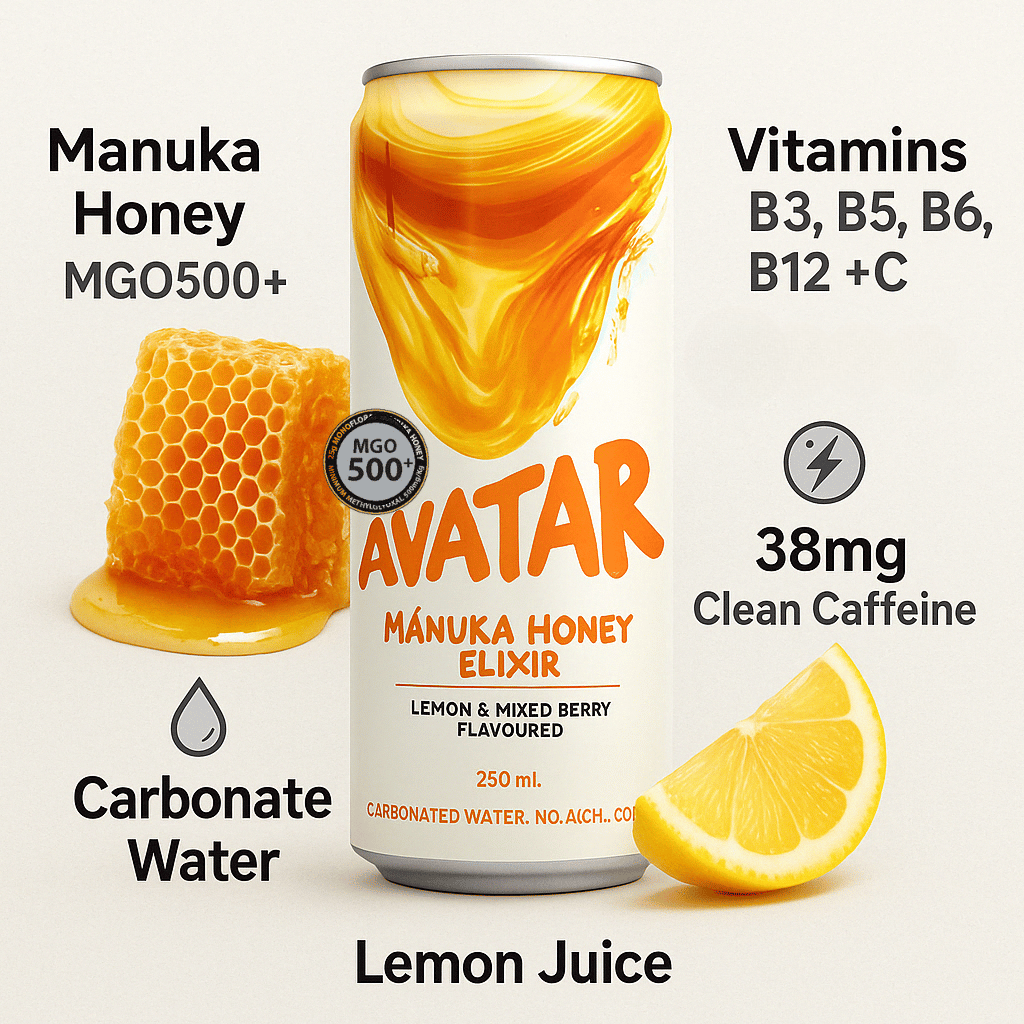
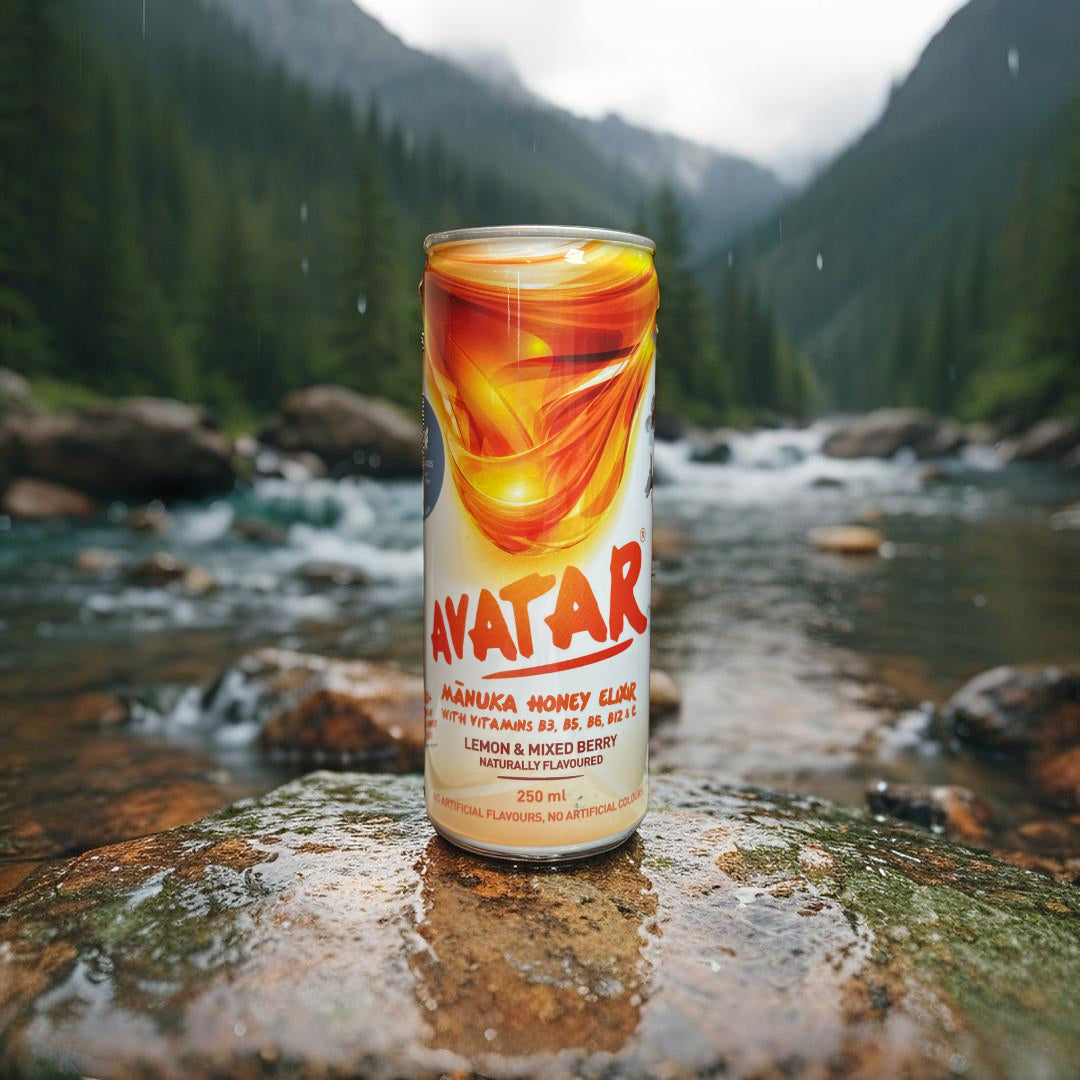
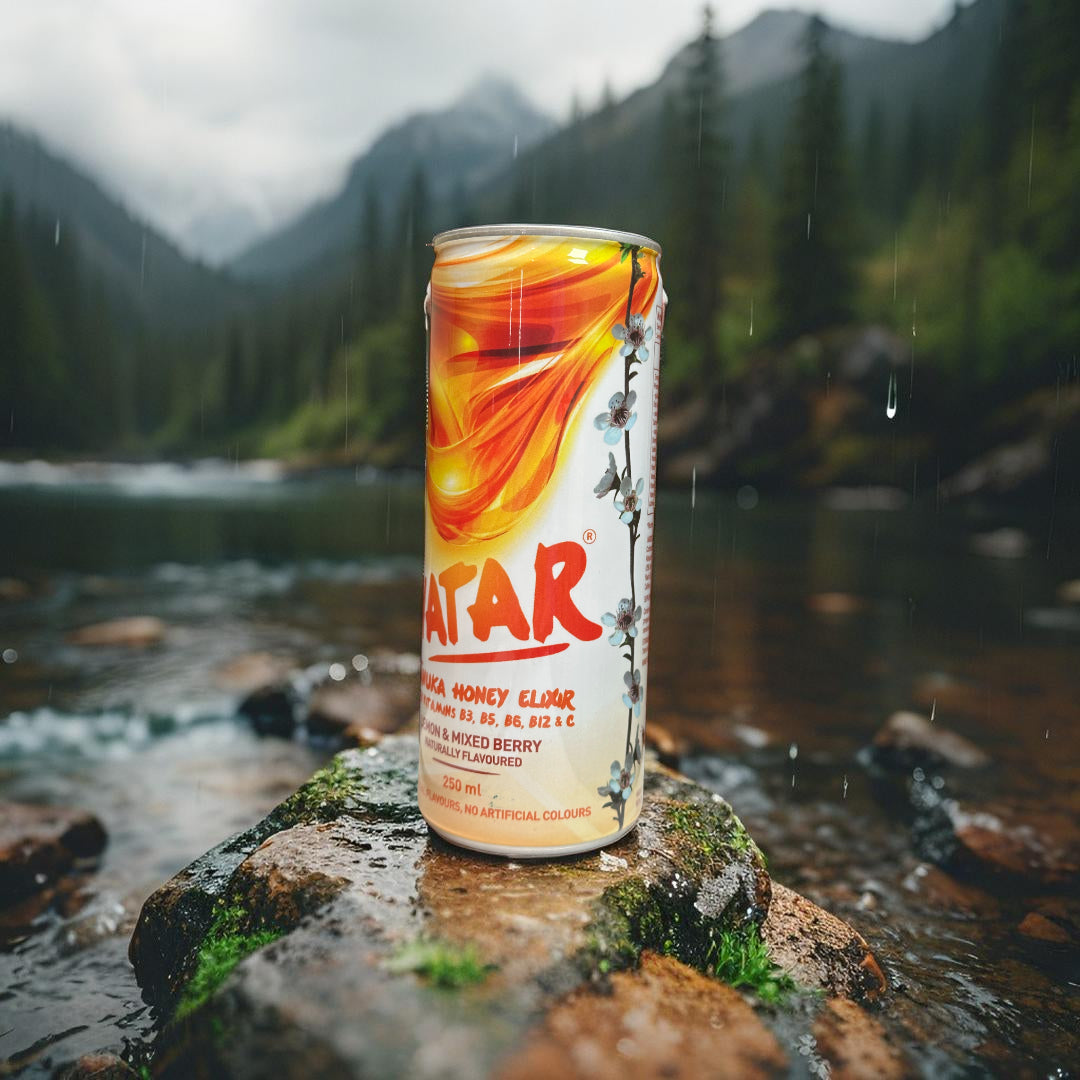
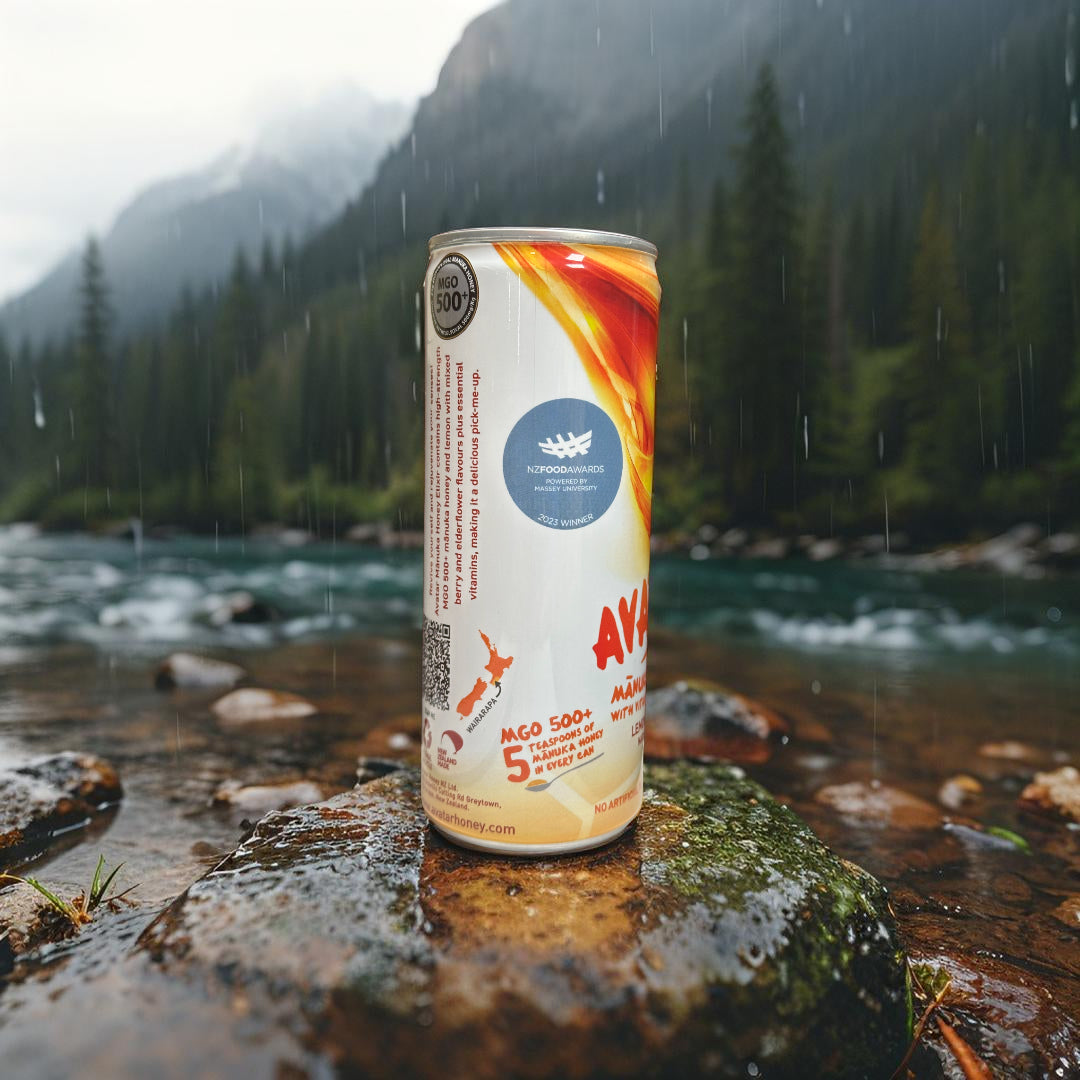
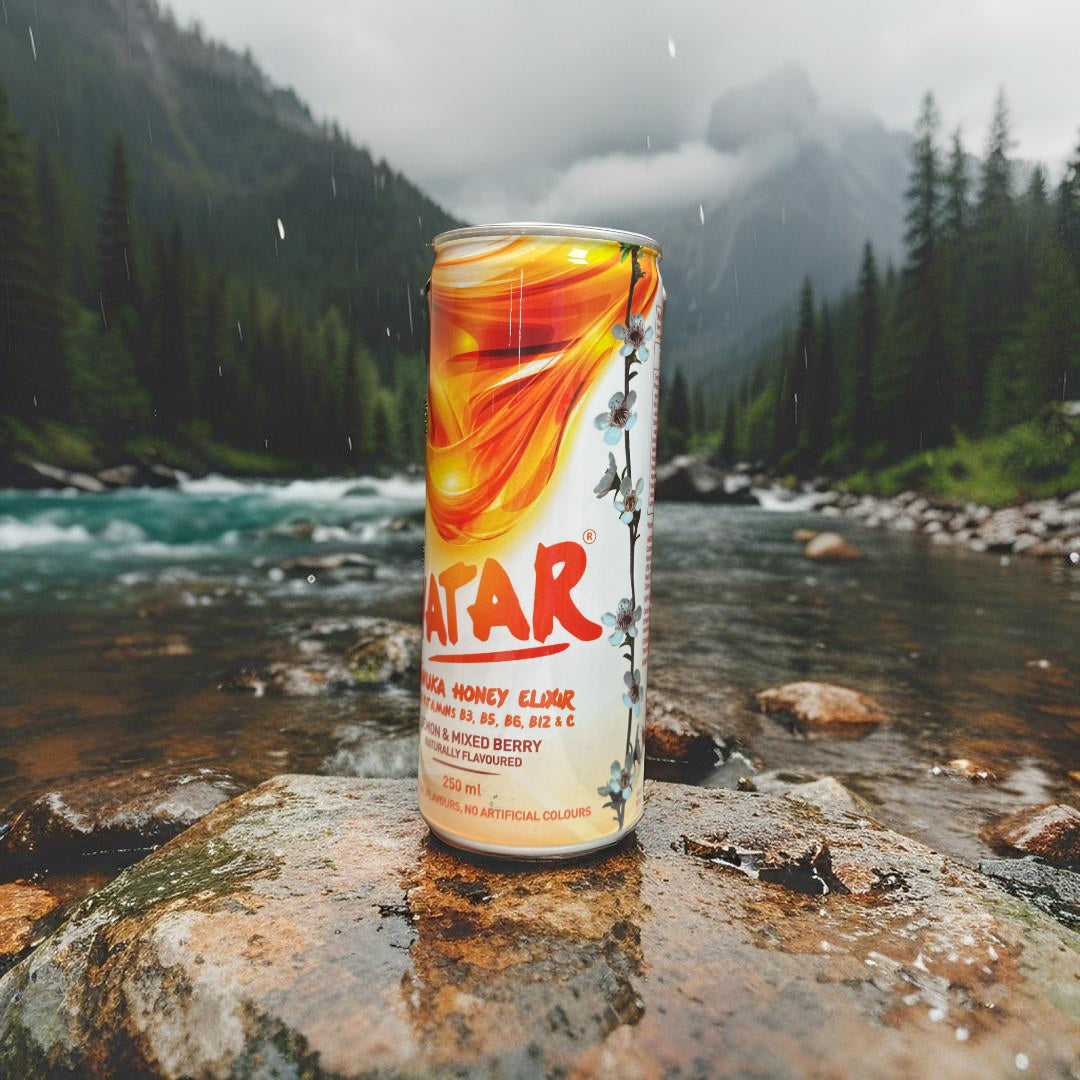
Avatar Elixir offers a practical example of this formulation approach. It is made with certified MGO500+ Manuka honey, lemon, elderflower, B vitamins, vitamin C, clean caffeine, and lightly carbonated water. In that combination, the honey sits within a citrus and floral flavour structure rather than functioning as a stand-alone spoonful of honey in water.
How does honey affect the mouthfeel of a functional drink?
Honey can give a beverage a slightly rounder and more integrated mouthfeel than very lean sweetener systems, although the effect depends heavily on how much is used. It can soften the transition between acidity, bitterness, botanical notes, and carbonation without necessarily making the drink thick.
Mouthfeel is the physical impression a drink creates in the mouth. It includes body, smoothness, carbonation, sweetness, dryness, and the length of the finish. A lightly carbonated honey beverage may feel soft at first, lively through the middle, and cleaner at the finish if the acidity is well balanced.
Honey should not automatically make a canned beverage syrupy. Water content, serving temperature, carbonation, acids, and the overall concentration of sweet ingredients all influence texture. A chilled, sparkling formulation can present honey in a relatively crisp way, while a still drink with more honey may feel fuller and richer.
This is one reason the ingredient list cannot tell the entire sensory story. Two beverages can both contain Manuka honey but taste very different because one uses it as a subtle background note and the other builds the recipe around a pronounced honey character.
Why does New Zealand provenance matter for Manuka honey?
New Zealand provenance matters because Manuka honey is connected to the mānuka plant, local landscapes, seasonal flowering, and beekeeping practices. For a drink producer, knowing the honey’s origin can provide a clearer relationship between the ingredient on the label and the people who produced it.
Honey is an agricultural ingredient, so it is shaped by place. Hive location, surrounding forage, weather, harvest timing, and handling can all influence a batch. Provenance does not mean every jar will taste identical. Instead, it provides context for why the ingredient has a particular identity and why traceable sourcing matters.
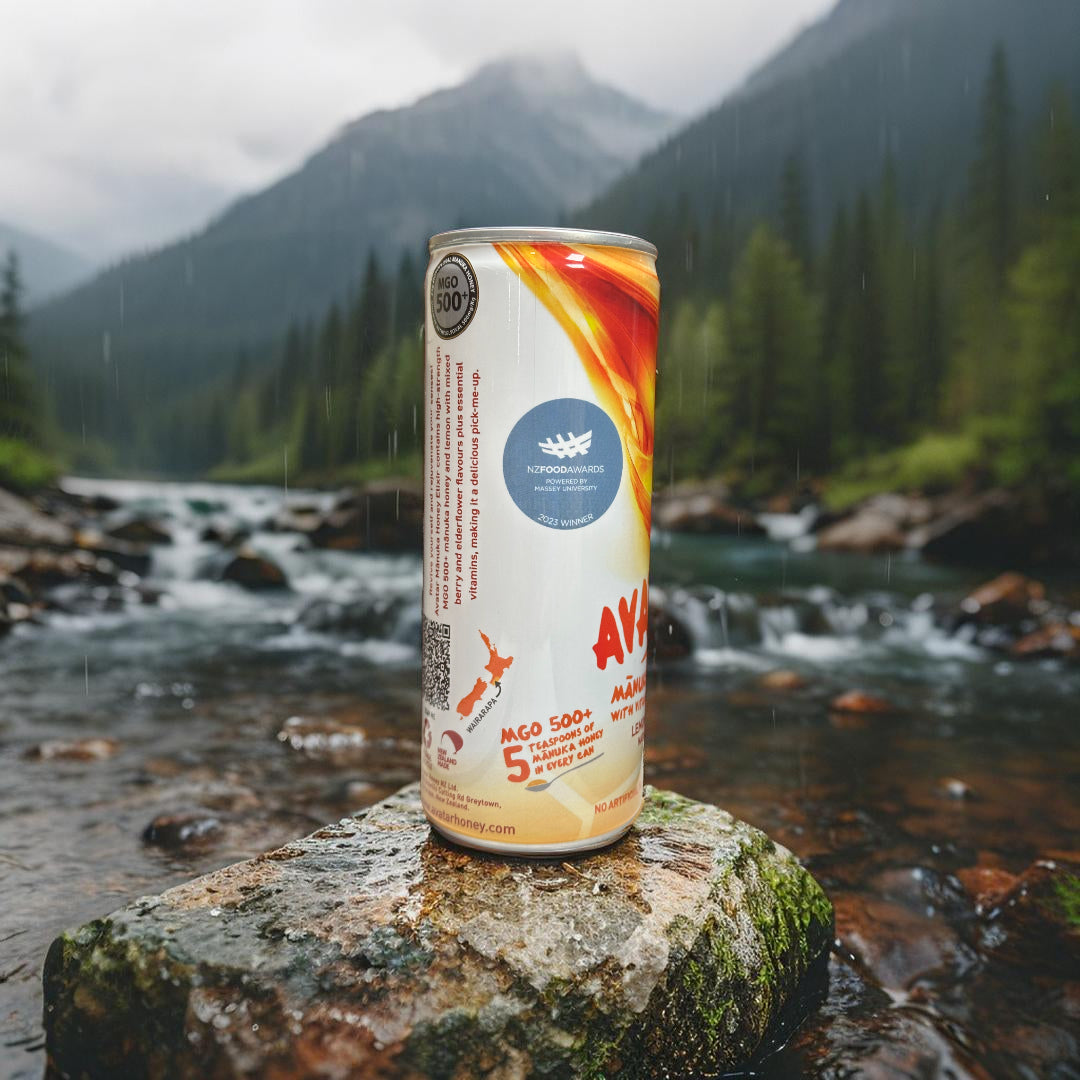
Avatar Elixir is created by Avatar Honey, a New Zealand beekeeping company with direct experience in Manuka honey. That background is relevant because formulating with honey requires an understanding of both its grade and its sensory character. A beekeeper-led perspective naturally pays attention to how the honey tastes, how it works with other ingredients, and how its origin is communicated.
When assessing another Manuka honey beverage, look for clear answers to practical questions:
- Does the label identify the honey specifically as Manuka honey?
- Is an MGO grade stated clearly?
- Does the producer explain where the honey comes from?
- Is the MGO claim clearly attached to the honey ingredient rather than the entire drink?
- Do the other ingredients support a coherent flavour profile?
Clear sourcing language is more useful than broad descriptions such as “premium” or “natural” on their own. Those words may express positioning, but they do not replace details about origin, grading, or formulation.
Is Manuka honey automatically a better sweetener for a functional beverage?
No. Manuka honey is a more distinctive and traceable ingredient than many ordinary sweeteners, but whether it is a better choice depends on what the drink is designed to taste like and what the consumer wants.
A neutral sweetener can be appropriate when a drink maker wants fruit, tea, or botanical flavours to dominate. Manuka honey is better suited to a recipe that has room for honey’s own aroma and depth. Its value is reduced if the formulation masks it completely or uses its name without giving the ingredient a meaningful sensory role.
Manuka honey also remains a source of sugars. A named botanical origin and MGO grade do not remove the need to read the nutrition information. People comparing functional beverages should consider the entire product, including serving size, sugar, caffeine, flavour, and the role the drink will have in their routine.
In practical terms, the strongest reason to choose a Manuka honey drink is not that honey makes every beverage universally better. It is that the ingredient can offer a combination of origin, grading, flavour, and texture that plain sugar or a neutral syrup does not provide.
How can you tell whether Manuka honey meaningfully contributes to a drink?
Look at the complete label and taste experience rather than relying on the word “Manuka” alone. A meaningful use of Manuka honey should make sense alongside the beverage’s sourcing information, ingredient list, flavour description, and overall balance.
- Check the exact wording. “Made with MGO500+ Manuka honey” identifies the grade of the honey used. Avoid assuming that this is the MGO concentration of the finished beverage.
- Read the full ingredient list. Note whether other sugars or sweeteners are present and how the honey fits into the broader recipe.
- Review the nutrition panel. This provides more useful information about the finished drink’s sugar content than the MGO number does.
- Consider the flavour partners. Citrus, floral botanicals, gentle bitterness, and light carbonation can all reveal different sides of Manuka honey.
- Look for sourcing detail. Specific information about New Zealand origin and beekeeping background is more informative than vague quality language.
- Judge the finish. A thoughtful formulation should taste balanced, with the honey contributing character rather than leaving only undifferentiated sweetness.
What is the key difference Manuka honey makes in the finished beverage?
The key difference is character. Manuka honey can connect a functional drink to a particular botanical source and New Zealand provenance while adding rounded sweetness, aromatic depth, and texture.
Its MGO grade provides information about the honey ingredient, but it should be interpreted accurately and without treating it as a health promise. The finished drink still needs to be judged as a complete food and beverage product, including its taste, sugar, caffeine, carbonation, ingredient balance, and suitability for the occasion.
For adults choosing between standard sweetened energy drinks, flavoured sparkling waters, and more ingredient-led functional beverages, that distinction can be useful. Manuka honey does not merely answer the question, “How is this drink sweetened?” It can also answer, “Where does this flavour come from, and what gives this drink its particular character?”
These follow-up points help you compare Manuka honey drinks and understand how the ingredient may appear in the finished flavour.
Can you taste Manuka honey in every drink that lists it?
Not necessarily. How noticeable Manuka honey tastes depends on the amount used and the balance of citrus, botanicals, acidity, carbonation, and other sweeteners. In some drinks it provides a subtle roundness, while in others its floral, herbal, caramel-like, or earthy character is more prominent.
Which flavours pair well with Manuka honey in a functional drink?
Citrus, floral botanicals, gentle bitterness, and light carbonation can complement Manuka honey. Lemon can brighten its richer notes, elderflower can reinforce its floral side, and carbonation can lift aromas while keeping the finish crisp. Avatar Elixir combines these elements with certified MGO500+ Manuka honey.
How should I compare two drinks made with MGO500+ Manuka honey?
Compare the complete products, not only the MGO grade. Check whether the label states how much honey is used, review the ingredient list and nutrition panel, consider the caffeine level, and look for specific New Zealand sourcing information. The same honey grade can produce very different drinks because formulation, sweetness, acidity, and carbonation also shape the result.