



Headline finding: Cooking with an energy drink does not reliably remove its caffeine. Heating can evaporate water without removing caffeine in the same proportion, so a reduction may concentrate the caffeine that remains. A cooked sauce, glaze or dessert should not be assumed caffeine-free, and its residual caffeine cannot be established without recipe-specific testing.
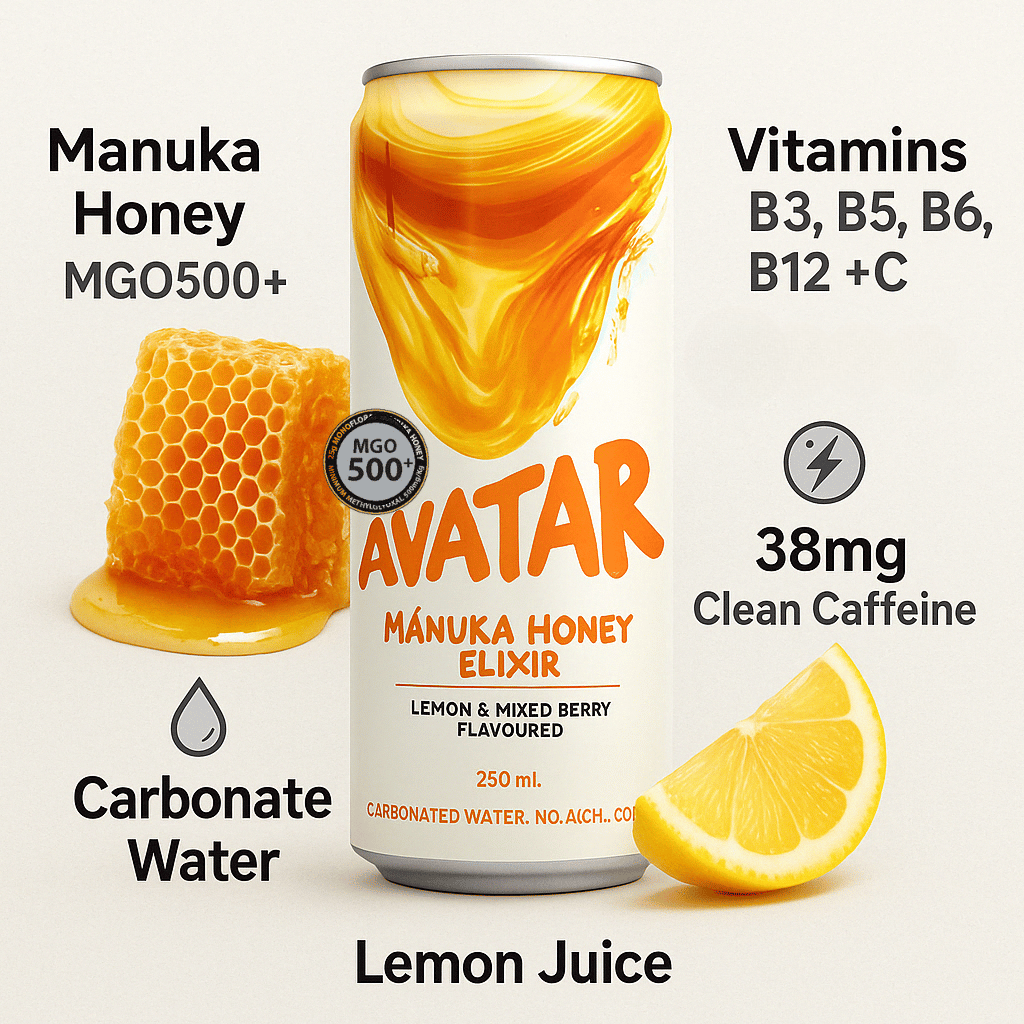
A drink’s flavour can make it seem like an appealing ingredient rather than simply something to sip. The Mānuka honey, lemon and elderflower in our Avatar Elixir, for example, might prompt questions about glazes or desserts. That flavour connection is not a tested cooking recommendation. It raises a separate question: what happens to the caffeine when a caffeinated drink becomes part of food?
The useful distinction is between changing a mixture and removing one of its ingredients. A sauce becoming thicker, a drink losing its fizz, or a dessert finishing its time in the oven does not establish that caffeine has disappeared.
Water evaporating is not evidence that caffeine has gone
Visible steam tells you that water is leaving a mixture, not that the mixture is being decaffeinated. Caffeine is a dissolved component of an energy drink. There is no sound basis for assuming that it leaves alongside evaporating water in an equal proportion.
During simmering, a liquid can lose volume and become thicker as water evaporates. The ingredients left behind then occupy a smaller amount of liquid. This explains why a reduction can become more concentrated without establishing exactly what happens to every individual compound.
Three different changes are easy to confuse:
- Evaporation: water leaves the mixture as vapour.
- Concentration: the amount of an ingredient relative to the mixture’s volume or mass changes.
- Caffeine removal or breakdown: caffeine itself is taken out or chemically changed.
The first change does not prove the third. Bubbling, thickening and a smaller amount in the pan are therefore not useful tests for whether a sauce still contains caffeine.
This does not mean caffeine is indestructible or that heating can never affect it. It means ordinary cooking observations cannot establish its removal. For someone deciding whether a dish is suitable for a guest avoiding caffeine, that distinction matters more than how dramatically the liquid has reduced.
Food-chemistry research supports persistence, not a kitchen removal rule
Controlled food-model research shows that caffeine can persist through heating. The relevant evidence supports caution about “cooking it off”, but it does not provide a retention figure for an energy-drink glaze.
A study published in European Food Research and Technology, titled Stability of hydroxycinnamic acids and caffeine from green coffee extracts after heating in food model systems, examined heated green-coffee extract in systems containing food components including starch, sugar, protein and oil. Caffeine losses were limited rather than complete.
That finding is useful because the caffeine was studied alongside food components, rather than only as an isolated substance. However, the experiment did not test Avatar Elixir, an energy-drink sauce or a finished home-baked dessert. Its controlled mixtures cannot stand in for every combination of ingredients, moisture and cooking conditions.
The defensible conclusion is narrow but practical: heating a caffeinated ingredient is not a dependable decaffeination step. The study does not justify either extreme claim, that all caffeine always survives cooking or that enough heating will reliably eliminate it in a kitchen.
For readers considering a caffeinated drink in food, this evidence changes the assumption that should guide the decision. The ingredient should still be treated as a source of caffeine, rather than presumed caffeine-free because it has been cooked.
An oven setting cannot tell you the caffeine left in a dessert
A cooking temperature and time are not, by themselves, a measurement of residual caffeine. An oven setting describes the cooking environment, not the temperature reached uniformly throughout a moist dessert.
A cake’s surface, centre and wetter areas can experience different conditions. The food-model researchers explicitly distinguished their stirred, uniformly heated systems from actual baked foods. That limitation prevents a direct translation from a laboratory heating result to a tray of desserts.
Pure-caffeine thermal experiments have a different limitation. Hitachi’s Thermal Analysis of Caffeine examined small samples under controlled heating and nitrogen flow. Those conditions are not equivalent to caffeine dissolved in a drink and mixed with other ingredients.
A laboratory temperature associated with sublimation, melting or sample mass loss is therefore not a kitchen instruction for removing caffeine. A single temperature taken out of that experimental context cannot establish that a sauce or baked food will become caffeine-free.
This is why “it was baked, not just warmed” does not settle the question. Different forms of cooking change food differently, but neither an oven setting nor a longer cooking time provides the missing measurement.
Reduction and dilution change concentration in opposite directions
Reducing a caffeinated mixture and diluting it are different processes, but neither establishes that it is caffeine-free. The distinction becomes clearer when total caffeine and caffeine concentration are kept separate.
Total caffeine means the amount present across the whole mixture. Concentration means how much caffeine is present relative to an amount of that mixture. OpenStax’s Chemistry 2e explains the underlying dilution principle: adding solvent lowers concentration without changing the amount of dissolved solute.
The following qualitative diagram illustrates the difference. It is not a measurement or a prediction of a particular recipe’s caffeine retention.
Starting caffeinated mixture
- Water evaporates → less liquid → remaining caffeine may be more concentrated.
- Caffeine-free liquid is added → more liquid → existing caffeine is more dilute.
Neither route establishes a caffeine-free mixture.
The dilution branch assumes mixing alone, without spills or other losses. Adding a caffeine-free liquid distributes the existing caffeine through a larger mixture; it does not remove it. The reduction branch is deliberately more cautious: water loss can concentrate the caffeine that remains, without proving how much caffeine survived heating.
The amount served also matters. A smaller portion of a more concentrated sauce and a larger portion of a diluted sauce cannot be compared from thickness or appearance alone. “Diluted” describes concentration, not an assurance that a serving meets someone’s caffeine preference.
A can label does not establish caffeine per cooked serving
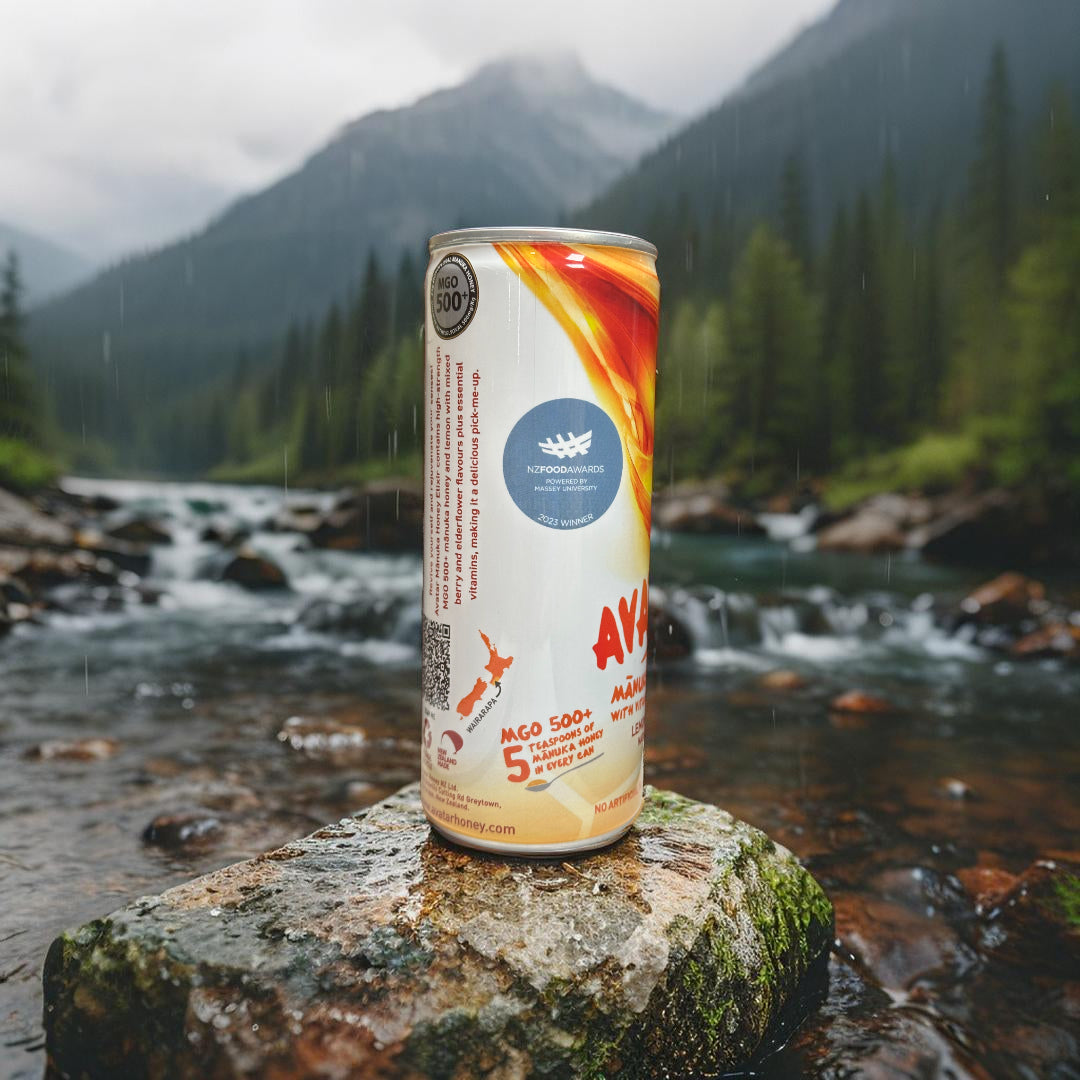
The drink’s label can describe the starting ingredient, but it does not measure the finished food. Even when the starting caffeine quantity is known, dividing it by the planned number of portions does not establish the caffeine actually present in each cooked serving.
Such a calculation would depend on assumptions about caffeine retention, even mixing, mixture left in the pan and the amount served. A glaze brushed unevenly across food is especially different from a uniformly portioned liquid. Those variables are separate from whether heating changes caffeine itself.
No recipe-specific caffeine measurements are available here for Avatar Elixir in a glaze, sauce or dessert. Neither the food-model study nor pure-caffeine thermal data fills that gap. Residual caffeine should therefore not be estimated from those sources or presented as a measured amount.
A simpler description can be more accurate than an unsupported number: the dish was made with a caffeinated drink, and its caffeine content after cooking has not been measured. That communicates what is known without implying either complete removal or an exact retained amount.
Ingredient disclosure matters when guests avoid caffeine
Someone avoiding caffeine needs to know about the caffeinated ingredient, even when it is served as food. A dessert or savoury glaze may not make that ingredient obvious.
The US Food and Drug Administration’s consumer guidance, Spilling the Beans: How Much Caffeine Is Too Much?, notes that sensitivity to caffeine varies and that caffeine occurs in foods as well as drinks. This supports clear ingredient disclosure rather than reassurance based on cooking method.
A description such as “made with a caffeinated energy drink” gives guests relevant information. Calling the dish caffeine-free because it was simmered, or suitable for caffeine-sensitive guests because the drink was diluted, would go beyond what those processes establish. Keeping the original packaging available can also help answer questions about the starting ingredient, although it cannot provide a tested value for the finished dish.
When caffeine must be avoided, the appropriate starting point is a verified caffeine-free ingredient, with the other ingredients considered too. “Decaffeinated” is not interchangeable with “caffeine-free”: the FDA notes that decaffeinated coffee and tea still contain caffeine.
The useful choice is therefore not how long to cook a caffeinated drink, but whether a caffeinated ingredient belongs in that dish at all. Cooking can change texture, volume and concentration. It should not be relied on to turn an energy drink into a caffeine-free ingredient.
These follow-up points clarify ingredient choices, serving options and the evidence needed for caffeine claims about cooked food.
Does a natural caffeine label change the cooking advice?
A natural caffeine label does not establish that cooking will remove the caffeine. It describes the starting ingredient, not its behaviour in a particular sauce or dessert. The same evidence boundary applies: a label claim is not a measurement of caffeine remaining after heating.
Would a caffeine-free substitute work exactly like the original drink?
A verified caffeine-free substitute addresses the caffeine requirement, but it does not establish an equivalent cooking result. Flavour, texture and reduction behaviour are separate questions. Our Avatar Elixir's honey, lemon and elderflower explain its flavour appeal, but no tested cooking comparison supports promising that another drink would behave identically.
Would serving a caffeinated sauce separately help guests choose?
Serving a caffeinated sauce separately can give guests a clearer choice about whether to add it. The sauce still needs clear ingredient disclosure, and the food served without it must be considered separately for other caffeine sources. Separate serving does not establish the sauce's caffeine content or suitability for someone sensitive to caffeine.
Would testing one recipe establish caffeine content in another?
A caffeine measurement from one recipe would not, by itself, establish the amount in another. Different ingredients, cooking conditions, final quantities and serving sizes limit that comparison. Evidence supporting a finished-food caffeine claim needs to apply to the actual preparation and portion being described, rather than a similar dish or a laboratory model.