


Headline finding: The MGO rating of Manuka honey largely reflects methylglyoxal that develops from dihydroxyacetone naturally present in Manuka nectar. This chemical change continues as honey matures after collection, so laboratory testing measures the honey at a defined point rather than simply identifying a fixed substance added by the flower.
MGO numbers are widely used to describe Manuka honey, but the number alone does not explain where methylglyoxal comes from. The key process begins with Manuka nectar and continues during honey formation, maturation, extraction, and storage.
At an accessible chemistry level, the relationship can be summarised like this: Manuka nectar contains a precursor called dihydroxyacetone, commonly shortened to DHA. Over time, some of that DHA is transformed into methylglyoxal, or MGO, within the concentrated chemical environment of honey.
This makes MGO a measured compositional marker. It is not caffeine, a sweetness scale, a serving instruction, or automatic evidence that a finished food or beverage will produce a particular health effect.
Manuka nectar provides a precursor rather than a finished rating
The central pattern is that Manuka flowers supply nectar containing DHA, while the familiar MGO rating emerges through changes that occur in the honey.
DHA is a small carbohydrate-related compound. MGO is a different compound belonging to a chemical group known as reactive carbonyl compounds. Although the two are related in the development of Manuka honey, they should not be treated as interchangeable names for the same material.
Bees collect nectar from Manuka flowers and carry it back to the hive. During honey production, the nectar becomes more concentrated as water is removed. Bees also introduce enzymes and repeatedly handle and store the nectar within the hive. These processes transform watery floral nectar into honey, but they do not instantly establish a permanent MGO level.
The amount of DHA entering the hive can vary. Floral source, season, growing conditions, nectar composition, and the mixture of nectar collected by bees may all influence the starting material. This is one reason a general statement such as “made from Manuka” cannot, by itself, establish a specific MGO rating.
In practical terms, the flower contributes important chemical potential. The measured MGO level develops within the honey matrix and must be determined from the resulting honey.
Takeaway: Manuka nectar contains DHA that can act as a precursor to MGO. The flower does not provide a ready-made MGO rating that remains unchanged from nectar collection onward.
The sequence from Manuka flower to measured MGO
MGO development is best understood as a staged process rather than a single event that happens when honey leaves the hive.
- Manuka flowering: Manuka flowers produce nectar containing sugars, water, aromatic compounds, and varying amounts of DHA.
- Nectar collection: Bees collect the nectar. A hive may receive nectar from multiple flowers and locations, so the floral composition of the resulting honey depends on actual foraging patterns.
- Honey formation: Bees process and concentrate the nectar. Moisture falls, sugars become highly concentrated, and the material develops the physical and chemical characteristics recognised as honey.
- Early maturation: DHA is present in the newly formed honey. Some MGO may already be present, but the eventual measured level is not necessarily established at this early stage.
- Post-harvest development: After extraction, chemical transformations can continue. Over time, a portion of the available DHA is converted into MGO.
- Sampling and testing: A representative honey sample is analysed to measure MGO concentration. The reported rating describes the tested honey at that point in its development.
This sequence is often simplified to “DHA becomes MGO.” That is useful as a basic explanation, but it should not be read as a perfectly direct or complete conversion. Honey is a chemically complex food containing sugars, water, acids, minerals, proteins, amino compounds, and many minor constituents. MGO can develop within this environment, and it can also participate in other reactions.
The process is therefore dynamic. DHA is not guaranteed to convert completely into MGO, and an MGO number cannot be calculated reliably from the name of the floral source alone.
Takeaway: The useful process model is Manuka nectar, DHA-containing honey, post-harvest maturation, laboratory sampling, and a measured MGO result.
Why MGO can continue developing after harvest
Honey remains chemically active after extraction, even though it is shelf-stable when appropriately handled. MGO development can continue because the precursor and the surrounding honey matrix remain present after the frames leave the hive.
The conversion of DHA into MGO is generally understood as a time-dependent chemical process rather than a reaction controlled by bees after extraction. Time and storage conditions can therefore influence what a later laboratory test records.
Temperature is an important consideration in many food reactions. Warmer conditions can accelerate chemical change, while cooler conditions may slow it. That does not mean heat is a simple or desirable way to create a higher grade. Heating honey can affect several characteristics at once, including aroma, colour, flavour, enzymes, and other indicators used to understand product condition.
Time also does not imply unlimited growth in MGO. As honey ages, precursor levels can decline, MGO can develop, and MGO itself can react with other components. The pattern is not necessarily a straight line in which every additional month produces a predictable increase.
Moisture, acidity, initial DHA concentration, handling, storage history, and the overall composition of a batch may also affect the chemical environment. Their relative importance cannot be determined from an MGO number alone.
What “after the hive” means in practice
The phrase does not suggest that MGO appears only after honey is extracted. Development may begin during honey formation and continue after harvest. The important distinction is that the final commercial rating is measured from honey that has already passed through biological and post-harvest stages.
This also explains why testing dates and batch identity matter when interpreting a result. A result belongs to the sample tested under a defined set of circumstances. It is not a permanent forecast of every future measurement from every container associated with a broad floral description.
Takeaway: Post-harvest maturation can contribute to MGO development, but the process depends on the honey and its history. It is neither instantaneous nor indefinitely linear.
What laboratory testing captures
An MGO test measures methylglyoxal in a honey sample. It does not measure the story, reputation, flavour, or intended use of the product.
MGO ratings are commonly expressed as a concentration by mass. In this context, a designation such as MGO500+ indicates that the tested honey meets or exceeds the stated MGO concentration threshold associated with that grading convention. The plus sign communicates a minimum threshold, not an exact promise that every measurement will equal the printed number precisely.
Laboratory analysis separates measurement from broad descriptive language. Terms such as “premium,” “active,” “potent,” or “high quality” can carry different meanings depending on who uses them. An MGO result has a narrower purpose: it quantifies a particular compound in a sample.
That precision should not be extended beyond what was measured. An MGO test does not automatically establish:
- how sweet the honey will taste;
- how strong its floral aroma will be;
- whether the honey contains caffeine;
- how a person will respond after consuming it;
- the MGO concentration of a beverage made with the honey;
- or the overall quality of every ingredient in a finished product.
A honey batch and a finished beverage are also different testing objects. If rated honey is used as one ingredient in a drink, the rating describes the honey input unless the beverage itself has been separately tested and labelled for MGO concentration. Water, juice, flavour ingredients, and serving size all change the composition of the finished drink.
Takeaway: Laboratory testing provides a defined measurement of MGO in a particular honey sample. It should not be expanded into claims about taste, caffeine, personal outcomes, or the composition of an untested finished beverage.
What an MGO number does and does not mean
The clearest interpretation is that an MGO number is a compositional marker used to distinguish Manuka honey grades. It is useful, but its meaning is narrower than some marketing language suggests.
MGO is not caffeine
Methylglyoxal and caffeine are unrelated compounds. MGO does not create the stimulant character associated with coffee or caffeinated energy drinks. If a honey beverage contains caffeine, that caffeine comes from a separately identified source, not from the MGO rating of the honey.
MGO is not a sweetness score
Honey tastes sweet mainly because of its sugars. MGO is measured for a different reason, and a higher rating does not establish that one honey will taste sweeter than another. Floral character, acidity, moisture, mineral notes, age, and processing can all shape sensory perception.
MGO is not a dosage instruction
A grade such as MGO500+ describes concentration in the honey. It does not tell a person how much honey to consume, and it should not be interpreted as medical or nutritional dosing advice.
A higher number does not settle every quality question
A higher MGO grade indicates a higher measured MGO threshold under the relevant grading convention. It does not automatically mean better flavour, a better beverage, more responsible sourcing, or a guaranteed wellness effect.
Product quality is broader than one marker. For honey, it may include floral character, freshness, handling, provenance, batch consistency, and suitability for the intended use. For a drink, the balance of sweetness, acidity, aroma, carbonation, caffeine, and other ingredients also matters.
MGO does not prove a beverage outcome
When Manuka honey is incorporated into a beverage, the honey contributes flavour and composition to a larger formula. The presence of rated honey does not, on its own, establish what the complete drink will do for energy, focus, health, or performance.
Takeaway: MGO is best interpreted as a specific honey measurement. It should not be used as a substitute for sensory evaluation, full ingredient information, beverage testing, or evidence for broader claims.
How MGO500+ Manuka honey fits into a formulated drink
A rated Manuka honey can provide a defined ingredient specification without turning the entire beverage into an MGO-graded product.
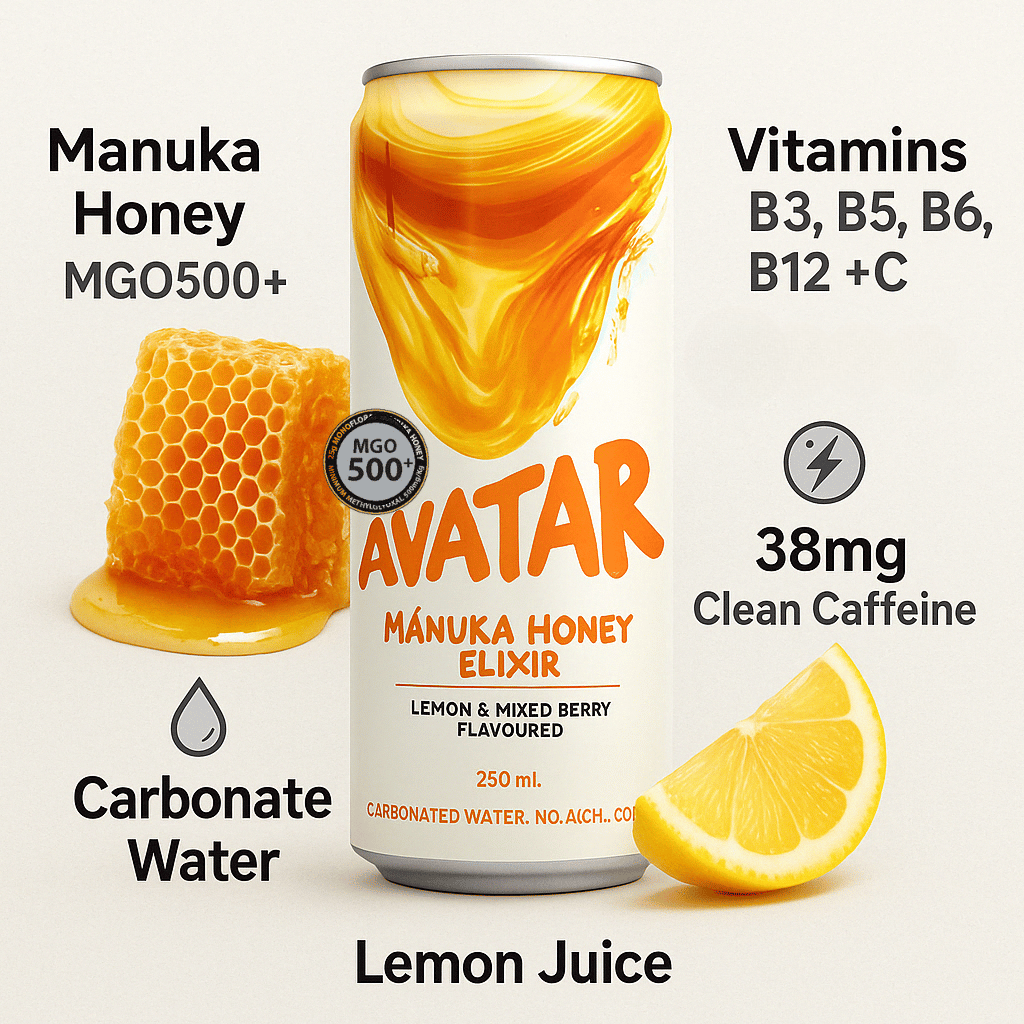
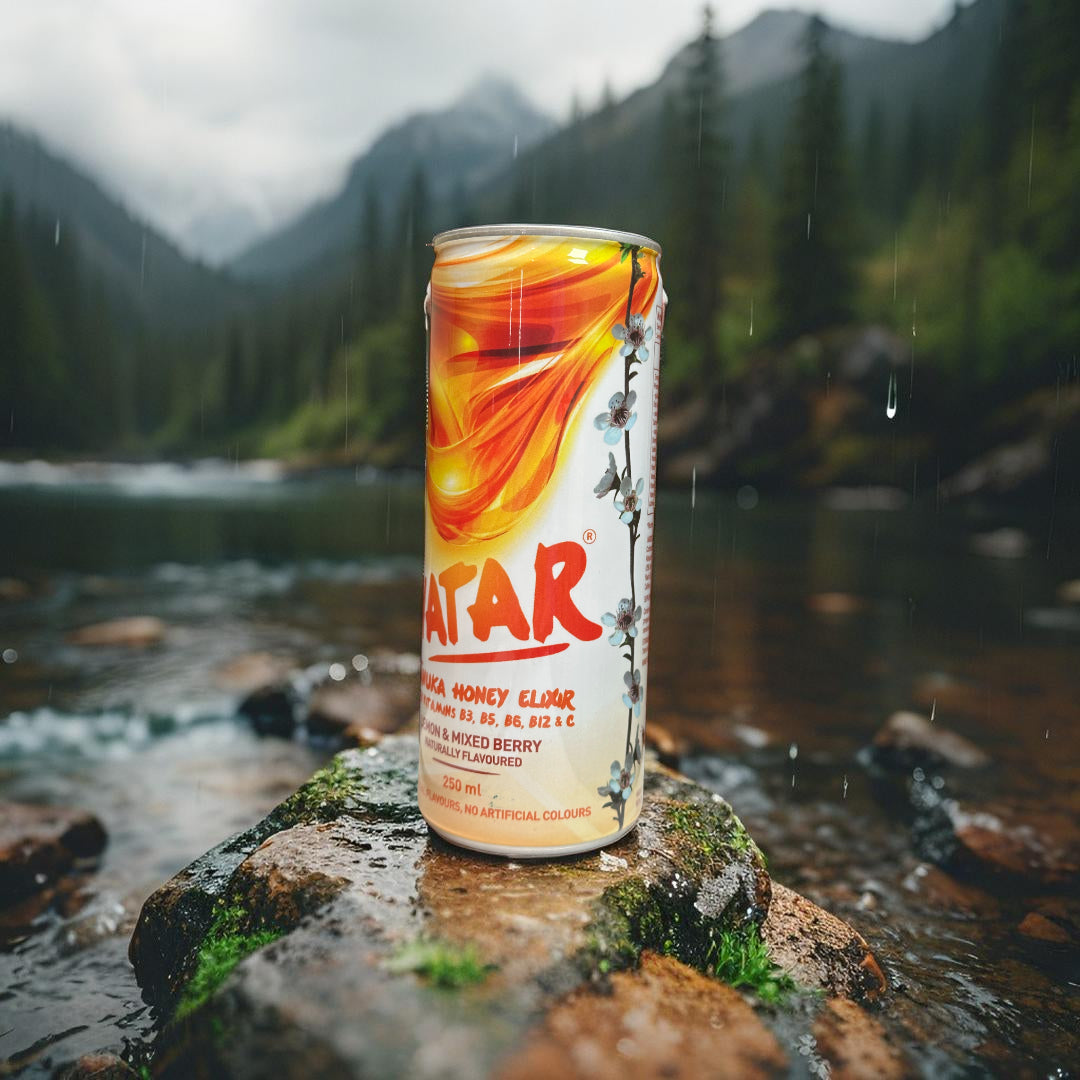
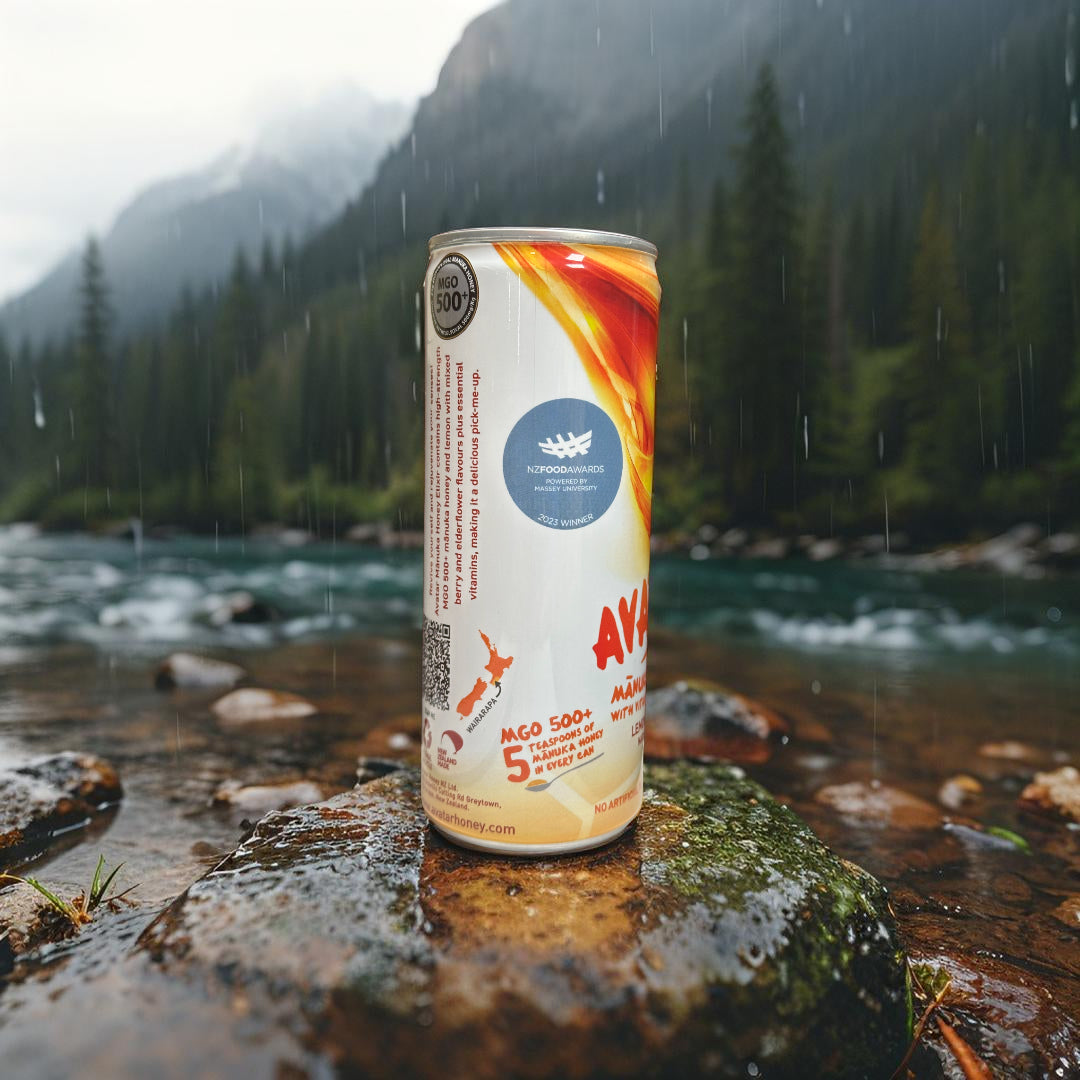
Avatar Elixir is made with certified MGO500+ Manuka honey from New Zealand, alongside lemon, elderflower, B vitamins, vitamin C, clean caffeine, and lightly carbonated water. In this context, MGO500+ describes the Manuka honey selected for the formulation. It does not mean that MGO supplies the caffeine or determines the drink’s sweetness, and it should not be read as a medical claim about the finished beverage.
This distinction helps keep ingredient communication precise. The rated honey has a measured marker associated with its Manuka origin and maturation. The finished drink has its own flavour and functional profile, shaped by the complete formulation.
Lemon contributes acidity and citrus brightness. Elderflower adds a light floral note. Carbonation changes texture and aroma release. Added caffeine accounts for the drink’s caffeinated character. The honey contributes sweetness, body, and distinctive flavour, while its MGO500+ description identifies the grade of Manuka honey used.
Understanding these separate roles prevents one prominent number from carrying more meaning than it can support. MGO500+ is relevant information about the honey ingredient, but it does not replace the rest of the product label or establish how every person will experience the drink.
Takeaway: In Avatar Elixir, certified MGO500+ identifies the grade of Manuka honey used. The finished beverage should still be understood through its complete ingredient list, flavour profile, caffeine content, and intended food-and-drink context.
The most accurate way to understand post-hive MGO development
MGO develops through chemistry that continues beyond nectar collection. Manuka flowers provide nectar containing DHA, bees transform that nectar into concentrated honey, and some DHA is subsequently converted into MGO as the honey matures. Laboratory testing then measures MGO in a specific sample at a particular stage.
This explanation is more precise than saying Manuka flowers simply “contain an MGO rating.” It also clarifies why a certified rating differs from an unsupported general claim about Manuka honey. The rating is tied to measurement, while broad language may only describe floral association, positioning, or an ingredient story.
The number remains only one part of the picture. It does not measure sweetness, caffeine, flavour quality, serving guidance, or guaranteed effects. Used within those limits, an MGO grade gives consumers a clear way to understand one defined characteristic of Manuka honey without asking the number to answer questions it was never designed to settle.
These follow-up points clarify how maturation, handling, and ingredient testing affect the interpretation of MGO results.
Does all DHA in Manuka honey eventually become MGO?
No. Some DHA can convert into MGO as Manuka honey matures, but the process is not a complete or perfectly direct conversion. Honey contains many interacting compounds, and MGO can also participate in other reactions. Initial DHA concentration, time, temperature, moisture, acidity, and batch composition may all influence the measured result.
Can heating Manuka honey create a higher MGO grade?
Heating is not a reliable or complete way to establish a higher MGO grade. Warmer conditions can accelerate chemical changes, but heat may also affect aroma, colour, flavour, enzymes, and other indicators of product condition. A grade still needs to be based on laboratory measurement of the honey rather than an assumption about its storage temperature.
Why can the timing of an MGO test matter?
The timing matters because Manuka honey can continue changing chemically after extraction. DHA may decline as some MGO develops, while MGO itself may react with other honey components. A test therefore records the concentration in a particular sample at a defined stage, rather than guaranteeing that every earlier or later measurement will be identical.
Does Avatar Elixir itself have an MGO500+ beverage rating?
MGO500+ describes the certified Manuka honey selected as an ingredient in Avatar Elixir, not the MGO concentration of the complete drink. The beverage also contains lemon, elderflower, B vitamins, vitamin C, clean caffeine, and lightly carbonated water. A finished beverage would require separate testing to establish its own MGO concentration.