


Quick read:
- Preservative-free claims no preservatives, while no artificial preservatives excludes only artificial ones. They are not interchangeable.
- No artificial ingredients describes ingredient character. It does not, by itself, establish that a drink is preservative-free.
- A can and a long shelf life do not reveal the preservation method. Compare the precise claim, ingredient functions, and actual package directions.
You are choosing canned drinks for the office fridge or a weekend away. One says “preservative-free”. Another says “no artificial preservatives”. A honey-based drink says “no artificial ingredients”. All sound appealing, but each answers a different buying question.
The useful distinction is not which phrase sounds cleanest. It is which one matches what you want to exclude. You can prefer particular ingredients without assuming that every unfamiliar ingredient is a preservative, or that a shelf-stable drink must contain one.
Compare the scope of the claim, not just its appeal
“Preservative-free” makes a broader exclusion about preservatives than “no artificial preservatives”. Meanwhile, “no artificial ingredients” covers a wider range of ingredients but does not necessarily exclude preservation ingredients of natural origin.
This table explains the ordinary buying meaning of each phrase. These are not three interchangeable FDA certifications.
| Phrase | What it communicates | What still needs checking |
|---|---|---|
| Preservative-free | A claim that the drink contains no preservatives, not merely no artificial ones. | The manufacturer’s support for the claim, ingredient functions, and separate processing and storage requirements. |
| No artificial preservatives | An exclusion limited to artificial preservatives. | Whether other ingredients serve preservation functions. It does not establish that every preservative is absent. |
| No artificial ingredients | A broader statement about the character of the ingredients. | The ingredients and their roles, plus any specific preservative claim. It does not identify the preservation process. |
If your priority is avoiding artificial preservatives, the second phrase directly addresses that preference. If you want to avoid preservatives altogether, it leaves a question unanswered. If your interest extends to artificial colours and flavours, a broader ingredient claim becomes relevant, but you still need to read what it actually covers.
A preservative is identified by its function, not how its name sounds
Preservatives can help control microbial spoilage, but that is not their only role. The FDA’s Types of Food Ingredients also describes antioxidant preservation, which can slow deterioration affecting flavour, colour, and other qualities.
That means an ingredient can serve a preservation purpose without the label simply saying “preservative”. Under U.S. regulation 21 CFR §101.22, added chemical preservatives generally must be declared by their common or usual name along with their function, subject to exemptions. Function wording can include “to help protect flavor” or “to promote color retention”. These are useful phrases to recognise when comparing U.S. ingredient panels.
Equally, an ingredient name alone does not prove its role. The FDA lists ascorbic acid in both preservative and nutrient categories, and citric acid in preservative and acidity-control categories. Those are possible uses, not a verdict on every drink containing them.
The practical question is: what is this ingredient doing in this formulation? If a strict preservative preference determines your purchase and the label leaves that unclear, ask the maker about the ingredient’s function rather than classifying it from its name.
“Chemical preservative” also has a specific U.S. regulatory meaning based on function, with explicit exclusions. It is not simply another way to say “artificial ingredient”.
A shelf-stable can does not tell you how the drink was preserved
Shelf stability is an outcome, not an ingredient disclosure. A drink’s formulation, processing, and packaging can work together to achieve it.
The Institute of Food Technologists’ Food Processing resource explains that preservation can involve processing, ingredient choices, or combinations of steps. It also describes canning and aseptic processing as approaches that can preserve food without added food additives. These are general examples, not evidence of the process used for any particular canned drink.
Keep these separate when shopping:
- Formulation: what ingredients are included and what they do.
- Processing: how the drink is treated during manufacture.
- Packaging: the container and closure used to protect the finished drink.
- Shelf-life information: how long the product is intended to keep under its stated conditions.
A can gives you visible information about the packaging. It cannot reveal whether preservatives were added, whether heat treatment was used, or which combination of steps made the drink shelf-stable.
Nor does “preservative-free” mean “unprocessed”. You cannot work backwards from either the container or the claim to identify the manufacturing method.
How to read Avatar Elixir’s ingredient claims
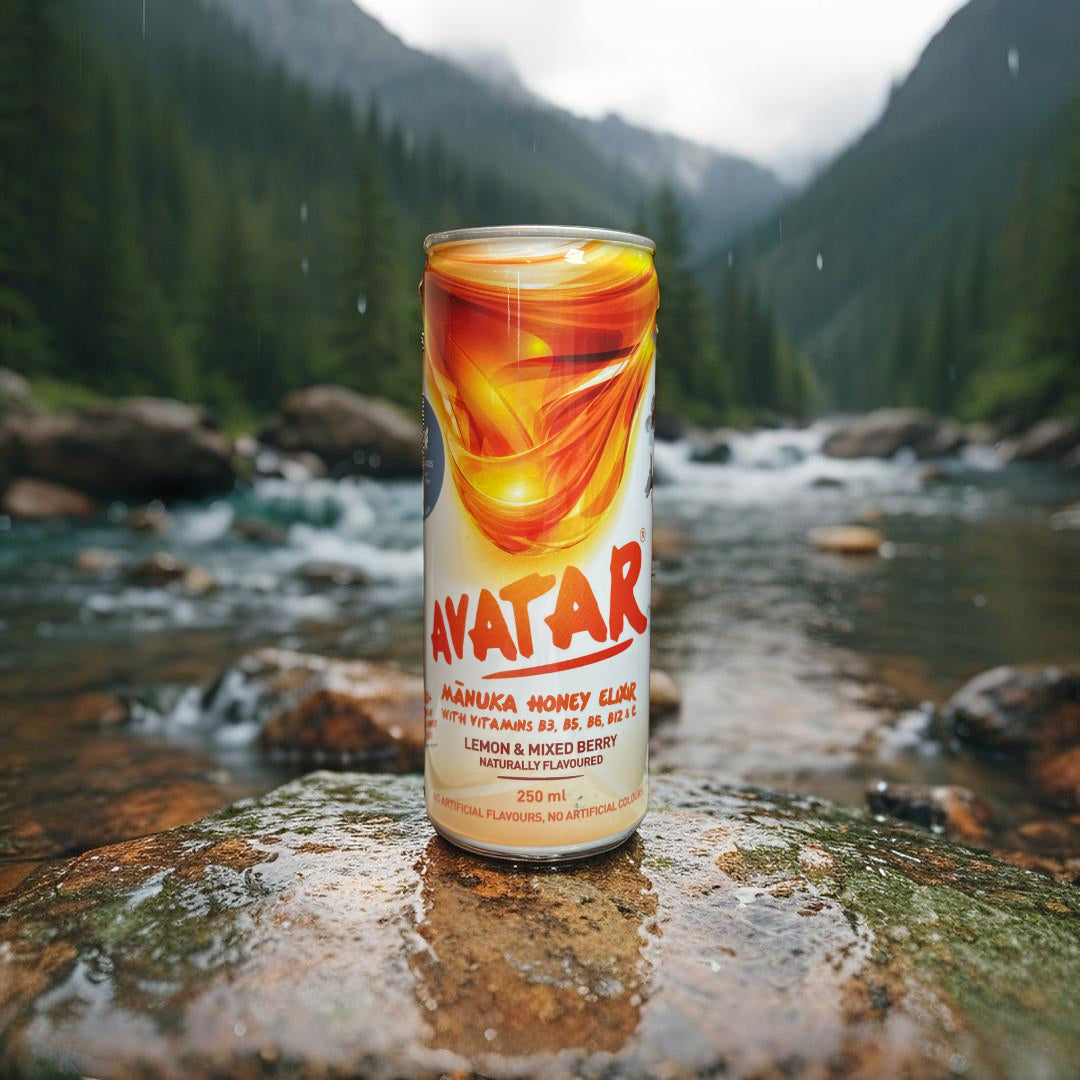
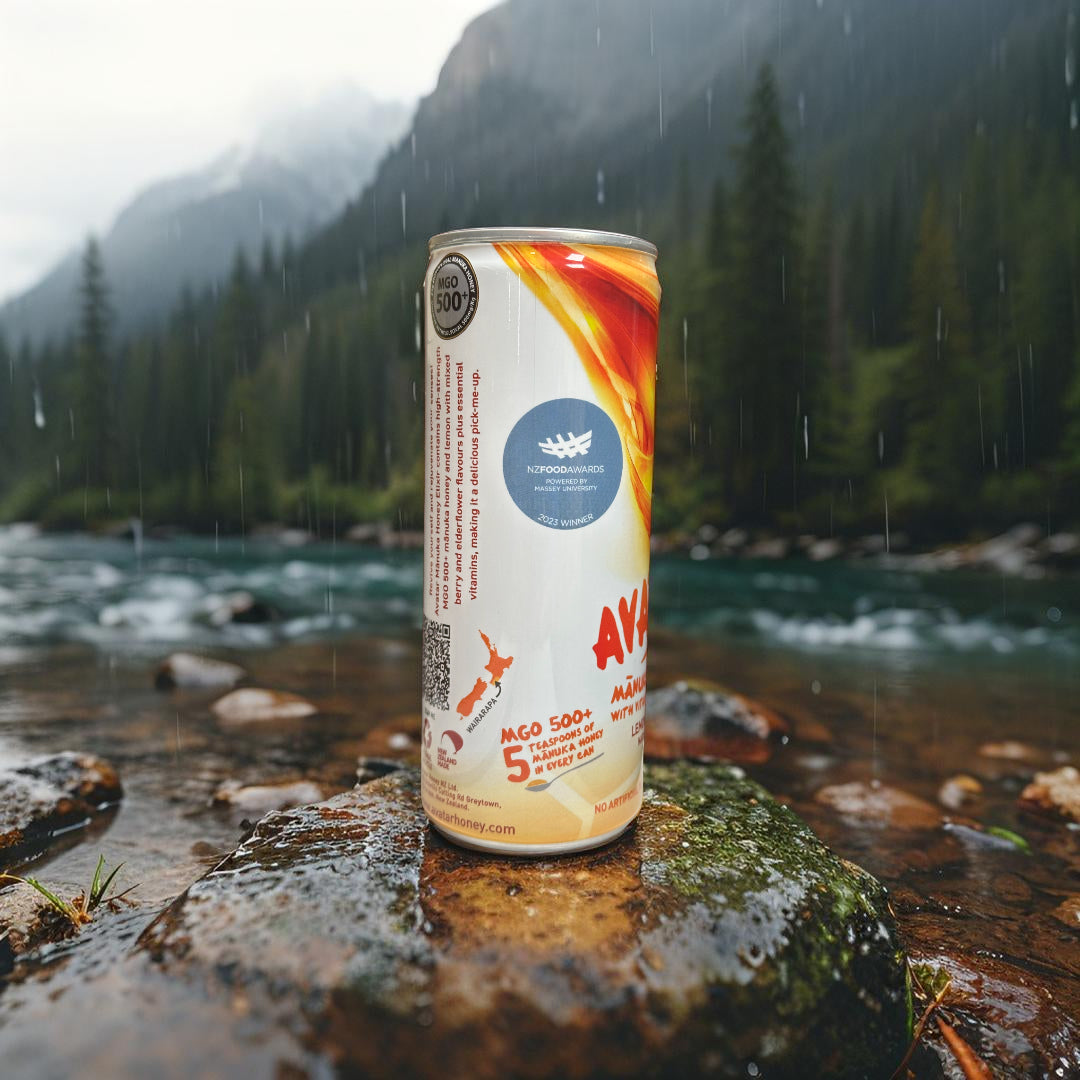
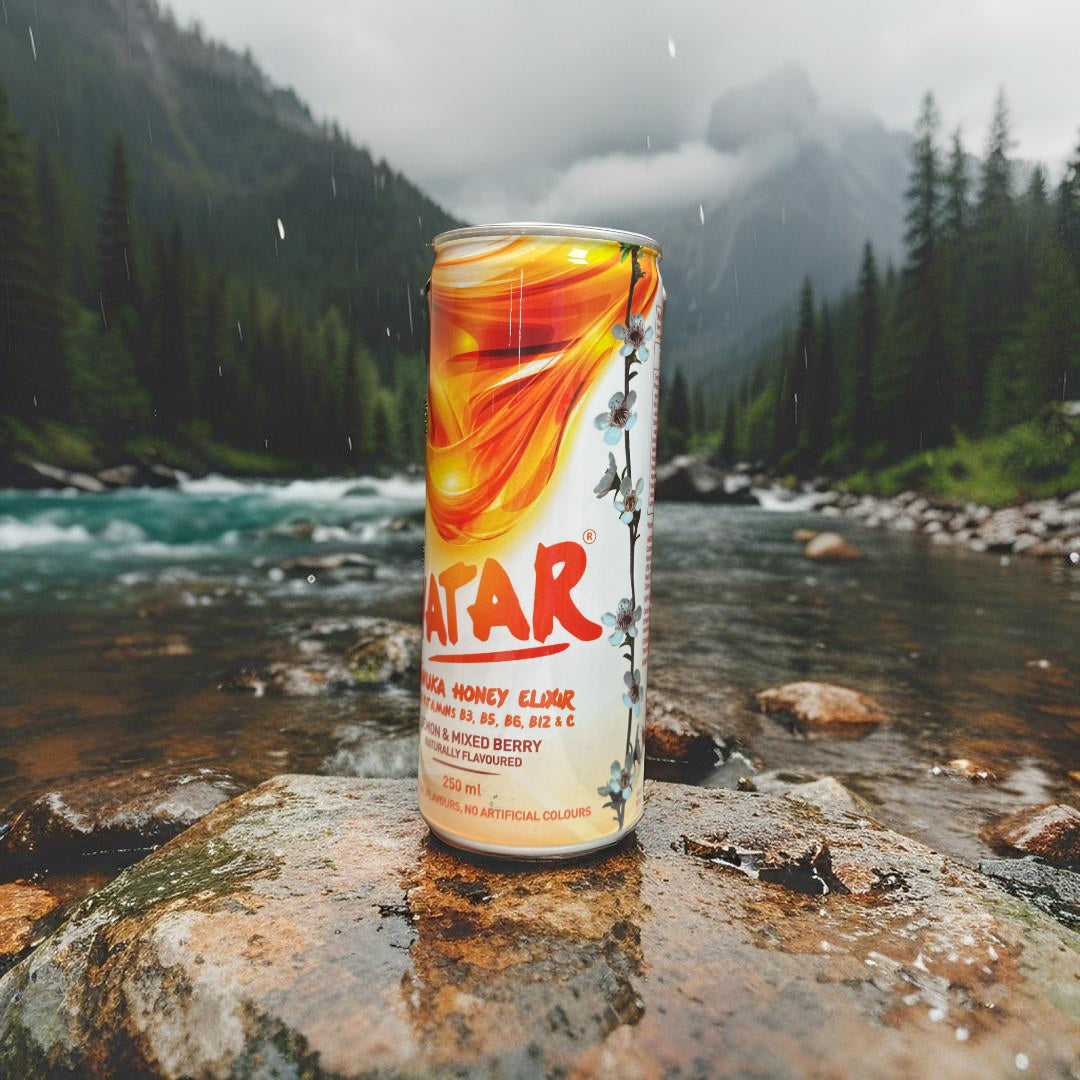
Our Avatar Elixir: Award Winning Clean Energy Powered By Manuka Honey provides a useful example. Its product page describes it as having “No artificial ingredients” and separately states “No Artificial Colours, Flavours, or Preservatives”.
Those statements address ingredient-conscious buying preferences. They should not be expanded into a verified claim that the drink is free of every preservative.
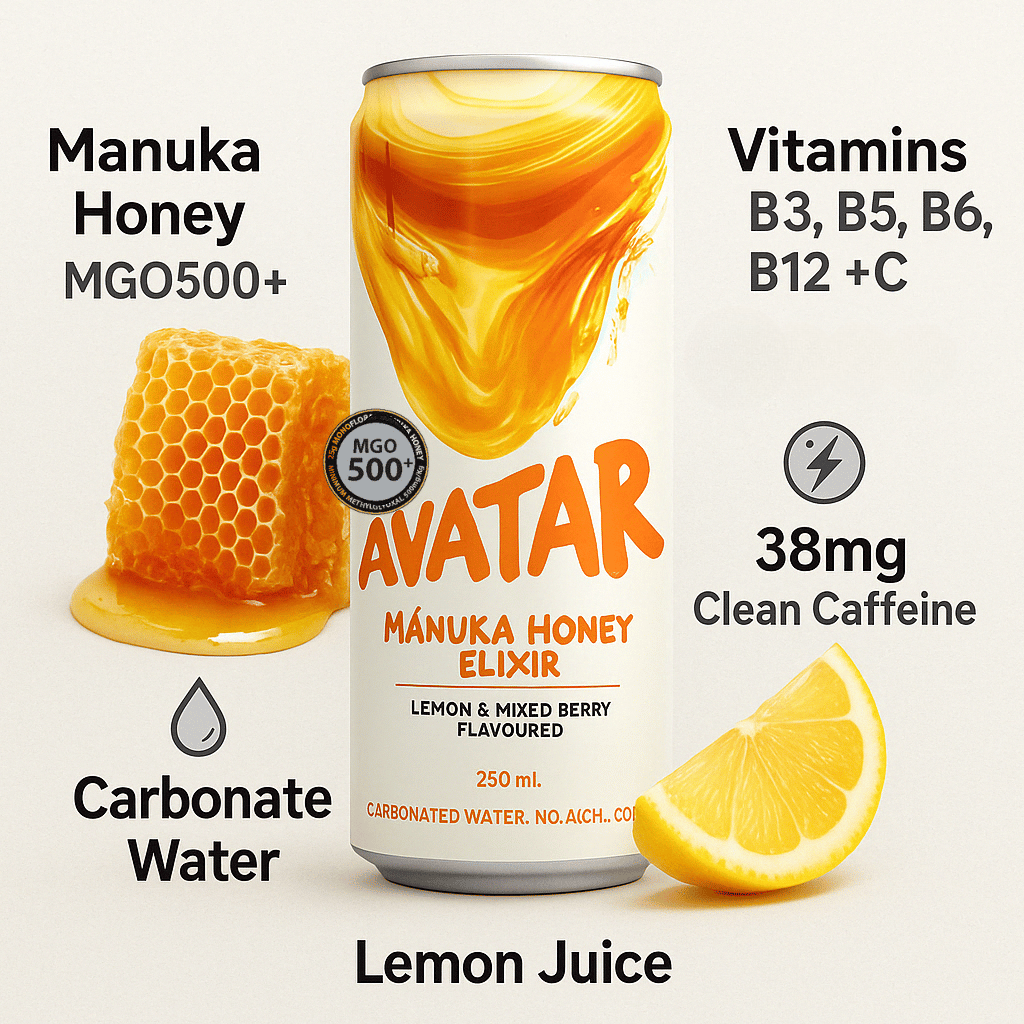
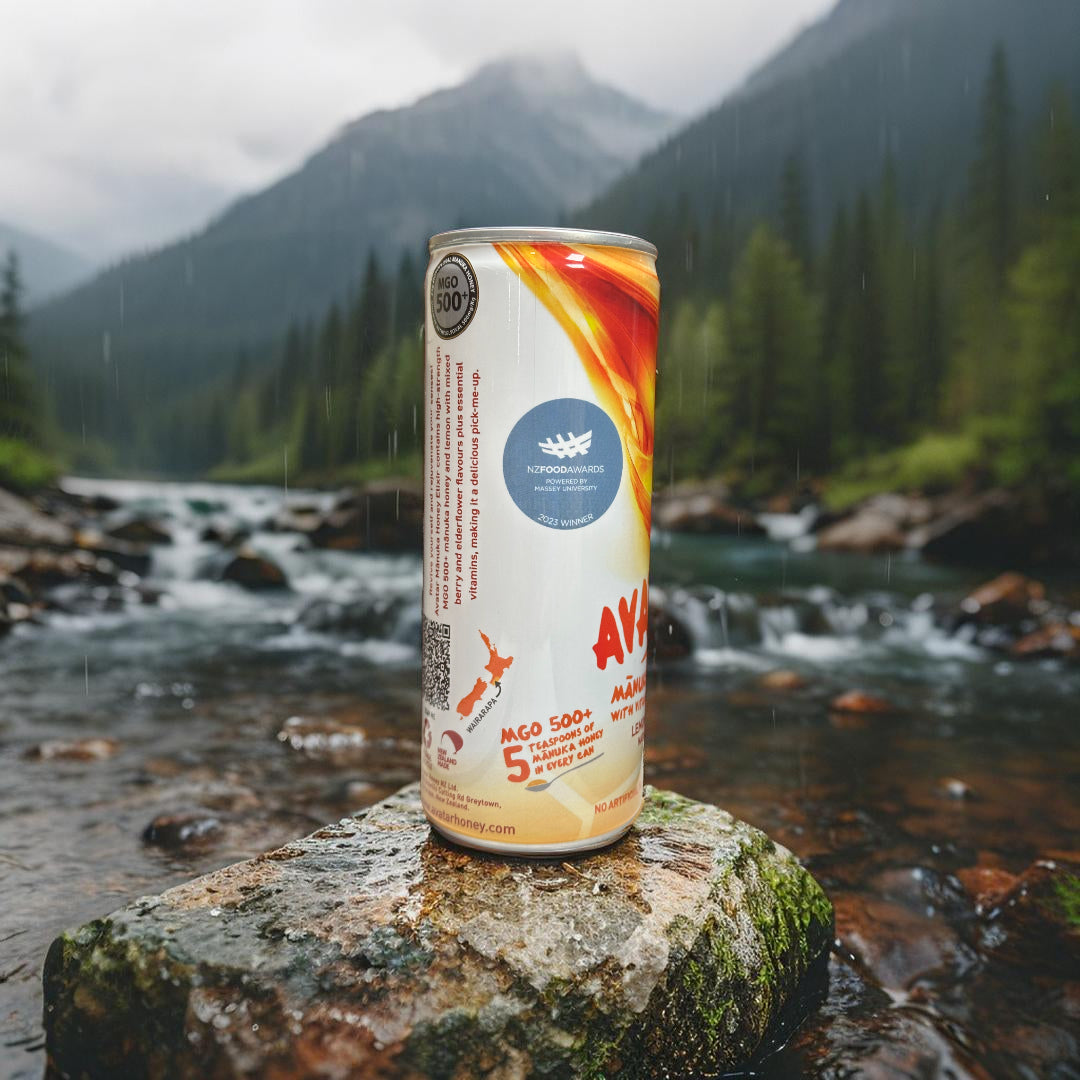
Avatar Elixir brings together certified MGO500+ Mānuka honey, lemon, elderflower, B vitamins, vitamin C, caffeine, and lightly carbonated water. For someone looking for a honey-led drink with citrus and floral notes, that ingredient character offers a concrete reason to consider it alongside other canned options.
The presence of lemon or vitamin C does not establish that either serves as a preservative in Avatar Elixir. Likewise, the can does not identify our preservation method. The useful buying comparison stays with the claims actually made, rather than adding assumptions to them.
Choose the wording that matches your preference
Consider two hypothetical cans: one says “preservative-free”; the other says “no artificial preservatives”. Neither phrase alone tells you which drink you will enjoy more, which has the nutritional profile you prefer, or which is safer.
The FDA states that naturally and artificially derived food ingredients must meet the same safety standard. Its policy on “natural” labelling also does not establish nutritional or health superiority or explicitly address manufacturing methods such as pasteurisation. A preference for particular ingredients is valid without turning that preference into a safety ranking.
For your next purchase, make the decision in this order:
- Name your priority. Are you avoiding artificial preservatives specifically, all preservatives, or artificial ingredients more broadly?
- Match it to the exact statement. Do not treat a broader-sounding phrase as proof of a different claim.
- Resolve any important uncertainty. Read ingredient-function wording or ask the manufacturer if the distinction matters to you.
- Follow the actual package. Use its date, storage directions, and any after-opening instructions. An online shelf-life statement is not a substitute.
If honey-led flavour and no artificial ingredients fit your priorities, Avatar Elixir is a relevant option to explore. Whatever you choose, the strongest comparison is the simplest: buy on what the label genuinely tells you, not what the can or a reassuring phrase seems to imply.
A few practical follow-ups can help you compare canned drinks and resolve unclear label wording before buying.
What should I ask a maker about an unclear preservative claim?
Ask whether any ingredients serve a preservation function in the finished drink, and whether the claim excludes all preservatives or only artificial ones. Name the exact product and ingredient you are checking. This gives the maker a specific question to answer, rather than simply asking whether the drink is "natural".
What if a product page and another listing use different claims?
Do not treat the stronger wording as confirmed when listings differ. Compare the current package with the page for the exact product, then ask the seller or maker to clarify the discrepancy. For Avatar Elixir, the selected product page's "no artificial" wording should not be expanded into verified preservative-free status.
Do the FDA labelling rules apply to every New Zealand drink?
The FDA rules discussed here concern U.S. labelling, not a universal standard for every New Zealand drink. For a New Zealand-made drink, consider the market it is sold in and the label supplied for that market. The U.S. examples help explain ingredient-function wording, but do not establish compliance elsewhere.
What storage information should I request when buying cans online?
Request a readable image of the current package's storage directions and any after-opening instructions if the listing does not show them. Check the date on the cans you receive. A general online shelf-life statement does not establish how to store an opened drink or how much shelf life remains when it arrives.