



Headline finding: The potential effect of an energy drink on teeth depends on more than its ingredients. Acidity can contribute to enamel softening, fermentable sugars can support tooth-decay processes, and frequent or prolonged sipping can extend exposure. Drinking with a meal, avoiding swishing, following with water, and allowing time before brushing after an acidic drink can help limit that exposure.
Questions about energy drinks and teeth often focus on a single feature, such as sugar content or acidity. Dental exposure is more complex. The drink’s composition matters, but so do the length and frequency of contact with the teeth.
A sweetened acidic drink consumed over a few minutes with food creates a different exposure pattern from the same drink sipped repeatedly across an afternoon. This does not make one pattern completely risk-free, nor does it establish that every energy drink affects every person in the same way. It shows why the ingredient list alone cannot provide a complete picture.
This article examines dental exposure rather than flavour. Acidity can shape brightness, tartness, and refreshment in a beverage, but its role in taste is separate from the question of how repeated acid contact may affect enamel.
How acidity and sugar affect teeth through different mechanisms
Acidity and fermentable sugars are separate considerations, although they can occur in the same drink. Understanding the difference makes energy-drink labels and drinking patterns easier to interpret.
Acidity relates to direct enamel exposure
Tooth enamel is a highly mineralised outer surface. When teeth are exposed to an acidic environment, the enamel surface can temporarily lose minerals and become more vulnerable to wear. Saliva normally helps neutralise acids and supports the return of minerals, but that process needs time.
A drink can be acidic because it contains ingredients such as citrus juice, citric acid, or other food acids. Carbonation can also contribute some acidity, although the complete formulation matters more than the presence of bubbles alone. A lightly carbonated drink should not automatically be treated as equivalent to every other sparkling or energy drink.
The pH of a beverage describes how acidic it is at a given point, but pH is not the only relevant product characteristic. The amount and type of acid present can also influence how long saliva takes to neutralise the oral environment. Without verified product measurements, it is not responsible to infer dental effects from flavour descriptions such as “tangy,” “citrusy,” or “lightly sparkling.”
Fermentable sugars relate to bacterial activity
Fermentable carbohydrates can be used by oral bacteria, which then produce acids. Repeated sugar exposure can therefore contribute to conditions associated with tooth decay, particularly when oral hygiene, saliva flow, or other individual factors are also involved.
The source of the sugar does not remove this consideration. Honey may be valued for its origin, flavour, and role in a premium beverage, but it still contains sugars. Describing a drink as honey-based or natural does not establish that it is harmless to teeth.
Acidic drinks without sugar can still expose enamel to acid. Sweetened drinks that are not strongly acidic can still provide fermentable carbohydrates. When a drink contains both acidity and sugar, both pathways deserve consideration.
Takeaway: Acidity is mainly relevant to direct enamel exposure, while fermentable sugars are relevant to acid production by oral bacteria. Neither factor should be used as a substitute for evaluating the other.
What common exposure patterns suggest about sipping time
Repeated contact can matter as much as the total amount consumed. Every sip can renew the presence of acids, sugars, or both in the mouth. This may give saliva less uninterrupted time to return the oral environment toward its usual balance.
A drink finished within a defined period generally creates a more concentrated exposure window than the same drink carried around and revisited for hours. The distinction is not about drinking quickly or consuming more. It is about avoiding a pattern in which the teeth are repeatedly bathed in the beverage.
| Exposure pattern | What changes | Dental relevance |
|---|---|---|
| Consumed with a meal | The drink is taken during a period when saliva production is commonly higher and other food and water may also be present. | This generally creates a more defined exposure period than intermittent sipping between meals. |
| Finished during one short occasion | Acid and sugar contact occurs over a limited window. | Saliva has a clearer period afterward in which to neutralise the mouth. |
| Sipped throughout work or study | Each sip renews contact with the teeth. | The total exposure window may become more significant even when the serving size is unchanged. |
| Held or swished in the mouth | The beverage remains in direct contact with tooth surfaces for longer. | Prolonged contact is generally less favourable than swallowing normally. |
| Followed by plain water | Residual drink is diluted and cleared from the mouth. | This can reduce lingering exposure, although it does not cancel the original contact. |
| Consumed repeatedly between meals | The number of separate exposure events increases. | Frequent exposure may leave less recovery time between drinks. |
The table describes general patterns, not a method for calculating personal risk. Saliva flow, existing enamel condition, oral hygiene, medications, diet, and individual dental history can all change the context.
Caffeine is not the same mechanism as acidity or sugar. However, the way a caffeinated drink is used may shape exposure. For example, an energy drink kept beside a computer and sipped through a long work session creates a different pattern from one consumed with lunch. The relevant issue here is the behaviour around the beverage, not an assumption that caffeine itself causes enamel erosion.
Takeaway: A drink’s serving size does not reveal how long the teeth are exposed. Frequency, duration, and whether the drink is held in the mouth all influence the exposure pattern.
Why labels cannot answer every dental question
Nutrition information can identify sugars, but it usually does not provide a complete account of acidity or likely contact time. Product comparisons should therefore remain limited to what has actually been verified.
The current Nutrition Facts panel is the appropriate place to check the amount of total sugars in a serving and the serving size to which that figure applies. An ingredient list can also show whether a drink contains honey, fruit juice, sugar, or food acids. It does not necessarily state the finished beverage’s measured pH, its acid concentration, or how it behaves in an individual mouth.
Terms such as “natural,” “clean,” “premium,” and “no artificial sweeteners” describe particular product choices, but they are not dental-safety classifications. Likewise, “sugar-free” does not automatically mean “non-acidic.” An unsweetened drink may still contain acids that are relevant to enamel exposure.
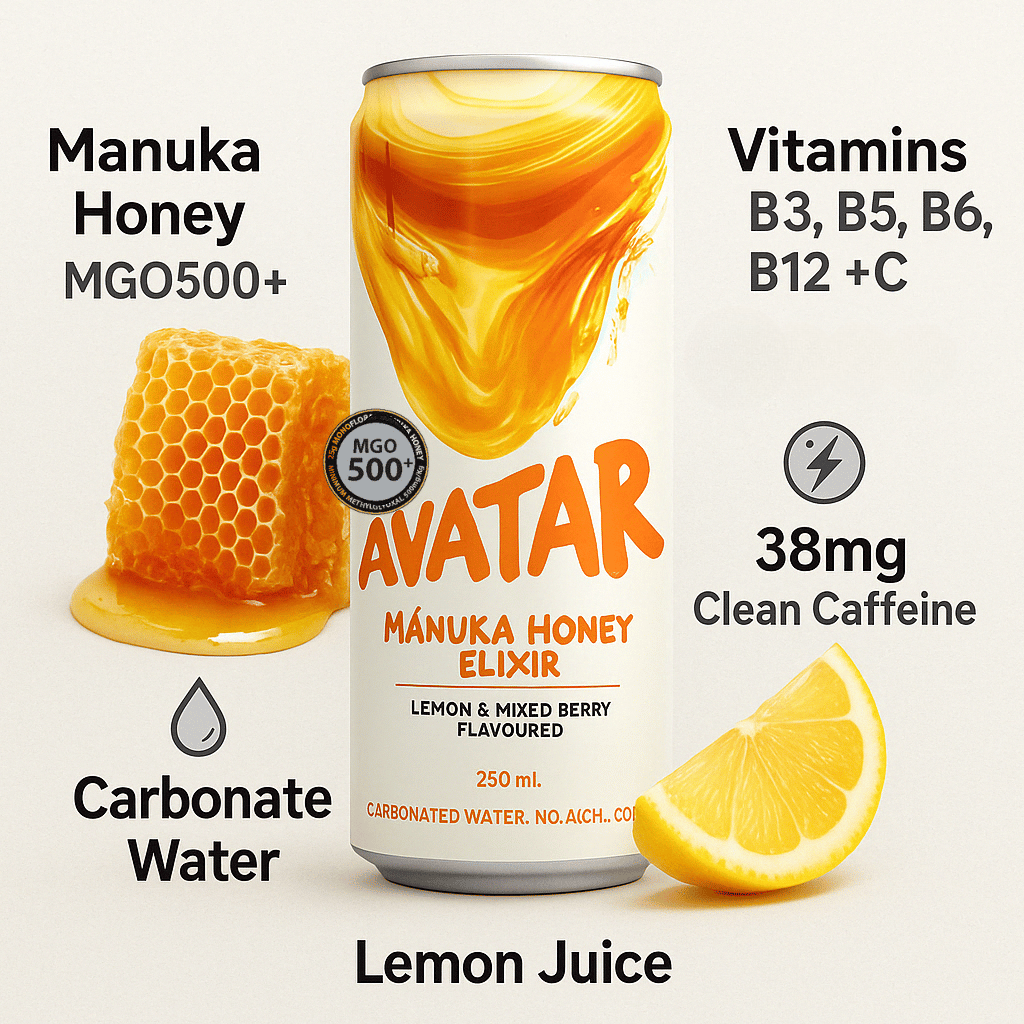
Avatar Elixir can be acknowledged as a beverage made with Manuka honey and lemon in a lightly carbonated format. Those features describe ingredients and sensory character. They should not be used to estimate its sugar content, pH, or dental effect. Any discussion of its sugars must rely on the current Nutrition Facts, while claims about measured acidity would require verified product data.
The same restraint applies across the energy-drink category. A citrus flavour does not prove a specific pH. Honey does not make a beverage harmless to teeth. Carbonation alone does not establish that two drinks present the same exposure. Product ranking is unreliable when formulations and verified measurements are unavailable.
Takeaway: Labels help identify sugars and ingredients, but they rarely capture the full dental context. Verified product data and actual drinking behaviour are both needed for a more meaningful assessment.
Practical habits that can reduce exposure
Common dental guidance focuses on limiting the frequency and duration of acid and sugar contact rather than promising that one habit will prevent dental problems. Advice published by organisations such as the American Dental Association commonly emphasises meal timing, water, avoiding prolonged contact, and taking care with brushing after acidic foods or drinks.
- Having the drink with a meal: This keeps the beverage within a defined eating occasion rather than adding repeated exposures across the day.
- Drinking normally rather than swishing: Holding an acidic or sweetened beverage around the teeth extends direct contact without adding to the drinking experience.
- Avoiding all-day sipping: Finishing the beverage within one occasion gives the mouth a clearer period without renewed exposure.
- Following with plain water: Water can help clear residual beverage and is preferable to immediately starting another acidic or sweetened drink.
- Allowing time before brushing when appropriate: Brushing immediately after an acidic drink may act on a temporarily softened enamel surface. Common dental advice is to let saliva neutralise the mouth first. A dentist can provide timing guidance suited to an individual’s teeth and routine.
- Maintaining regular oral hygiene: Energy-drink habits sit within the wider context of fluoride toothpaste use, interdental cleaning, dental examinations, and the rest of the diet.
These measures reduce or organise exposure. They do not make an acidic or sugar-containing drink neutral, and rinsing with water does not erase the effects of frequent consumption. The practical value comes from changing the pattern, particularly the number of contact events and how long each event lasts.
It is also important not to replace one prolonged exposure with another. Alternating an energy drink with juice, sweetened coffee, soft drinks, or acidic flavoured water may still create repeated contact throughout the day.
Takeaway: The most relevant habits shorten contact, reduce repeated exposure, and allow saliva time to do its normal buffering work.
What warning signs merit a dentist’s attention
Changes in sensitivity, appearance, or tooth structure should be assessed professionally rather than attributed to energy drinks without an examination. Similar symptoms can have several causes, and a person cannot reliably diagnose enamel erosion or tooth decay from appearance alone.
Signs worth discussing with a dentist include:
- New or increasing sensitivity to cold, heat, sweetness, or touch
- Persistent tooth pain or discomfort when biting
- Visible pits, indentations, rough edges, cracks, or chipping
- Changes in tooth shape, translucency, or colour
- Fillings that appear raised as the surrounding tooth surface changes
- Dry mouth that is persistent or affecting comfort and eating
- Any rapid or unexplained change in the teeth or gums
These observations do not confirm that a drink is responsible. A dentist can consider the full pattern, including beverage frequency, diet, brushing habits, saliva flow, medicines, reflux, tooth grinding, and existing restorations.
Persistent dry mouth deserves particular attention because saliva plays an important role in clearing sugars, neutralising acids, and supporting the tooth surface. Individual advice may be useful when dry mouth is associated with medication, health conditions, or ongoing symptoms.
Takeaway: Symptoms cannot identify the cause on their own. Persistent sensitivity, pain, structural changes, or dry mouth are appropriate reasons to seek dental assessment.
What this means when choosing and consuming an energy drink
No single label claim determines how an energy drink will interact with teeth. A useful framework considers composition, occasion, and individual context together.
Composition includes verified sugar information and, when available, reliable acidity data. Occasion includes whether the drink is consumed with food, finished within a limited period, or repeatedly sipped. Individual context includes saliva flow, enamel condition, dental history, oral hygiene, and other acidic or sweetened foods and drinks consumed during the day.
This framework also explains why simple rankings can mislead. A lower-sugar drink may still be acidic. A honey drink still contains sugars unless the current label shows otherwise. A small serving may create prolonged exposure if it is sipped slowly. A larger serving consumed once does not become harmless, but its contact pattern differs from repeated sipping.
For adults using energy drinks during work, study, travel, or long social occasions, the clearest practical question is not only “What is in this drink?” It is also “How often are the teeth being exposed, and for how long?”
General information cannot account for individual dental needs. Anyone with existing enamel wear, frequent decay, sensitive teeth, dry mouth, restorations, or other oral-health concerns should discuss beverage habits with a dentist or another qualified dental professional.
Final takeaway: Acidity, fermentable sugars, and sipping time affect teeth through related but distinct pathways. Verified label information helps, but exposure pattern and personal dental context complete the picture.
These follow-up points clarify personal frequency, brushing, mixed drinks, and conversations with a dentist.
Is there a universally safe frequency for energy drinks?
No universal frequency can guarantee dental safety. The number of exposure events, length of each drinking occasion, sugar and acidity, saliva flow, oral hygiene, and existing dental condition can all affect the context. Someone concerned about sensitivity, enamel wear, frequent decay, or dry mouth should ask a dentist about their individual drinking pattern.
Does following an energy drink with water make immediate brushing appropriate?
Not necessarily. Plain water can help clear residual beverage, but it does not confirm that a tooth surface exposed to acid is ready for brushing. Common dental guidance allows saliva time to neutralise the mouth before brushing after acidic foods or drinks. A dentist can advise on timing for individual needs.
How should mixers and mocktails be considered for dental exposure?
The finished drink should be considered as a whole. Adding juice, soft drink, syrup, or another mixer may change its sugar and acidity profile, while slowly sipping a mocktail can extend contact time. Without verified information about the complete mixture, its dental effect should not be inferred from one ingredient alone.
What details are useful to discuss with a dentist?
Useful details include how often the drink is consumed, whether it is sipped over a long period, whether it is taken with meals, and whether sensitivity or dry mouth is present. A dentist may also consider medicines, oral hygiene, other acidic or sweetened drinks, existing restorations, and previous dental problems.